







Question: Maximum Likelihood Exercises We have a twin study in which we observe responses from m pairs of twins, y (311, 3/12, 3/21, 322, 931, 132,
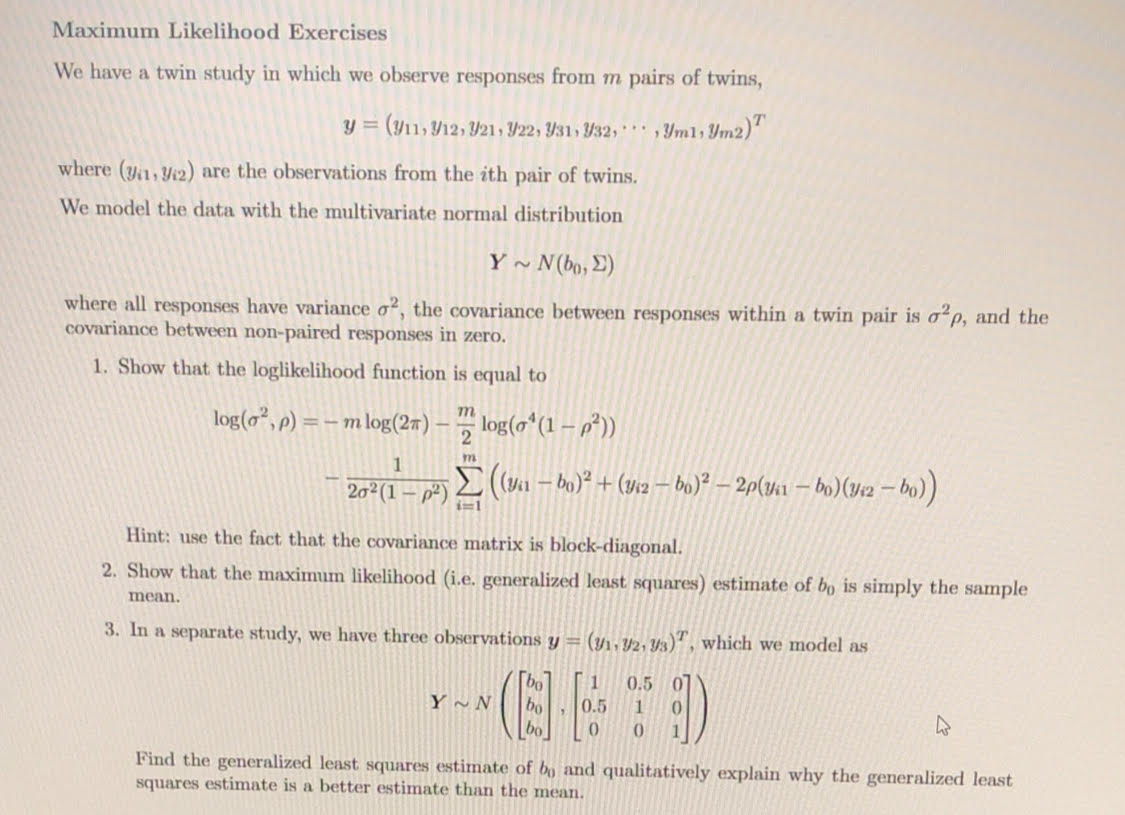
Maximum Likelihood Exercises We have a twin study in which we observe responses from m pairs of twins, y (311, 3/12, 3/21, 322, 931, 132, " . . , yml, Um2)" where (Un, yiz) are the observations from the ith pair of twins. We model the data with the multivariate normal distribution Y ~ N (bo, E) where all responses have variance o', the covariance between responses within a twin pair is o'p, and the covariance between non-paired responses in zero. 1. Show that the loglikelihood function is equal to log(a', p) -mlog(27) log(* (1 - p?) ) 202 (1 - p2) E (va - bo)? + (312 - bo)- - 2p(va - bo)(312 -bo)) Hint: use the fact that the covariance matrix is block-diagonal. 2. Show that the maximum likelihood (i.e. generalized least squares) estimate of bo is simply the sample mean. 3. In a separate study, we have three observations y - (11, 12, 13)", which we model as Find the generalized least squares estimate of bo and qualitatively explain why the generalized least squares estimate is a better estimate than the mean
Step by Step Solution
There are 3 Steps involved in it

Get step-by-step solutions from verified subject matter experts
 Study Help