







Question: May I get some help with this question, please? Assignment Show dear and detailed workings for all quantitative questions (Question 1,3,4,5). 3. In a market
May I get some help with this question, please?

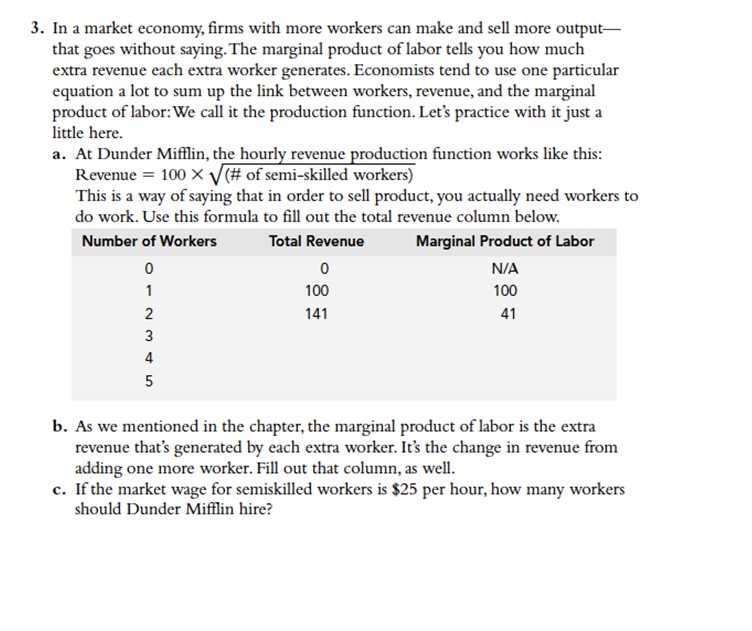
Assignment Show dear and detailed workings for all quantitative questions (Question 1,3,4,5). 3. In a market economy, firms with more workers can make and sell more output- that goes without saying. The marginal product of labor tells you how much extra revenue each extra worker generates. Economists tend to use one particular equation a lot to sum up the link between workers, revenue, and the marginal product of labor: We call it the production function. Let's practice with it just a little here. a. At Dunder Mifflin, the hourly revenue production function works like this: Revenue = 100 X (# of semi-skilled workers) This is a way of saying that in order to sell product, you actually need workers to do work. Use this formula to fill out the total revenue column below. Number of Workers Total Revenue Marginal Product of Labor UI AWN - O 0 N/A 100 100 141 41 b. As we mentioned in the chapter, the marginal product of labor is the extra revenue that's generated by each extra worker. It's the change in revenue from adding one more worker. Fill out that column, as well. c. If the market wage for semiskilled workers is $25 per hour, how many workers should Dunder Mifflin hire
Step by Step Solution
There are 3 Steps involved in it

Get step-by-step solutions from verified subject matter experts
 Study Help