







Question: May you explain the examples step by step please, especially the one highlighted and why its negative Example 3.1.5 1 Evaluate detA whenA = 1
May you explain the examples step by step please, especially the one highlighted and why its negative
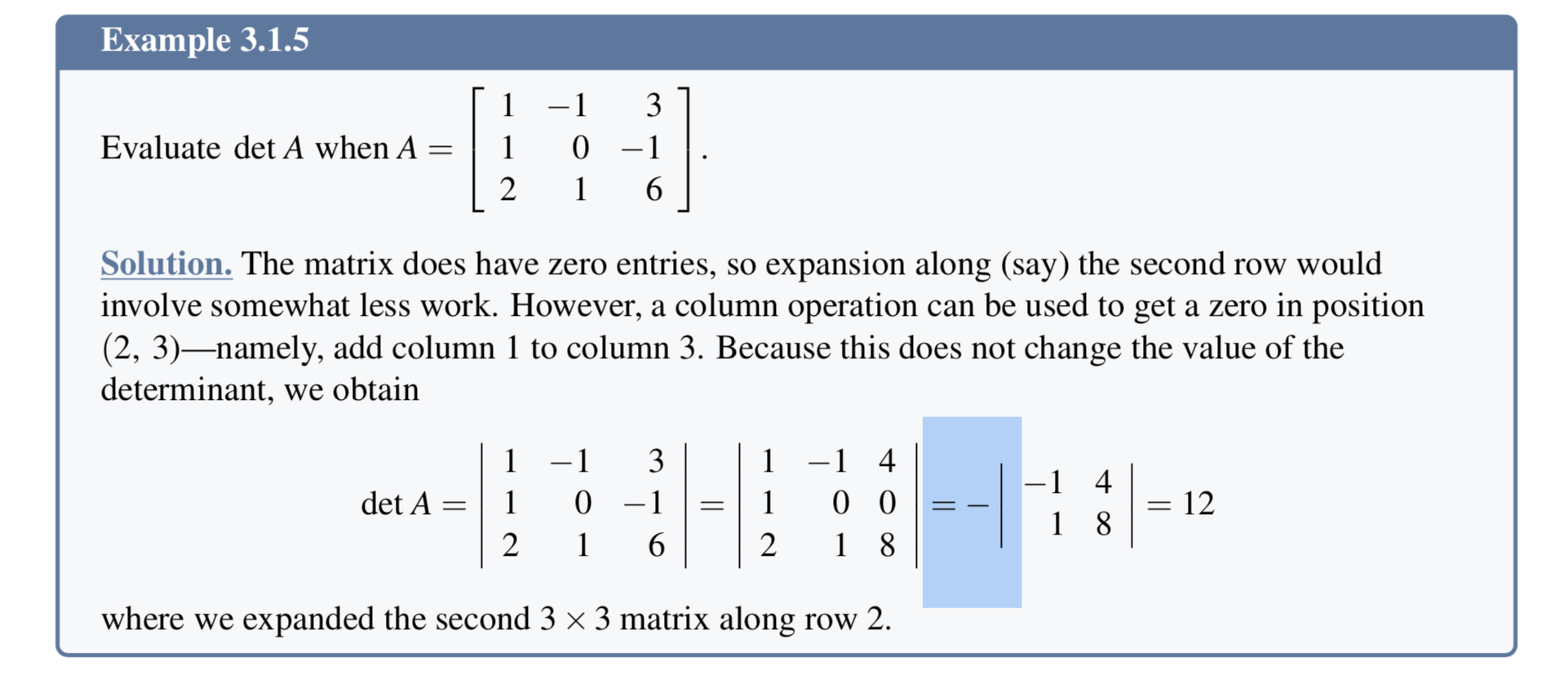
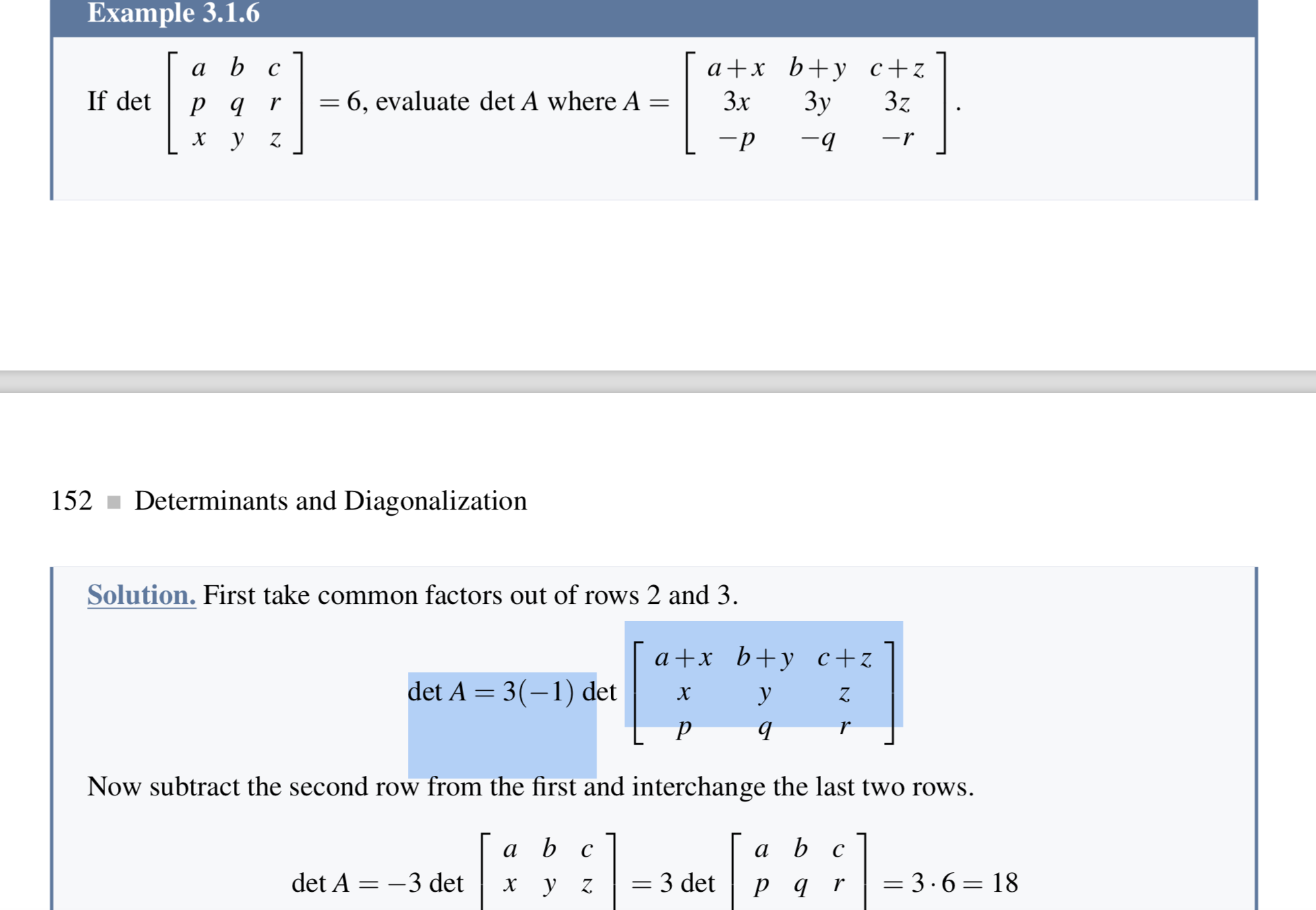
Example 3.1.5 1 Evaluate detA whenA = 1 2 Solution. The matrix does have zero entries, so expansion along (say) the second row would involve somewhat less work. However, a column operation can be used to get a zero in position (2, 3)namely, add column 1 to column 3. Because this does not change the value of the determinant, we obtain 1 1 1 detA= 1 l O 2 2 1 where we expanded the second 3 x 3 matrix along row 2. Example 3.1.6 ab atx bty c+z If det p r = 6, evaluate det A where A = 3x 3y 3z X y Z - P - q -r 152 Determinants and Diagonalization Solution. First take common factors out of rows 2 and 3. atx bty c + z det A = 3(-1) det X 2 P Now subtract the second row from the first and interchange the last two rows. a b c a b c det A = -3 det y z = 3 det p q r =3.6 = 18
Step by Step Solution
There are 3 Steps involved in it

Get step-by-step solutions from verified subject matter experts
 Study Help