







Question: MC = 16 29. A monopoly's total cost function is TC = 100 + 960. The inverse demand function of the firm's typical consumer is
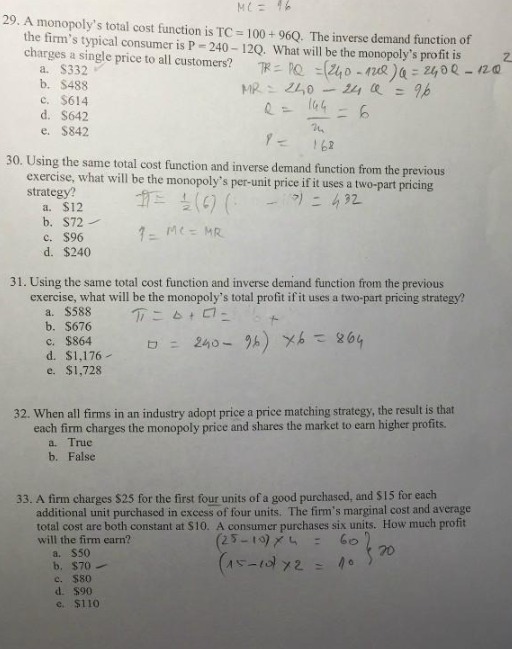
MC = 16 29. A monopoly's total cost function is TC = 100 + 960. The inverse demand function of the firm's typical consumer is P = 240-120. What will be the monopoly's profit is charges a single price to all customers? a. $332 TR= PQ = (240 - 1208) 4 = 2402-120 b. $488 MR = 240 - 24 1 = 9% c. $614 d. $642 R = 144 - 6 e. $842 Y = 30. Using the same total cost function and inverse demand function from the previous exercise, what will be the monopoly's per-unit price if it uses a two-part pricing strategy? a. $12 - 31 = 432 b. $72 c. $96 7 = MC = MR d. $240 31. Using the same total cost function and inverse demand function from the previous exercise, what will be the monopoly's total profit if it uses a two-part pricing strategy? a. $588 b. $676 + C. $864 D = 240 - 96) *6= 864 d. $1,176- e. $1,728 32. When all firms in an industry adopt price a price matching strategy, the result is that each firm charges the monopoly price and shares the market to earn higher profits. a. True b. False 33. A firm charges $25 for the first four units of a good purchased, and $15 for each additional unit purchased in excess of four units. The firm's marginal cost and average total cost are both constant at $10. A consumer purchases six units. How much profit will the firm earn? (25-1:0) X 4 = 602 a. $50 b. 570 - (15 - 101 72 = 10 $20 C. 580 $90 $110
Step by Step Solution
There are 3 Steps involved in it

Get step-by-step solutions from verified subject matter experts
 Study Help