



Question: McDonnell Douglas Corp. v . Green 4 1 1 U . S . 7 9 2 ( U . S . Supreme Court 1 9
McDonnell Douglas Corp. v Green
USUS Supreme Court
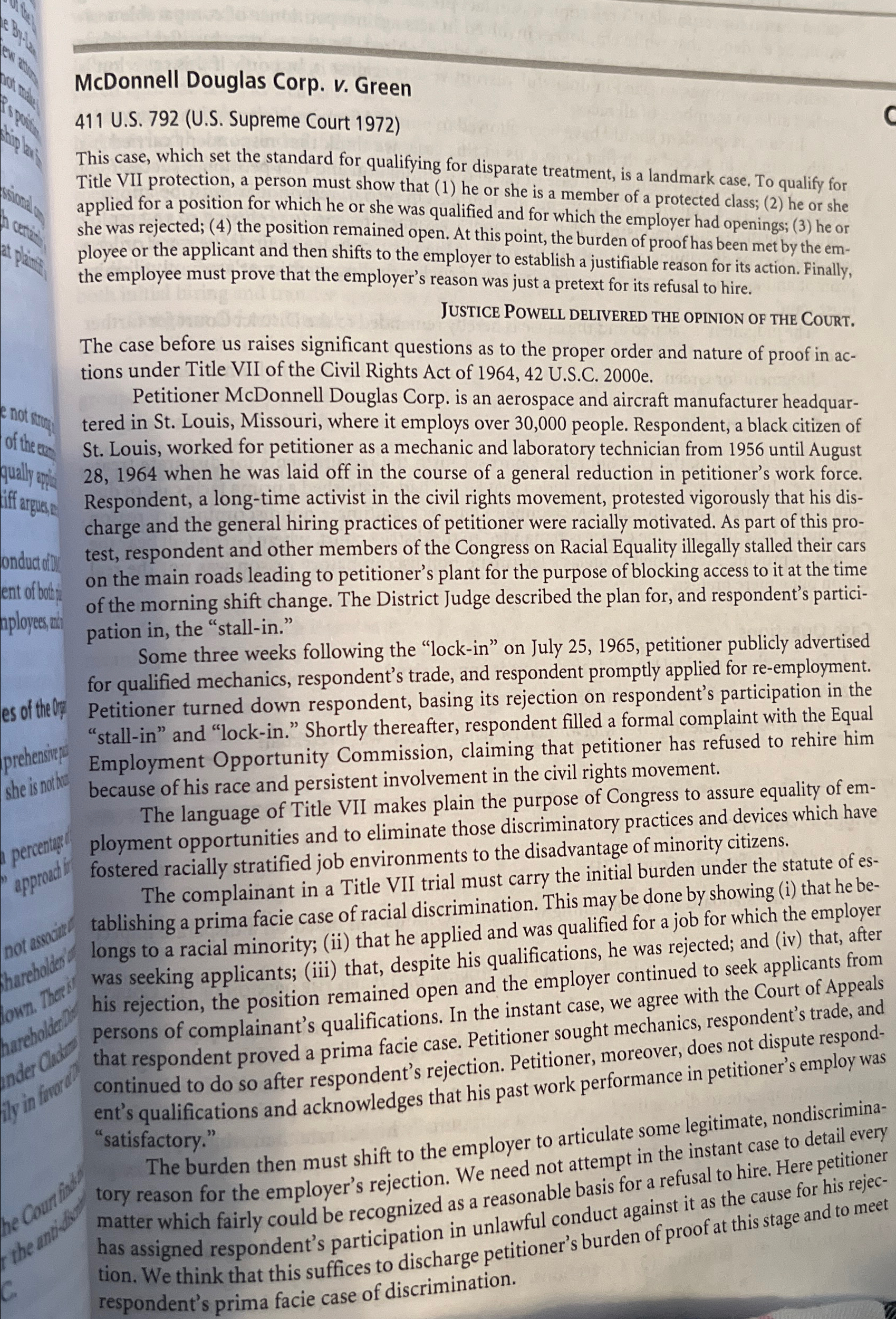
This case, which set the standard for qualifying for disparate treatment, is a landmark case. To qualify for Title VII protection, a person must show that he or she is a member of a protected class; he or she applied for a position for which he or she was qualified and for which the employer had openings; he or she was rejected; the position remained open. At this point, the burden of proof has been met by the employee or the applicant and then shifts to the employer to establish a justifiable reason for its action. Finally, the employee must prove that the employer's reason was just a pretext for its refusal to hire.
JUSTICE POWELL DELIVERED THE OPINION OF THE COURT.
The case before us raises significant questions as to the proper order and nature of proof in actions under Title VII of the Civil Rights Act of USCe
Petitioner McDonnell Douglas Corp. is an aerospace and aircraft manufacturer headquartered in St Louis, Missouri, where it employs over people. Respondent, a black citizen of St Louis, worked for petitioner as a mechanic and laboratory technician from until August when he was laid off in the course of a general reduction in petitioner's work force. Respondent, a longtime activist in the civil rights movement, protested vigorously that his discharge and the general hiring practices of petitioner were racially motivated. As part of this protest, respondent and other members of the Congress on Racial Equality illegally stalled their cars on the main roads leading to petitioner's plant for the purpose of blocking access to it at the time of the morning shift change. The District Judge described the plan for, and respondent's participation in the "stallin
Some three weeks following the "lockin on July petitioner publicly advertised for qualified mechanics, respondent's trade, and respondent promptly applied for reemployment. Petitioner turned down respondent, basing its rejection on respondent's participation in the "stallin and "lockin Shortly thereafter, respondent filled a formal complaint with the Equal Employment Opportunity Commission, claiming that petitioner has refused to rehire him because of his race and persistent involvement in the civil rights movement.
The language of Title VII makes plain the purpose of Congress to assure equality of employment opportunities and to eliminate those discriminatory practices and devices which have fostered racially stratified job environments to the disadvantage of minority citizens.
The complainant in a Title VII trial must carry the initial burden under the statute of establishing a prima facie case of racial discrimination. This may be done by showing i that he belongs to a racial minority; ii that he applied and was qualified for a job for which the employer was seeking applicants; iii that, despite his qualifications, he was rejected; and iv that, after his rejection, the position remained open and the employer continued to seek applicants from persons of complainant's qualifications. In the instant case, we agree with the Court of Appeals that respondent proved a prima facie case. Petitioner sought mechanics, respondent's trade, and continued to do so after respondent's rejection. Petitioner, moreover, does not dispute respondent's qualifications and acknowledges that his past work performance in petitioner's employ was "satisfactory."
The burden then must shift to the employer to articulate some legitimate, nondiscriminatory reason for the employer's rejection. We need not attempt in the instant case to detail every matter which fairly could be recognized as a reasonable basis for a refusal to hire. Here petitioner has assigned respondent's participation in unlawful conduct against it as the cause for his rejection. We think that this suffices to discharge petitioner's burden of proof at this stage and to meet respondent's prima facie case of discrimination.
Step by Step Solution
There are 3 Steps involved in it
1 Expert Approved Answer
Step: 1 Unlock

Question Has Been Solved by an Expert!
Get step-by-step solutions from verified subject matter experts
Step: 2 Unlock
Step: 3 Unlock