







Question: Mcgill Physics Newton 2nd Law Exercise There are 2 Procedures : A and B with respective questions at Part C * Part A is Instructions
Mcgill Physics Newton 2nd Law Exercise
There are 2 Procedures : A and B with respective questions at Part C
* Part A is Instructions
Part B are the results
Part C are the **Questions** with Both Procedure A and B respectively
(a) Instructions and procedure are below
(Includes formulas but how are they derived / derivation of formula)
** Point 17: Slope s=hould be a = (slope)^2 /2
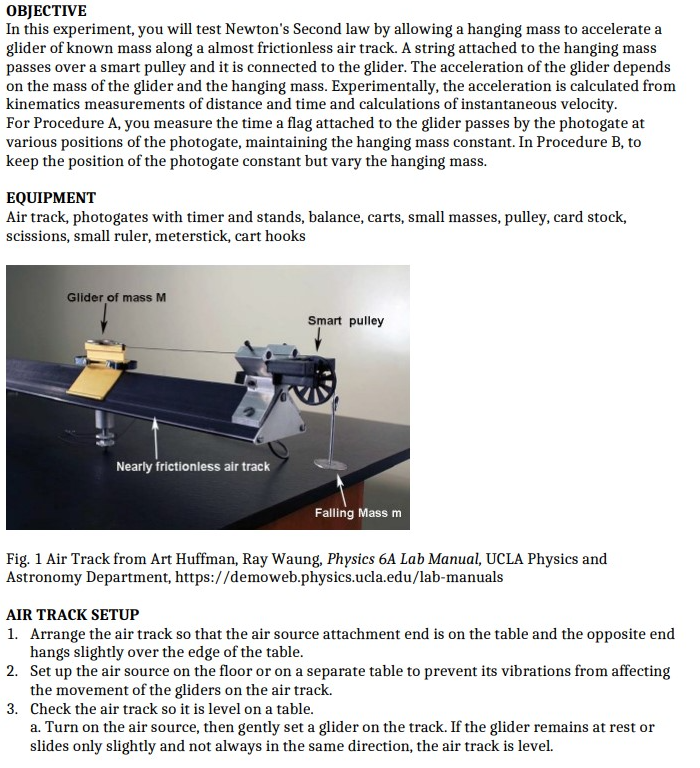
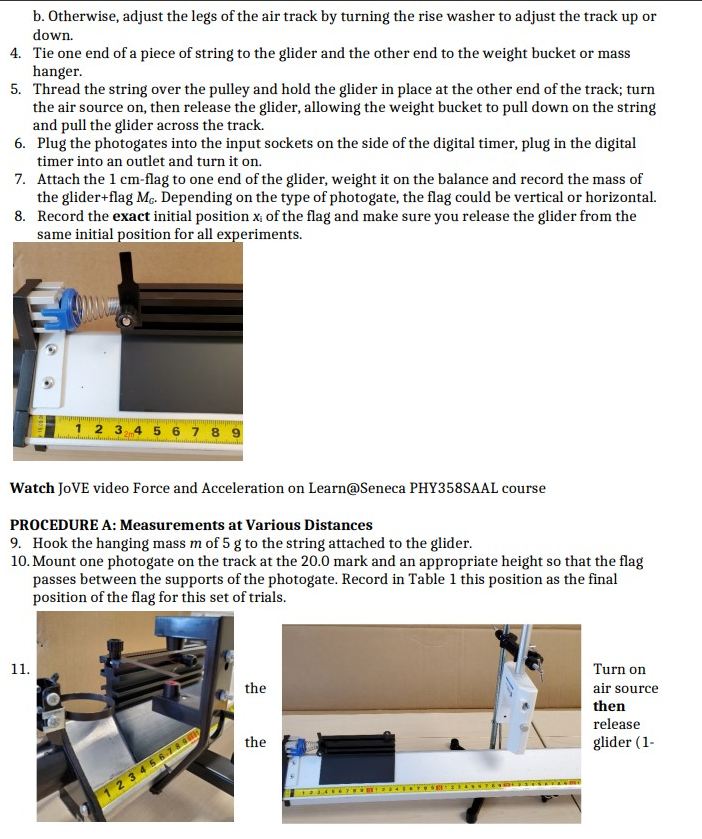
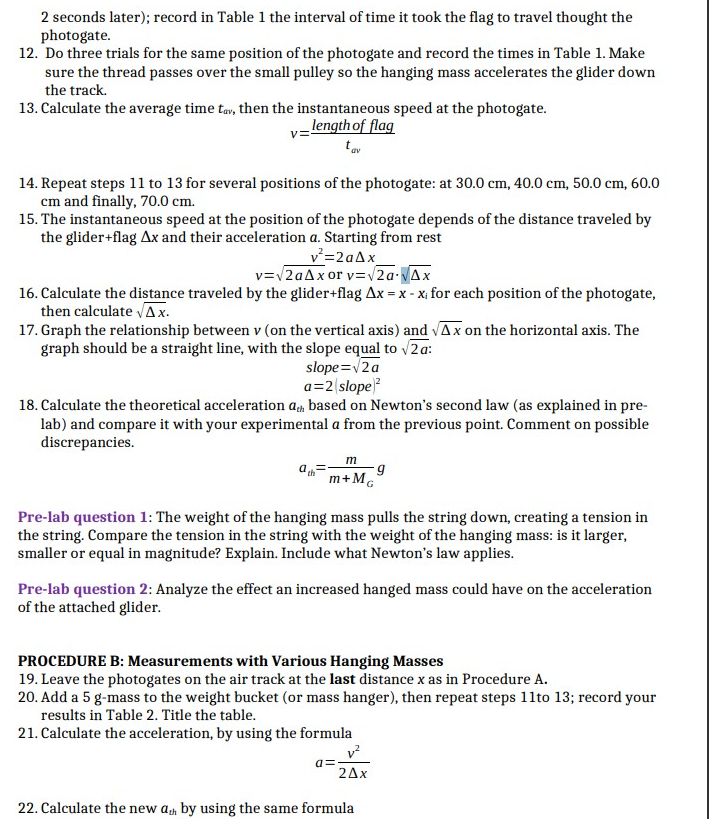
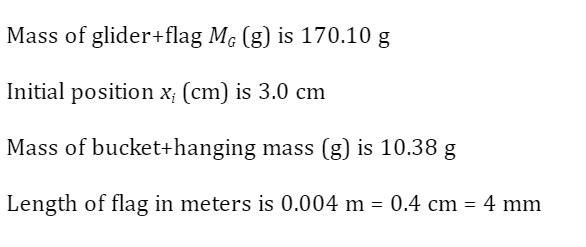
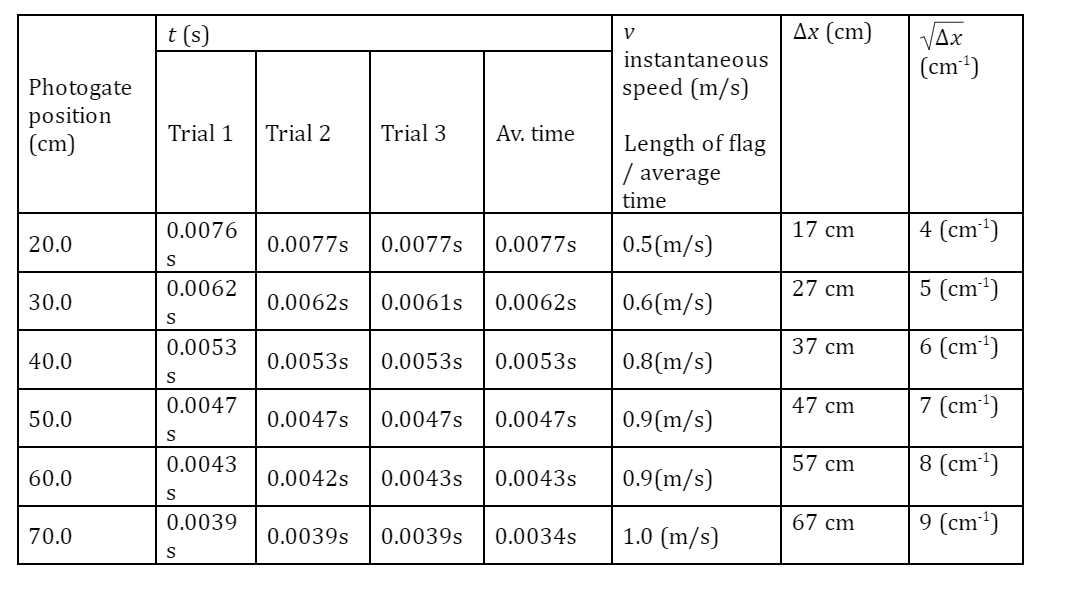
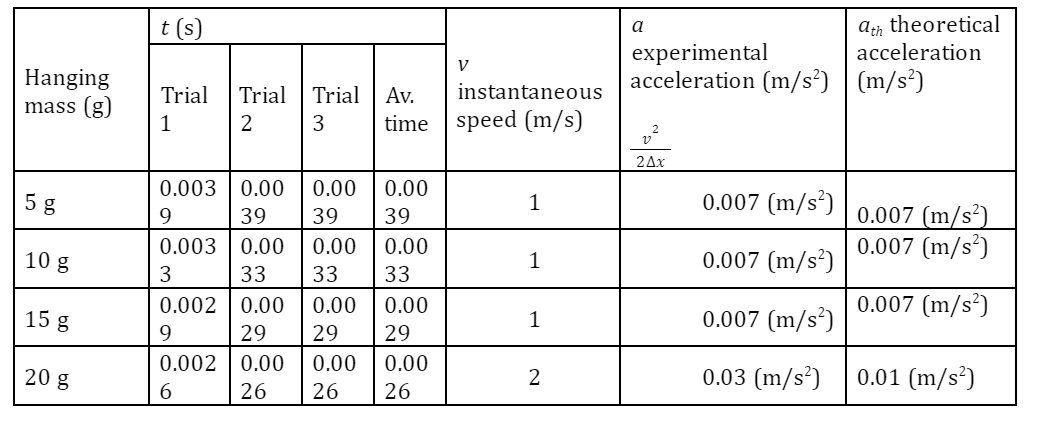
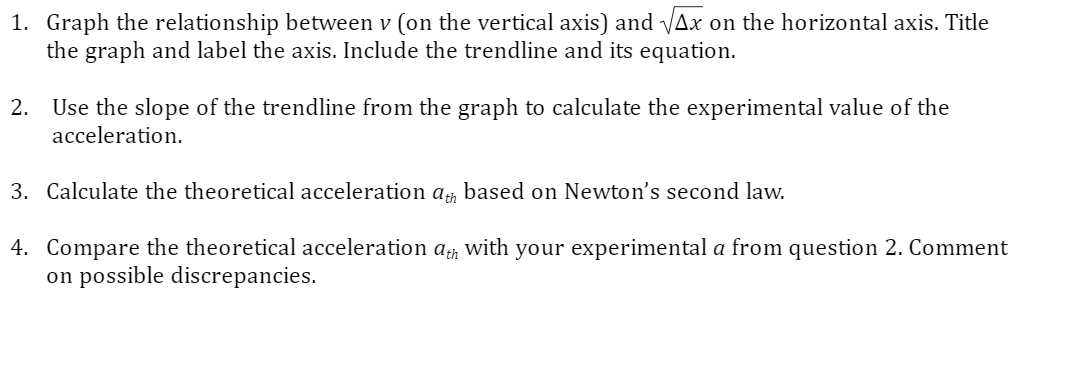
DEIECTWE In this experiment, you will test Newton's Second law by allowing a hanging mass to accelerate a glider of known mass along a almost frictionless air track. A string attached to the hanging mass passes over a smart pulley and it is connected to the glider. The acceleration of the glider depends on the mass of the glider and the hanging mass. Experimentally, the acceleration is calculated from kinematics measurements of distance and time and calculations of instantaneous velocity. For Procedure A, you measure the time a flag attached to the glider passes by the photogate at various positions of the photogate, maintaining the hanging mass constant. In Procedure B, to keep the position of the photo gate constant but vary the hanging mass. EQUIPMENT Air track, photogates with timer and stands, balance, carts, small masses, pulley, card stock, scissions, small ruler, meterstick, cart hooks Smart pulley l Nearly frictionless alrtraclr. Falling Mass or Fig, 1 Air Track from Art Huffman, Ray 1'lll'aung, Physics 6.31 In it Manual, UCLA Physics and Astronomy Department, https : H Hdemowebphysic s.ucla.eduf1abmanuals AIR TRACK SETUP 1. Arrange the air track so that the air source attachment end is on the table and the opposite end hangs slightly over the edge ofthe table. 2. Set up the air source on the oor or on a separate table to prevent its vibrations from affecting the movement of the gliders on the air track. 3. Check the air track so it is level on a table. a. Turn on the air source, then gently set a glider on the track. If the glider remains at rest or slides only slightly and not always in the same direction, the air track is level. b. Otherwise, adjust the legs of the air track by turning the rise washer to adjust the track up or down. 4. Tie one end of a piece of string to the glider and the other end to the weight bucket or mass hanger. 5. Thread the string over the pulley and hold the glider in place at the other end of the track; turn the air source on, then release the glider, allowing the weight bucket to pull down on the string and pull the glider across the track. 6. Plug the photogates into the input sockets on the side of the digital timer, plug in the digital timer into an outlet and turn it on. 7. Attach the 1 cm-flag to one end of the glider, weight it on the balance and record the mass of the glider+flag Mc. Depending on the type of photogate, the flag could be vertical or horizontal. 8. Record the exact initial position * of the flag and make sure you release the glider from the same initial position for all experiments. 1 2 3 4 5 6 7 8 9 Watch JoVE video Force and Acceleration on Learn@Seneca PHY358SAAL course PROCEDURE A: Measurements at Various Distances 9. Hook the hanging mass m of 5 g to the string attached to the glider. 10. Mount one photogate on the track at the 20.0 mark and an appropriate height so that the flag passes between the supports of the photogate. Record in Table 1 this position as the final position of the flag for this set of trials. 11. Turn on the air source then release the glider (1- 34 22 seconds later); record in Table 1 the interval of time it took the flag to travel thought the photogate. 12. Do three trials for the same position of the photogate and record the times in Table 1. Make sure the thread passes over the small pulley so the hanging mass accelerates the glider down the track. 13. Calculate the average time to, then the instantaneous speed at the photogate. v-length of flag Lav 14. Repeat steps 11 to 13 for several positions of the photogate: at 30.0 cm, 40.0 cm, 50.0 cm, 60.0 cm and finally, 70.0 cm. 15. The instantaneous speed at the position of the photogate depends of the distance traveled by the glider+flag Ax and their acceleration a. Starting from rest v-=2aAx v=v2ax or v=v2a.VAx 16. Calculate the distance traveled by the glider+flag Ax = x - x for each position of the photogate, then calculate VA x. 17. Graph the relationship between v (on the vertical axis) and vA x on the horizontal axis. The graph should be a straight line, with the slope equal to v2a: slope = v2a a=2 slopez 18. Calculate the theoretical acceleration do based on Newton's second law (as explained in pre- lab) and compare it with your experimental a from the previous point. Comment on possible discrepancies. m m+MG Pre-lab question 1: The weight of the hanging mass pulls the string down, creating a tension in the string. Compare the tension in the string with the weight of the hanging mass: is it larger, smaller or equal in magnitude? Explain. Include what Newton's law applies. Pre-lab question 2: Analyze the effect an increased hanged mass could have on the acceleration of the attached glider. PROCEDURE B: Measurements with Various Hanging Masses 19. Leave the photogates on the air track at the last distance x as in Procedure A. 20. Add a 5 g-mass to the weight bucket (or mass hanger), then repeat steps 11to 13; record your results in Table 2. Title the table. 21. Calculate the acceleration, by using the formula V 2 2Ax 22. Calculate the new du by using the same formulaMass of glider+flag Me (g) is 170.10 g Initial position x; (cm) is 3.0 cm Mass of bucket+hanging mass (g) is 10.38 g Length of flag in meters is 0.004 m = 0.4 cm = 4 mmt (s) V Ax (cm) VAx instantaneous (cm-!) Photogate speed (m/s) position Trial 1 Trial 2 Trial 3 Av. time (cm) Length of flag / average time 0.0076 17 cm 4 (cm ]) 20.0 0.0077s 0.0077s 0.0077s 0.5(m/s) S 0.0062 27 cm 5 (cm ]) 30.0 0.0062s 0.0061s 0.0062s 0.6(m/s) S 0.0053 37 cm 6 (cm-]) 40.0 0.0053s 0.0053s 0.0053s 0.8(m/s) S 0.0047 47 cm 7 (cm ]) 50.0 0.0047s 0.0047s 0.0047s 0.9(m/s) S 0.0043 57 cm 8 (cm ]) 60.0 0.0042s 0.0043s 0.0043s 0.9(m/s) S 0.0039 67 cm 9 (cm ]) 70.0 0.0039s 0.0039s 0.0034s 1.0 (m/s) St (s) a ath theoretical V experimental acceleration Hanging mass (g) Trial Trial Trial Av. instantaneous acceleration (m/s) (m/s2) 1 2 3 time speed (m/s) N 24x 0.003 0.00 0.00 0.00 5 g 9 39 39 39 0.007 (m/s2 ) 0.007 (m/s2) 0.003 0.00 0.00 0.00 10 g 0.007 (m/s) 3 33 33 33 0.007 (m/$2) 0.002 0.00 0.00 0.00 15 g 0.007 (m/s2) 9 29 29 29 0.007 (m/s2) 0.002 0.00 0.00 0.00 20 g 2 6 26 26 26 0.03 (m/s2) 0.01 (m/s2)Graph the relationship between v [on the vertical axis] and Mac on the horizontal axis. Title the graph and label the axis. Include the trendline and its equation. Use the slope of the trendline from the graph to calculate the experimental value of the acceleration. Calculate the theoretical acceleration at}. based on Newton's second law. Compare the theoretical acceleration am with your experimental a from question 2. Comment on possible discrepancies
Step by Step Solution
There are 3 Steps involved in it

Get step-by-step solutions from verified subject matter experts
 Study Help