





Question: MCQs: 1) Intuitive decision-making uses experience and judgment rather than logic or reasoning to foster decisions. a) True b) False a) c) 2) Cheryl is
MCQs: 1) Intuitive decision-making uses

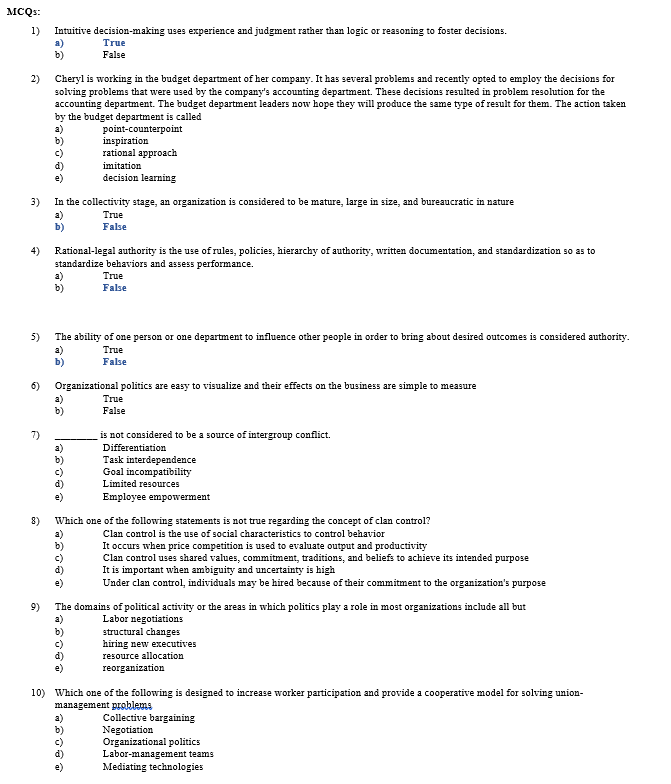
MCQs: 1) Intuitive decision-making uses experience and judgment rather than logic or reasoning to foster decisions. a) True b) False a) c) 2) Cheryl is working in the budget department of her company. It has several problems and recently opted to employ the decisions for solving problems that were used by the company's accounting department. These decisions resulted in problem resolution for the accounting department. The budget department leaders now hope they will produce the same type of result for them. The action taken by the budget department is called point-counterpoint b) inspiration rational approach d) imitation decision learning 3) In the collectivity stage, an organization is considered to be mature, large in size, and bureaucratic in nature a) b) False 4) Rational-legal authority is the use of rules, policies, hierarchy of authority, written documentation, and standardization so as to standardize behaviors and assess performance. True b) False True a) True 5) The ability of one person or one department to influence other people in order to bring about desired outcomes is considered authority. a) b) False 6) Organizational politics are easy to visualize and their effects on the business are simple to measure True b) False 7) is not considered to be a source of intergroup conflict. Differentiation Task interdependence Goal incompatibility Limited resources Employee empowerment 8) Which one of the following statements is not true regarding the concept of clan control? Clan control is the use of social characteristics to control behavior It occurs when price competition is used to evaluate output and productivity Clan control uses shared values, commitment, traditions, and beliefs to achieve its intended purpose It is important when ambiguity and uncertainty is high Under clan control, individuals may be hired because of their commitment to the organization's purpose 9) The domains of political activity or the areas in which politics play a role in most organizations include all but a) Labor negotiations b) structural changes hiring new executives resource allocation reorganization 10) Which one of the following is designed to increase worker participation and provide a cooperative model for solving union- management problems Collective bargaining Negotiation Organizational politics Labor-management teams Mediating technologies a) b) c) d) 9)

Step by Step Solution

There are 3 Steps involved in it

1 Expert Approved Answer
Step: 1 Unlock blur-text-image

Question Has Been Solved by an Expert!

Get step-by-step solutions from verified subject matter experts

Step: 2 Unlock
Step: 3 Unlock

Students Have Also Explored These Related General Management Questions!