







Question: MDM4U Module 2: Probability Unit 3: Intro to Probability Lesson 5 Date: Mutually Exclusive and Non-Mutually Exclusive Events A. Recall Venn Diagrams When we looked
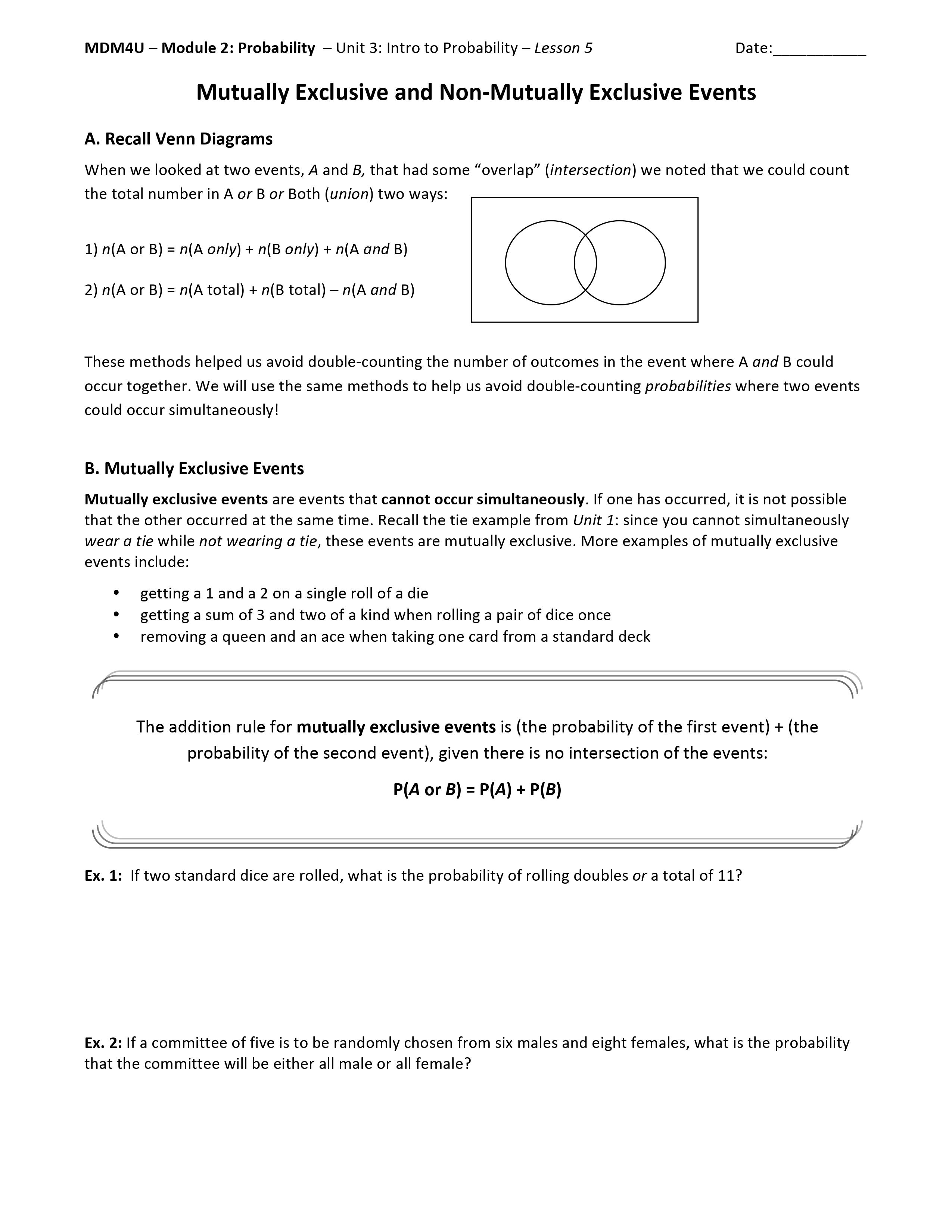
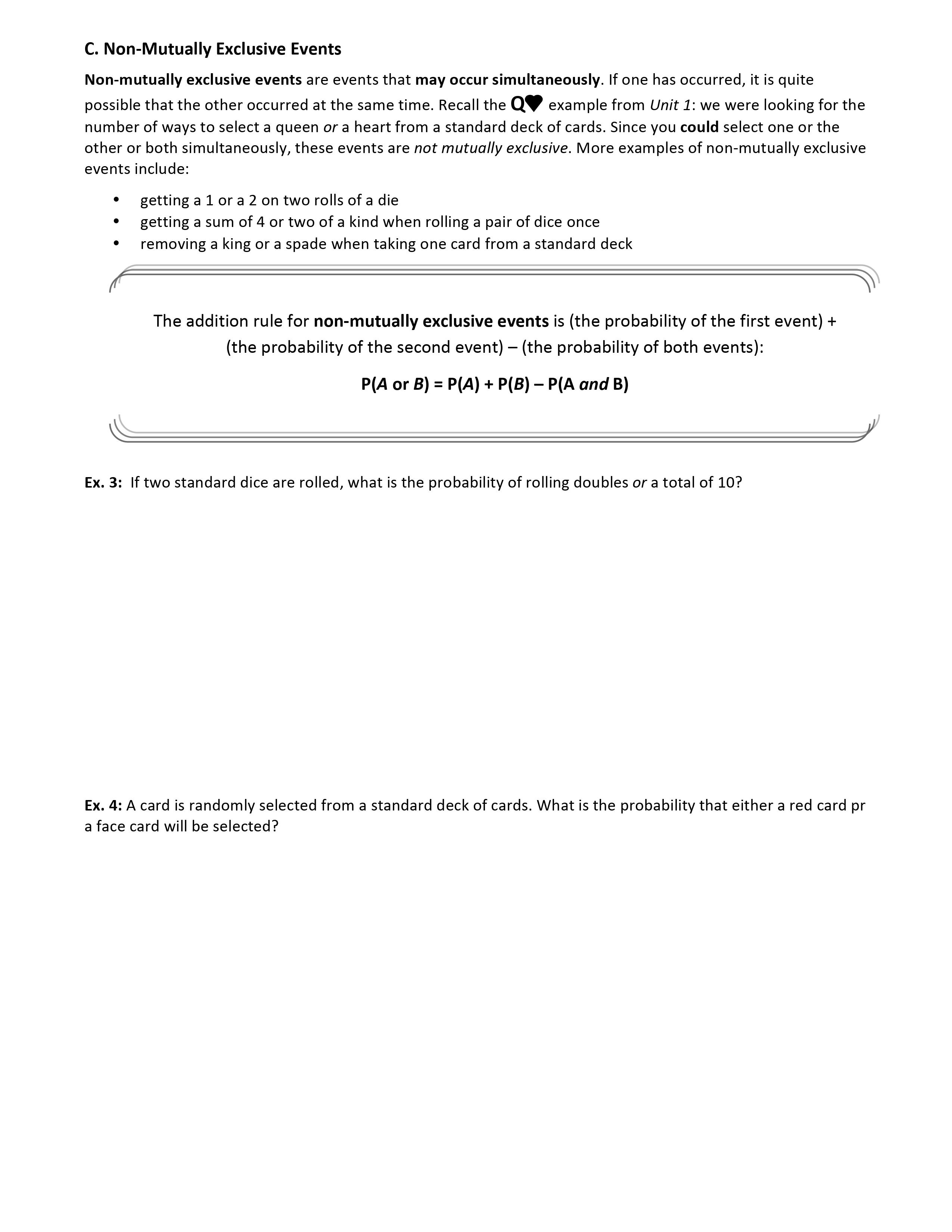
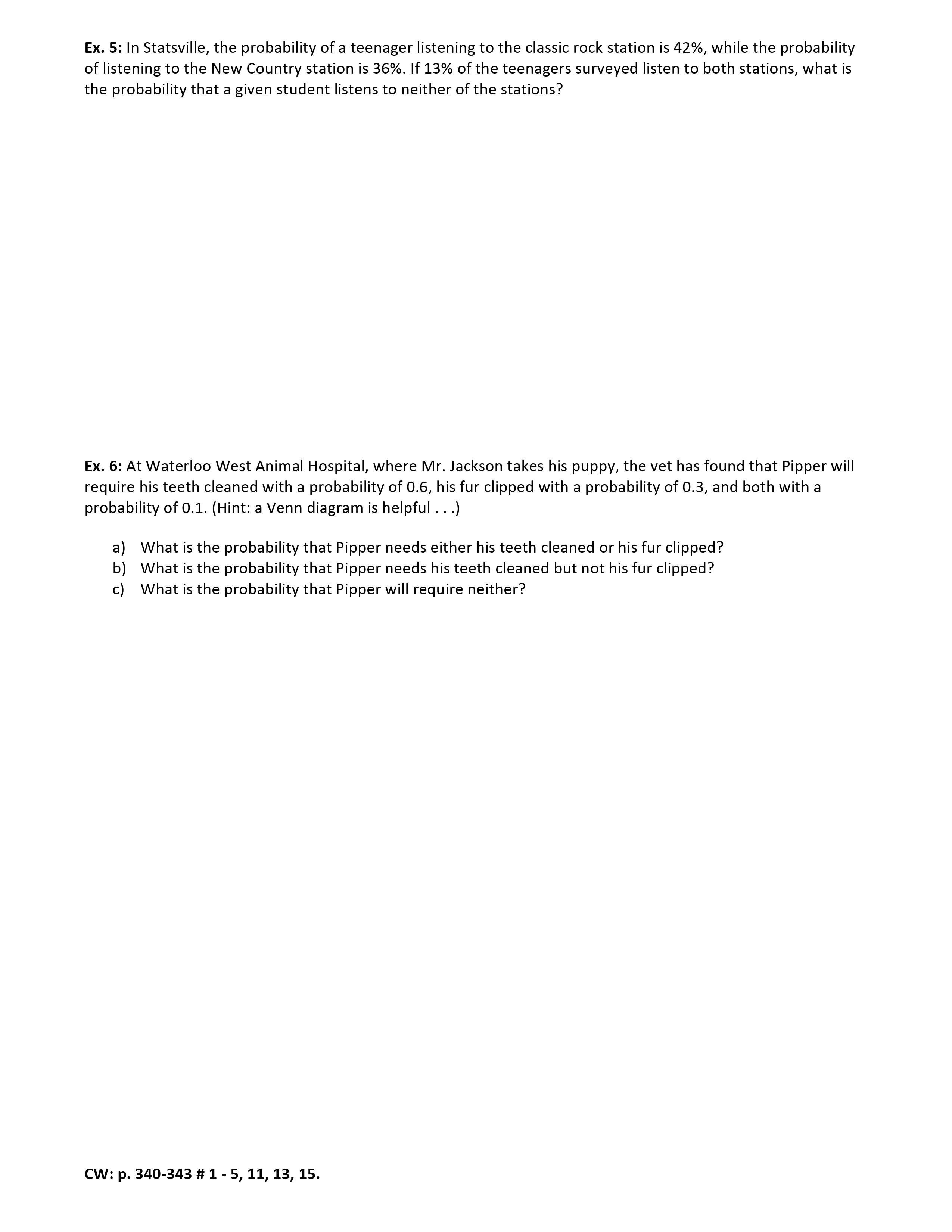
MDM4U Module 2: Probability Unit 3: Intro to Probability Lesson 5 Date: Mutually Exclusive and Non-Mutually Exclusive Events A. Recall Venn Diagrams When we looked at two events, A and B, that had some \"overlap" (intersection) we noted that we could count the total number in A or B or Both (union) two ways: 1) n(A or B) = n(A only) + n(B only) + n(A and B) 2) n(A or B) = n(A total) + n(B total) n(A and B) These methods helped us avoid double-counting the number of outcomes in the event where A and B could occur together. We will use the same methods to help us avoid double-counting probabilities where two events could occur simultaneously! B. Mutually Exclusive Events Mutually exclusive events are events that cannot occur simultaneously. If one has occurred, it is not possible that the other occurred at the same time. Recall the tie example from Unit 1: since you cannot simultaneously wear a tie while not wearing a tie, these events are mutually exclusive. More examples of mutually exclusive events include: ' getting a 1 and a 2 on a single roll of a die ' getting a sum of 3 and two of a kind when rolling a pair of dice once ' removing a queen and an ace when taking one card from a standard deck E The addition rule for mutually exclusive events is (the probability of the first event) + (the probability of the second event), given there is no intersection of the events: PM or B) = PM) + P(B) \\K / Ex. 1: If two standard dice are rolled, what is the probability of rolling doubles or a total of 11? Ex. 2: If a committee of five is to be randomly chosen from six males and eight females, what is the probability that the committee will be either all male or all female? C. Non-Mutually Exclusive Events Non-mutually exclusive events are events that may occur simultaneously. If one has occurred, it is quite possible that the other occurred at the same time. Recall the Q. example from Unit 1: we were looking for the number of ways to select a queen or a heart from a standard deck of cards. Since you could select one or the other or both simultaneously, these events are not mutually exclusive. More examples of non-mutually exclusive events include: ' gettinga 1 ora2 on two rolls ofa die ' getting a sum of 4 or two of a kind when rolling a pair of dice once ' removing a king or a spade when taking one card from a standard deck xz The addition rule for non-mutually exclusive events is (the probability of the first event) + (the probability of the second event) (the probability of both events): P(A or B) = P(A) + P(B) P(A and B) 1' Ex. 3: If two standard dice are rolled, what is the probability of rolling doubles or a total of 10? Ex. 4: A card is randomly selected from a standard deck of cards. What is the probability that either a red card pr a face card will be selected? Ex. 5: In Statsville, the probability of a teenager listening to the classic rock station is 42%, while the probability of listening to the New Country station is 36%. If 13% of the teenagers surveyed listen to both stations, what is the probability that a given student listens to neither of the stations? Ex. 6: At Waterloo West Animal Hospital, where Mr. Jackson takes his puppy, the vet has found that Pipper will require his teeth cleaned with a probability of 0.6, his fur clipped with a probability of 0.3, and both with a probability of 0.1. (Hint: a Venn diagram is helpful...) a) What is the probability that Pipper needs either his teeth cleaned or his fur clipped? b) What is the probability that Pipper needs his teeth cleaned but not his fur clipped? c) What is the probability that Pipper will require neither? cw: p. 340-343 # 1 - 5, 11, 13, 15
Step by Step Solution
There are 3 Steps involved in it

Get step-by-step solutions from verified subject matter experts
 Study Help