







Question: ME310: System Analysis & Design Code Sample From Problem 1d: Problem 3.2: (include all plots in For Problem 3.1 let c = 0, then find
ME310: System Analysis & Design
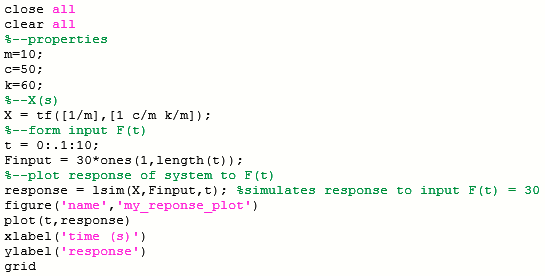
Code Sample From Problem 1d:
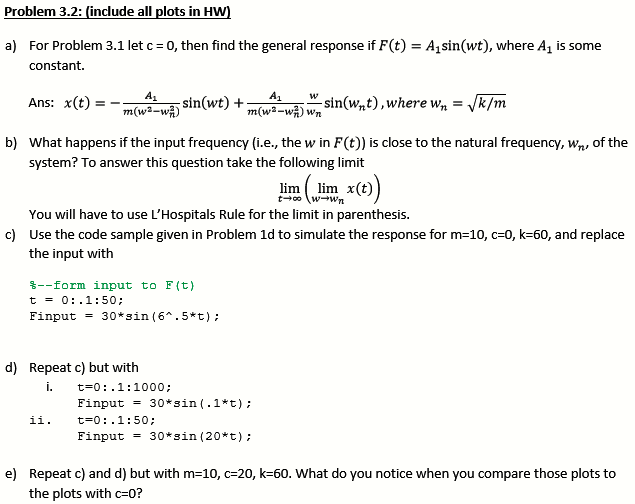
Problem 3.2: (include all plots in For Problem 3.1 let c = 0, then find the general response if F(t) = Alsin(wt), where A1 is some constant. a) x(t)-- (4-sin(wt) + (A- -sin(wnt) , where w n=v/k/m Ans: m(wa-wa) wn What happens if the input frequency (i.e., the w in F(t)) is close to the natural frequency, w, of the system? To answer this question take the following limit b) im You will have to use L'Hospitals Rule for the limit in parenthesis. Use the code sample given in Problem 1d to simulate the response for m=10, c=0, k-60, and replace the input with c) %--form input to F(t) t 0: .1:50; Finput 30*sin ( 6^.5*t); d) Repeat c) but with t=0 : .1:1000; Finput 30*sin ( .1*t); Finput 30+sin (20*t) ; e) Repeat c) and d) but with m-10, c-20, k-60. What do you notice when you compare those plots to the plots with c 0? Problem 3.2: (include all plots in For Problem 3.1 let c = 0, then find the general response if F(t) = Alsin(wt), where A1 is some constant. a) x(t)-- (4-sin(wt) + (A- -sin(wnt) , where w n=v/k/m Ans: m(wa-wa) wn What happens if the input frequency (i.e., the w in F(t)) is close to the natural frequency, w, of the system? To answer this question take the following limit b) im You will have to use L'Hospitals Rule for the limit in parenthesis. Use the code sample given in Problem 1d to simulate the response for m=10, c=0, k-60, and replace the input with c) %--form input to F(t) t 0: .1:50; Finput 30*sin ( 6^.5*t); d) Repeat c) but with t=0 : .1:1000; Finput 30*sin ( .1*t); Finput 30+sin (20*t) ; e) Repeat c) and d) but with m-10, c-20, k-60. What do you notice when you compare those plots to the plots with c 0
Step by Step Solution
There are 3 Steps involved in it

Get step-by-step solutions from verified subject matter experts
 Study Help