







Question: Mean-Variance Analysis and the CAPM (25 points) Consider a world with exactly three assets: two are risky and one is risk-free. Assume all investors are
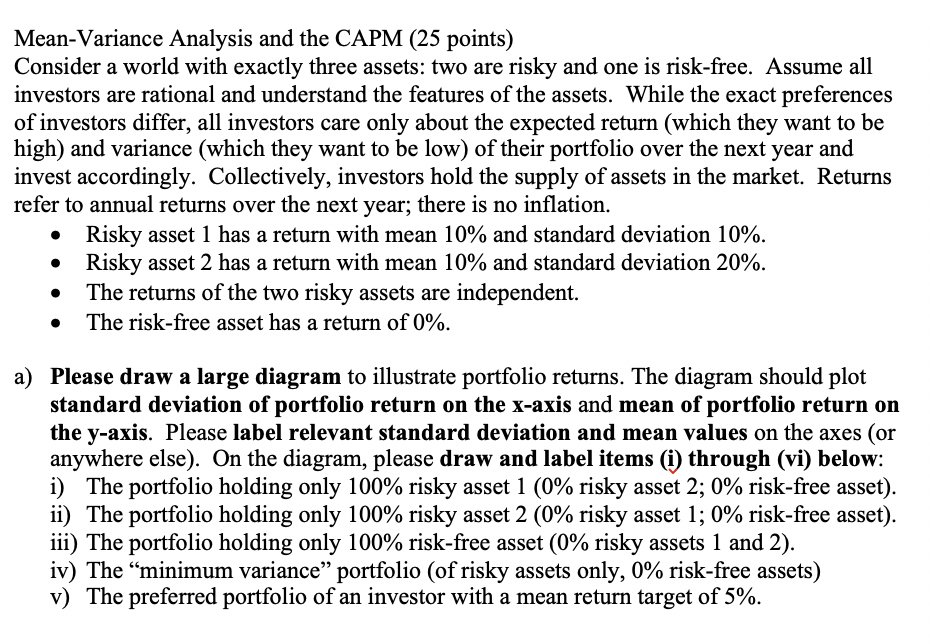
Mean-Variance Analysis and the CAPM (25 points) Consider a world with exactly three assets: two are risky and one is risk-free. Assume all investors are rational and understand the features of the assets. While the exact preferences of investors differ, all investors care only about the expected return (which they want to be high) and variance (which they want to be low) of their portfolio over the next year and invest accordingly. Collectively, investors hold the supply of assets in the market. Returns refer to annual returns over the next year; there is no inflation. Risky asset 1 has a return with mean 10% and standard deviation 10%. Risky asset 2 has a return with mean 10% and standard deviation 20%. The returns of the two risky assets are independent. The risk-free asset has a return of 0%. a) Please draw a large diagram to illustrate portfolio returns. The diagram should plot standard deviation of portfolio return on the x-axis and mean of portfolio return on the y-axis. Please label relevant standard deviation and mean values on the axes (or anywhere else). On the diagram, please draw and label items (i) through (vi) below: i) The portfolio holding only 100% risky asset 1 (0% risky asset 2; 0% risk-free asset). ii) The portfolio holding only 100% risky asset 2 (0% risky asset 1; 0% risk-free asset). iii) The portfolio holding only 100% risk-free asset (0% risky assets 1 and 2). iv) The "minimum variance" portfolio (of risky assets only, 0% risk-free assets) v) The preferred portfolio of an investor with a mean return target of 5%. Mean-Variance Analysis and the CAPM (25 points) Consider a world with exactly three assets: two are risky and one is risk-free. Assume all investors are rational and understand the features of the assets. While the exact preferences of investors differ, all investors care only about the expected return (which they want to be high) and variance (which they want to be low) of their portfolio over the next year and invest accordingly. Collectively, investors hold the supply of assets in the market. Returns refer to annual returns over the next year; there is no inflation. Risky asset 1 has a return with mean 10% and standard deviation 10%. Risky asset 2 has a return with mean 10% and standard deviation 20%. The returns of the two risky assets are independent. The risk-free asset has a return of 0%. a) Please draw a large diagram to illustrate portfolio returns. The diagram should plot standard deviation of portfolio return on the x-axis and mean of portfolio return on the y-axis. Please label relevant standard deviation and mean values on the axes (or anywhere else). On the diagram, please draw and label items (i) through (vi) below: i) The portfolio holding only 100% risky asset 1 (0% risky asset 2; 0% risk-free asset). ii) The portfolio holding only 100% risky asset 2 (0% risky asset 1; 0% risk-free asset). iii) The portfolio holding only 100% risk-free asset (0% risky assets 1 and 2). iv) The "minimum variance" portfolio (of risky assets only, 0% risk-free assets) v) The preferred portfolio of an investor with a mean return target of 5%
Step by Step Solution
There are 3 Steps involved in it

Get step-by-step solutions from verified subject matter experts
 Study Help