



Question: Mechanical Oscillation Pre - lab questions: Answer these questions and submit your answers via Blackboard before coming to lab. Make sure your submission is correctly
Mechanical Oscillation
Prelab questions: Answer these questions and submit your answers via Blackboard before coming to lab. Make sure your submission is correctly uploaded to Blackboard and readable. If your submission is not loaded properly or if it is not readable, you will receive no credit for your submission.
Based on your reading, what do the terms periodic motion and harmonic motion mean? Explain each term using one or two complete sentences.
Remember how a spring works: when you pull on it it stretches. Newton's Law of motion says that the spring pulls back on you too. If you pull the end of the spring in the direction with a force, vec in the direction, the spring stretches by an amount You know that the force has only an component, and hence
where is the force applied, is the force constant of the spring, and is how much the spring stretches.
a What are the physical dimensions of the force constant,
b What does Newton's Law say about the force that the spring must exert on the hand stretching itIn one dimension you can use to show direction.
From your reading, if a mass, is attached to a spring of force constant to make an oscillator, what formula gives the period of oscillation,
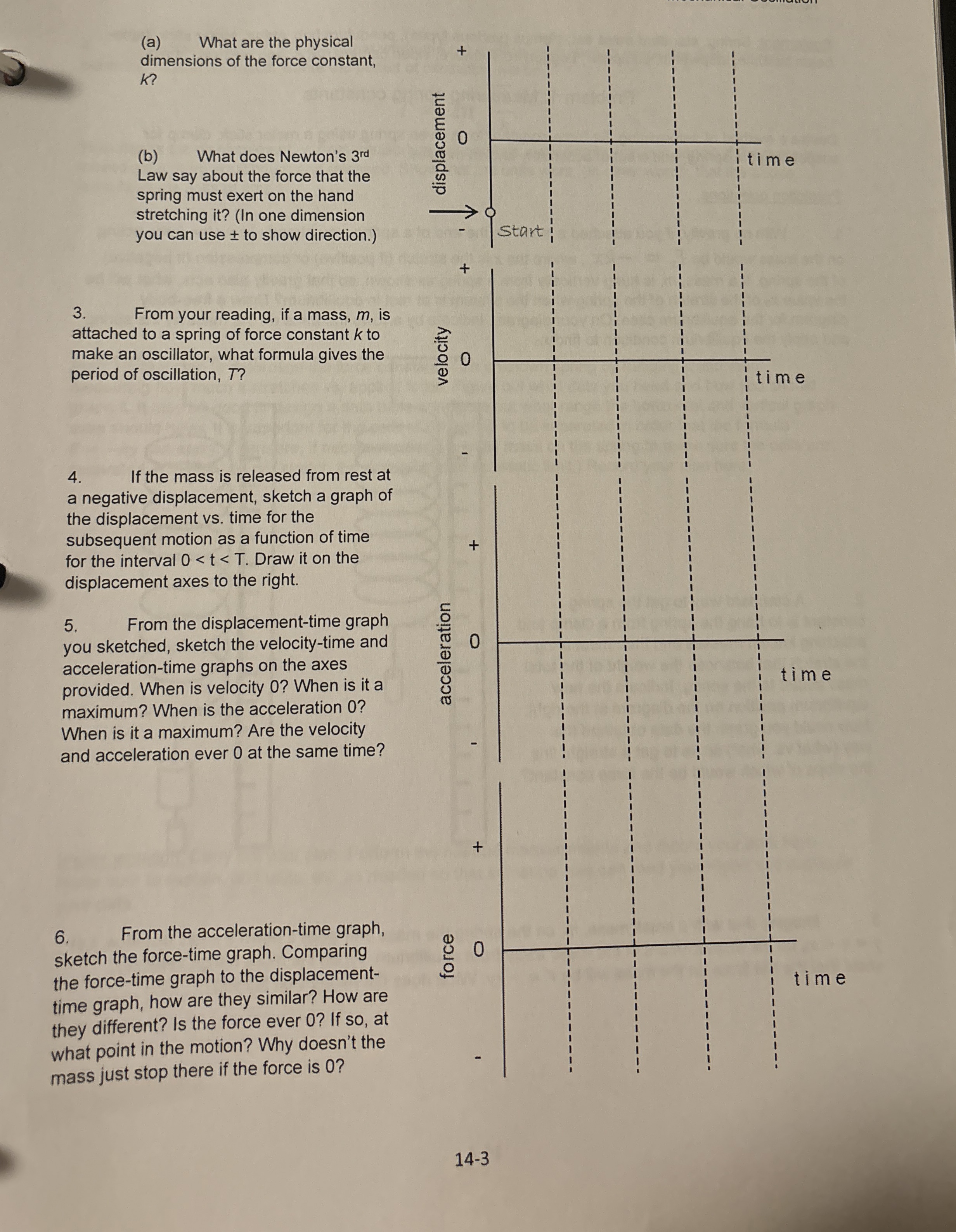
If the mass is released from rest at a negative displacement, sketch a graph of the displacement vs time for the subsequent motion as a function of time for the interval Draw the displacement axes the right.
From the displacementtime graph you sketched, sketch the velocitytime and accelerationtime graphs the axes provided. When velocity When a maximum? When the acceleration When a maximum? Are the velocity and acceleration ever the same time?
From the accelerationtime graph, sketch the forcetime graph. Comparing the forcetime graph the displacementtime graph, how are they similar? How are they different? the force ever what point the motion? Why doesn't the mass just stop there the force
Step by Step Solution
There are 3 Steps involved in it
1 Expert Approved Answer
Step: 1 Unlock

Question Has Been Solved by an Expert!
Get step-by-step solutions from verified subject matter experts
Step: 2 Unlock
Step: 3 Unlock