







Question: Medical imaging reconstruction with Python. Medical imaging reconstruction. (10 points) In this problem, you will consider an example resembles medical imaging reconstruction in MRI. We
Medical imaging reconstruction with Python.
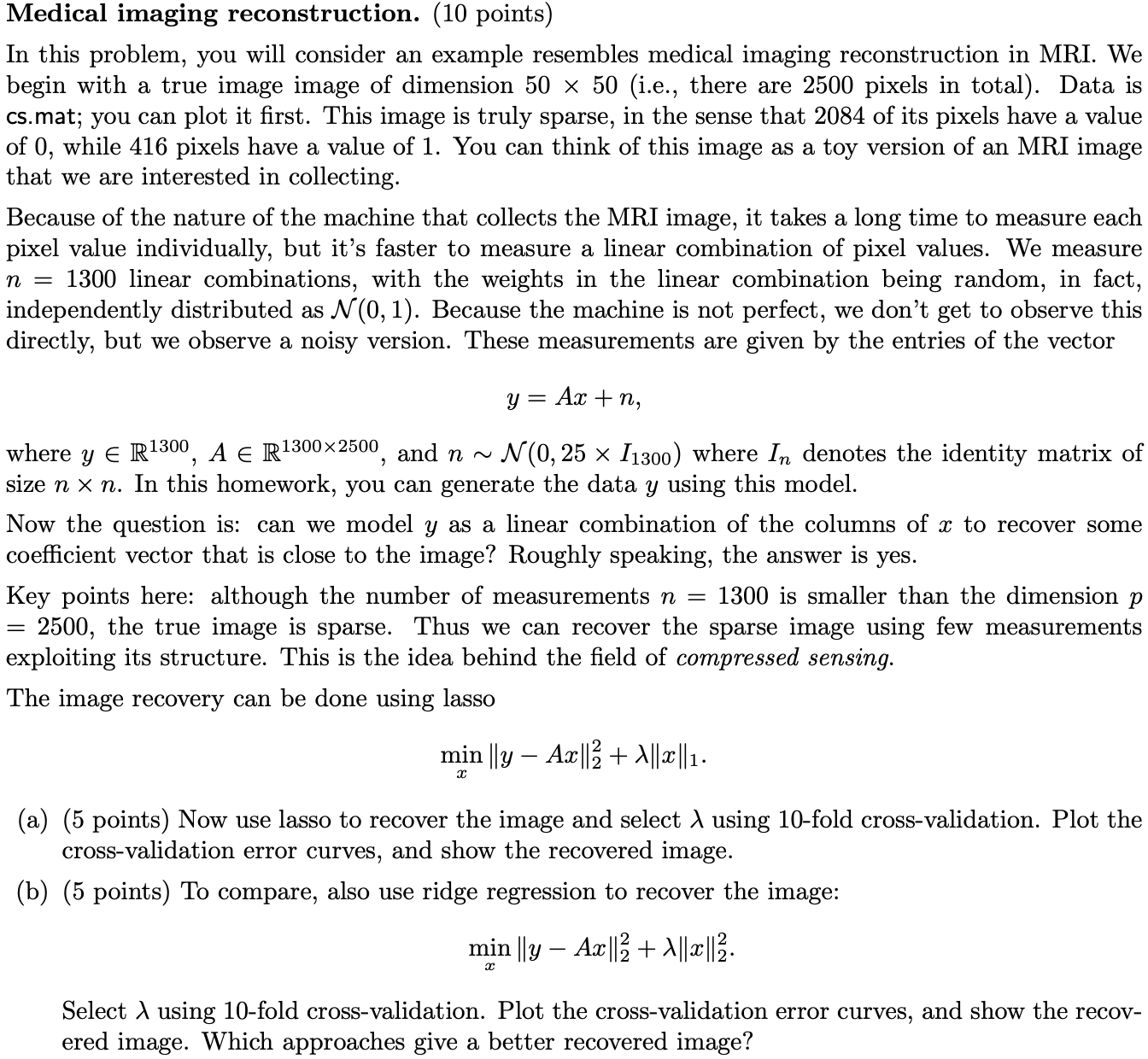
Medical imaging reconstruction. (10 points) In this problem, you will consider an example resembles medical imaging reconstruction in MRI. We begin with a true image image of dimension 50 x 50 (i.e., there are 2500 pixels in total). Data is cs.mat; you can plot it rst. This image is truly sparse, in the sense that 2084 of its pixels have a value of 0, while 416 pixels have a value of 1. You can think of this image as a toy version of an MRI image that we are interested in collecting. Because of the nature of the machine that collects the MRI image, it takes a long time to measure each pixel value individually, but it's faster to measure a linear combination of pixel values. We measure 71 = 1300 linear combinations, with the weights in the linear combination being random, in fact, independently distributed as N (0, 1). Because the machine is not perfect, we don't get to observe this directly, but we observe a noisy version. These measurements are given by the entries of the vector y = Ar + n. where y E R1300, A E R13X25OO, and n N N(0, 25 X Ilgoo) where In denotes the identity matrix of size n X n. In this homework, you can generate the data y using this model. Now the question is: can we model 3; as a linear combination of the columns of a: to recover some coefcient vector that is close to the image? Roughly speaking, the answer is yes. Key points here: although the number of measurements 11 = 1300 is smaller than the dimension 3) = 2500, the true image is sparse. Thus we can recover the sparse image using few measurements exploiting its structure. This is the idea behind the eld of compressed sensing. The image recovery can be done using lasso 111311 My - Amllg + Allxlll- (a) (5 points) Now use lasso to recover the image and select A using 10-fold cross-validation. Plot the cross-validation error curves, and show the recovered image. (b) (5 points) To compare, also use ridge regression to recover the image: min Ily Amll + Allwlli- Select A using 10-fold cross-validation. Plot the cross-validation error curves, and show the recov- ered image. Which approaches give a better recovered image
Step by Step Solution
There are 3 Steps involved in it

Get step-by-step solutions from verified subject matter experts
 Study Help