



Question: Memo Assignment Your direct supervisor, Ms. Kathryn Martin, has been invited to be a keynote speaker for the Center for Business Ethics. She would like
Memo Assignment
Your direct supervisor, Ms. Kathryn Martin, has been invited to be a keynote speaker for the Center for Business Ethics. She would like to address the events related to the decision by CVS to stop selling tobacco products, and how that decision is related to decisions about other product lines that CVS continues to sell.
She has come to you for your help in putting together her presentation. She has provided you with the following articles on the events and has asked you to prepare a brief (1-2 pages, single-spaced) memo for her that accomplishes the following goals:
Provides a clear description of the situation, stating the key issues in the decision-making process,
Identifies the major stakeholders involved and how each of those stakeholders is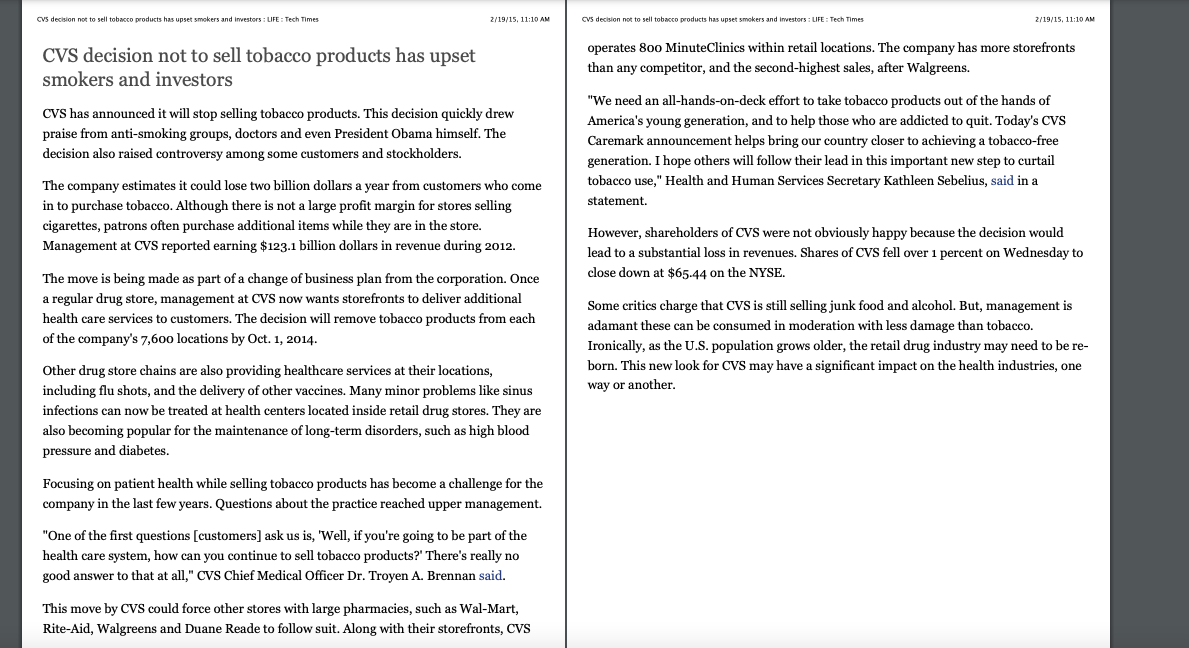
 affected by the decision(s), and
Describes at least 2 insightful alternatives for resolving the issues that demonstrate originality, rationale, and sound business judgment.
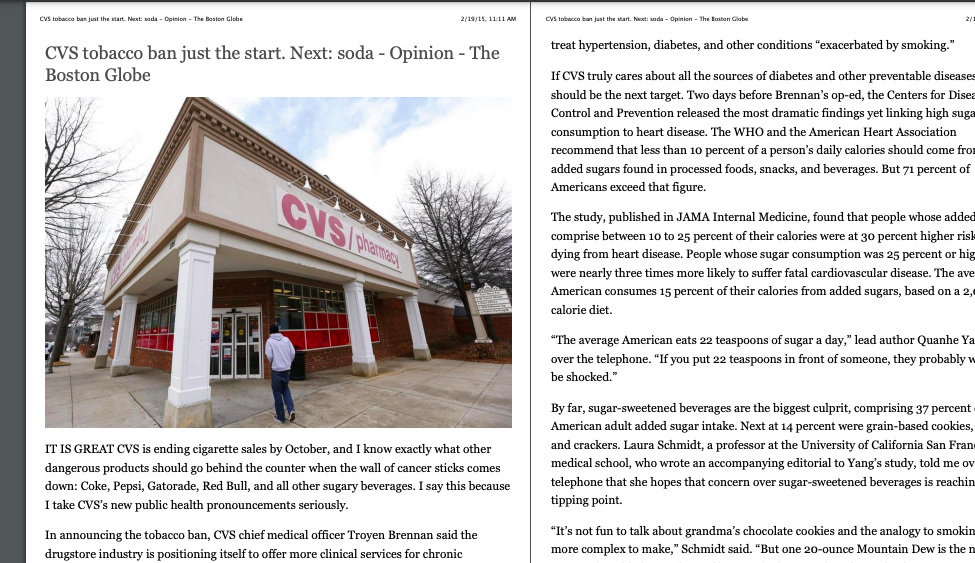
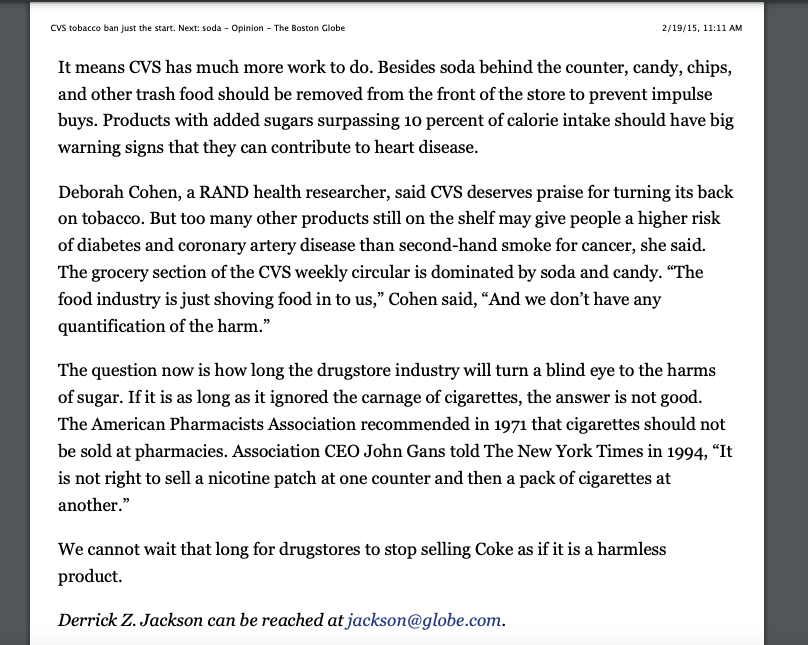
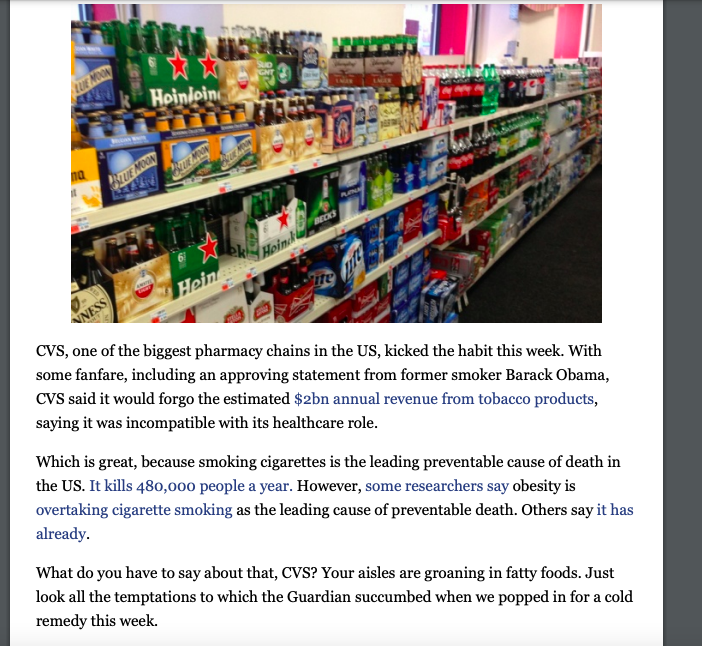
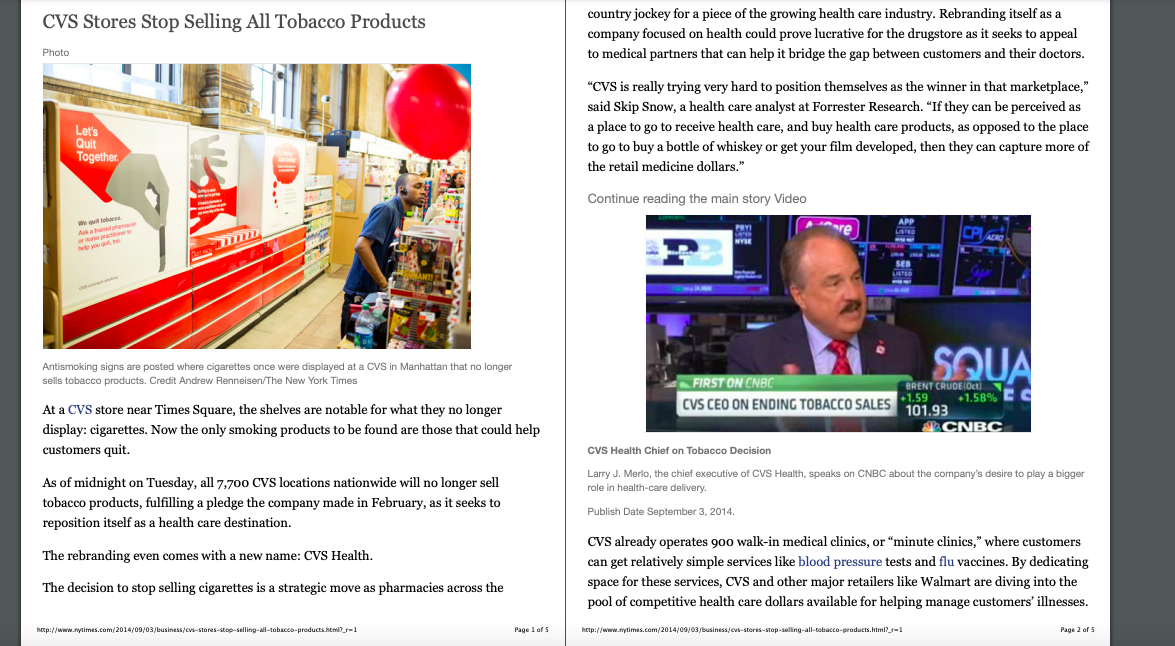
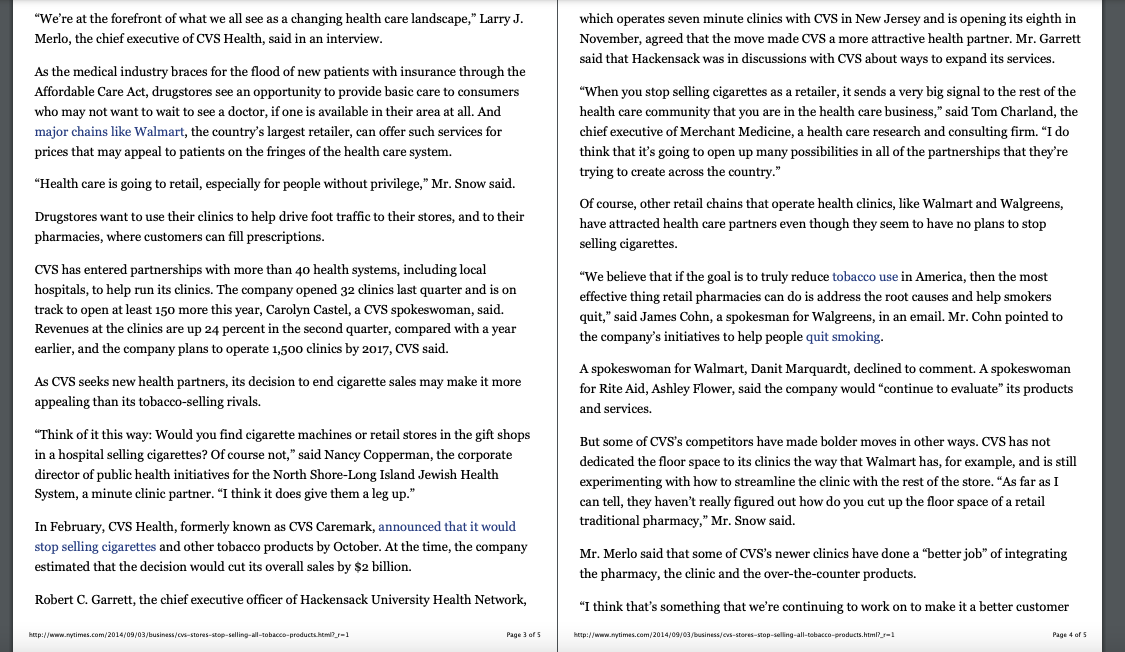
Cvs decision not to sell tobacco products has upset smokers and investors : LIFE : Tech Times 2/19/15, 11:10 AM Cvs decision not to sell tobacco products has upset smokers and investors : LIFE : Tech Times 2/19/15, 11:10 AM CVS decision not to sell tobacco products has upset smokers and investors operates 8oo MinuteClinics within retail locations. The company has more storefronts than any competitor, and the second-highest sales, after Walgreens. CVS has announced it will stop selling tobacco products. This decision quickly drew praise from anti-smoking groups, doctors and even President Obama himself. The decision also raised controversy among some customers and stockholders. "We need an all-hands-on-deck effort to take tobacco products out of the hands of America's young generation, and to help those who are addicted to quit. Today's CVS Caremark announcement helps bring our country closer to achieving a tobacco-free generation. I hope others will follow their lead in this important new step to curtail tobacco use," Health and Human Services Secretary Kathleen Sebelius, said in a statement. The company estimates it could lose two billion dollars a year from customers who come in to purchase tobacco. Although there is not a large profit margin for stores selling cigarettes, patrons often purchase additional items while they are in the store. Management at CVS reported earning $123.1 billion dollars in revenue during 2012. However, shareholders of CVS were not obviously happy because the decision would lead to a substantial loss in revenues. Shares of CVS fell over 1 percent on Wednesday to close down at $65.44 on the NYSE. The move is being made as part of a change of business plan from the corporation. Once a regular drug store, management at CVS now wants storefronts to deliver additional health care services to customers. The decision will remove tobacco products from each of the company's 7,600 locations by Oct. 1, 2014. Some critics charge that CVS is still selling junk food and alcohol. But, management is adamant these can be consumed in moderation with less damage than tobacco. Ironically, as the U.S. population grows older, the retail drug industry may need to be re- born. This new look for CVS may have a significant impact on the health industries, one way or another. Other drug store chains are also providing healthcare services at their locations, including flu shots, and the delivery of other vaccines. Many minor problems like sinus infections can now be treated at health centers located inside retail drug stores. They are also becoming popular for the maintenance of long-term disorders, such as high blood pressure and diabetes. Focusing on patient health while selling tobacco products has become a challenge for the company in the last few years. Questions about the practice reached upper management. "One of the first questions (customers) ask us is, 'Well, if you're going to be part of the health care system, how can you continue to sell tobacco products?' There's really no good answer to that at all," CVS Chief Medical Officer Dr. Troyen A. Brennan said. This move by CVS could force other stores with large pharmacies, such as Wal-Mart, Rite-Aid, Walgreens and Duane Reade to follow suit. Along with their storefronts, CVS CVS tobacco ban just the start. Next: soda - Opinion - The Boston Globe 2/19/15, 11:11 AM CVS tobacco ban just the start. Nest: soda - Opinion - The Boston Globe treat hypertension, diabetes, and other conditions "exacerbated by smoking." CVS tobacco ban just the start. Next: soda - Opinion - The Boston Globe If CVS truly cares about all the sources of diabetes and other preventable diseases should be the next target. Two days before Brennan's op-ed, the Centers for Disea Control and Prevention released the most dramatic findings yet linking high suga consumption to heart disease. The WHO and the American Heart Association recommend that less than 10 percent of a person's daily calories should come from added sugars found in processed foods, snacks, and beverages. But 71 percent of Americans exceed that figure. CUSI phanmen The study, published in JAMA Internal Medicine, found that people whose added comprise between 10 to 25 percent of their calories were at 30 percent higher risk dying from heart disease. People whose sugar consumption was 25 percent or hig were nearly three times more likely to suffer fatal cardiovascular disease. The ave American consumes 15 percent of their calories from added sugars, based on a 2, calorie diet. "The average American eats 22 teaspoons of sugar a day," lead author Quanhe Ya over the telephone. "If you put 22 teaspoons in front of someone, they probably w be shocked." By far, sugar-sweetened beverages are the biggest culprit, comprising 37 percent American adult added sugar intake. Next at 14 percent were grain-based cookies, and crackers. Laura Schmidt, a professor at the University of California San Fran medical school, who wrote an accompanying editorial Yang's study, telephone that she hopes that concern over sugar-sweetened beverages is reachin tipping point. IT IS GREAT CVS is ending cigarette sales by October, and I know exactly what other dangerous products should go behind the counter when the wall of cancer sticks comes down: Coke, Pepsi, Gatorade, Red Bull, and all other sugary beverages. I say this because I take CVS's new public health pronouncements seriously. me ov In announcing the tobacco ban, CVS chief medical officer Troyen Brennan said the drugstore industry is positioning itself to offer more clinical services for chronic *It's not fun to talk about grandma's chocolate cookies and the analogy to smokin more complex to make," Schmidt said. "But one 20-ounce Mountain Dew is the n CVS tobacco ban just the start. Next: soda - Opinion - The Boston Globe 2/19/15, 11:11 AM It means CVS has much more work to do. Besides soda behind the counter, candy, chips, and other trash food should be removed from the front of the store to prevent impulse buys. Products with added sugars surpassing 10 percent of calorie intake should have big warning signs that they can contribute to heart disease. Deborah Cohen, a RAND health researcher, said CVS deserves praise for turning its back on tobacco. But too many other products still on the shelf may give people a higher risk of diabetes and coronary artery disease than second-hand smoke for cancer, she said. The grocery section of the CVS weekly circular is dominated by soda and candy. The food industry is just shoving food in to us, Cohen said, And we don't have any quantification of the harm." The question now is how long the drugstore industry will turn a blind eye to the harms of sugar. If it is as long as it ignored the carnage of cigarettes, the answer is not good. The American Pharmacists Association recommended in 1971 that cigarettes should not be sold at pharmacies. Association CEO John Gans told The New York Times in 1994, It is not right to sell a nicotine patch at one counter and then a pack of cigarettes at another." We cannot wait that long for drugstores to stop selling Coke as if it is a harmless product. Derrick Z. Jackson can be reached at jackson@globe.com. Heinloin na UE NON V NEMA Heine Beas Hein VNESS CVS, one of the biggest pharmacy chains in the US, kicked the habit this week. With some fanfare, including an approving statement from former smoker Barack Obama, CVS said it would forgo the estimated $2bn annual revenue from tobacco products, saying it was incompatible with its healthcare role. Which is great, because smoking cigarettes is the leading preventable cause of death in the US. It kills 480,000 people a year. However, some researchers say obesity is overtaking cigarette smoking as the leading cause of preventable death. Others say it has already. What do you have to say about that, CVS? Your aisles are groaning in fatty foods. Just look all the temptations to which the Guardian succumbed when we popped in for a cold remedy this week. CVS Stores Stop Selling All Tobacco Products country jockey for a piece of the growing health care industry. Rebranding itself as a company focused on health could prove lucrative for the drugstore as it seeks to appeal to medical partners that can help it bridge the gap between customers and their doctors. Photo Let's Quit Together "CVS is really trying very hard to position themselves as the winner in that marketplace," said Skip Snow, a health care analyst at Forrester Research. If they can be perceived as a place to go to receive health care, and buy health care products, as opposed to the place to go to buy a bottle of whiskey or get your film developed, then they can capture more of the retail medicine dollars." Continue reading the main story Video guito ted 287! mere APP LISTED NTSE ame UB SES LISTED ANT Antismoking signs are posted where cigarettes once were displayed at a CVS in Manhattan that no longer sells tobacco products. Credit Andrew Renneisen/The New York Times SQUA FIRST ON CNBC BRENT CRUDE/OCL) CVS CEO ON ENDING TOBACCO SALES 101.93 - 1.59 CNBC +1.58% Ed At a CVS store near Times Square, the shelves are notable for what they no longer display: cigarettes. Now the only smoking products to be found are those that could help customers quit. CVS Health Chief on Tobacco Decision As of midnight on Tuesday, all 7.700 CVS locations nationwide will no longer sell tobacco products, fulfilling a pledge the company made in February, as it seeks to reposition itself as a health care destination. Larry J. Merlo, the chief executive of CVS Health, speaks on CNBC about the company's desire to play a bigger a role in health-care delivery. Publish Date September 3, 2014. , The rebranding even comes with a new name: CVS Health. CVS already operates 900 walk-in medical clinics, or "minute clinics," where customers can get relatively simple services like blood pressure tests and flu vaccines. By dedicating space for these services, CVS and other major retailers like Walmart are diving into the pool of competitive health care dollars available for helping manage customers' illnesses. The decision to stop selling cigarettes is a strategic move as pharmacies across the http://www.nytimes.com/2014/09/03/business/cs-Stores-stop-selling-all-tobacco-products.html?_=1 Page 1 of 5 http://www.nytimes.com/2014/09/03/business/cvs-store-stop-selling-all-tobacco-products.html?_s-1 Page 2 of 5 "We're at the forefront of what we all see as a changing health care landscape," Larry J. Merlo, the chief executive of CVS Health, said in an interview. which operates seven minute clinics with CVS in New Jersey and is opening its eighth in November, agreed that the move made CVS a more attractive health partner. Mr. Garrett said that Hackensack was in discussions with CVS about ways to expand its services. As the medical industry braces for the flood of new patients with insurance through the Affordable Care Act, drugstores see an opportunity to provide basic care to consumers who may not want to wait to see a doctor, if one is available in their area at all. And major chains like Walmart, the country's largest retailer, can offer such services for prices that may appeal to patients on the fringes of the health care system. "When you stop selling cigarettes as a retailer, it sends a very big signal to the rest of the health care community that you are in the health care business," said Tom Charland, the chief executive of Merchant Medicine, a health care research and consulting firm. I do think that it's going to open up many possibilities in all of the partnerships that they're trying to create across the country." "Health care is going to retail, especially for people without privilege," Mr. Snow said. Drugstores want to use their clinics to help drive foot traffic to their stores, and to their pharmacies, where customers can fill prescriptions. Of course, other retail chains that operate health clinics, like Walmart and Walgreens, have attracted health care partners even though they seem to have no plans to stop selling cigarettes. CVS has entered partnerships with more than 40 health systems, including local hospitals, to help run its clinics. The company opened 32 clinics last quarter and is on track to open at least 150 more this year, Carolyn Castel, a CVS spokeswoman, said. Revenues at the clinics are up 24 percent in the second quarter, compared with a year earlier, and the company plans to operate 1,500 clinics by 2017, CVS said. "We believe that if the goal is to truly reduce tobacco use in America, then the most effective thing retail pharmacies can do is address the root causes and help smokers quit, said James Cohn, a spokesman for Walgreens, in an email. Mr. Cohn pointed to the company's initiatives to help people quit smoking. As CVS seeks new health partners, its decision to end cigarette sales may make it more appealing than its tobacco-selling rivals. A spokeswoman for Walmart, Danit Marquardt, declined to comment. A spokeswoman for Rite Aid, Ashley Flower, said the company would "continue to evaluate" its products and services. "Think of it this way: Would you find cigarette machines or retail stores in the gift shops in a hospital selling cigarettes? Of course not," said Nancy Copperman, the corporate director of public health initiatives for the North Shore-Long Island Jewish Health System, a minute clinic partner. I think it does give them a leg up." But some of CVS's competitors have made bolder moves in other ways. CVS has not dedicated the floor space to its clinics the way that Walmart has, for example, and is still experimenting with how to streamline the clinic with the rest of the store. "As far as I can tell, they haven't really figured out how do you cut up the floor space of a retail traditional pharmacy," Mr. Snow said. In February, CVS Health, formerly known as CVS Caremark, announced that it would stop selling cigarettes and other tobacco products by October. At the time, the company estimated that the decision would cut its overall sales by $2 billion. Mr. Merlo said that some of CVS's newer clinics have done a "better job" of integrating the pharmacy, the clinic and the over-the-counter products. Robert C. Garrett, the chief executive officer of Hackensack University Health Network, "I think that's something that we're continuing to work on to make it a better customer http://www.nytimes.com/2014/09/03/business/cs-stores-stop-selling-all-tobacco-products.html?s=1 Page 3 of 5 hetp://www.nytimes.com/2014/09/03/business/evs-store-stop-selling-all-tobacco-products.html?_r=1 Page 4 of 5 CVS Stores Stop Selling All Tobacco Products - NYTimes.com 2/19/15, 11:11 AM experience," he said. A big opportunity for CVS as it pushes into health care, however, has nothing to do with what happens in the pharmacy itself. The company also wants to become a larger pharmacy benefit manager, which manages prescription drug plans for employers and insurers. CVS expects its pharmacy benefit management business, CVS/Caremark, to grow to nearly $90 billion this year, up $30 billion over the last three years, Ms. Castel said. The company's push into other areas of health care could help CVS expand that business further. "If I'm an employer with 2,000 employees, it makes CVS more appealing to me as a pharmacy benefits management company as well because I have this integration with health systems," Mr. Charland said. That's important to employers who are trying to reduce their health care costs." For me, the story is not around how CVS can directly benefit from what they've done, Mr. Snow said. Rather, the story is around how CVS is engineering their public image in order to be perceived as the place to go to become healthy
Step by Step Solution
There are 3 Steps involved in it

Get step-by-step solutions from verified subject matter experts