







Question: Memory in a computer system is access in either sequential accesses or random accesses. Sequential accesses are the memory accesses that make memory access
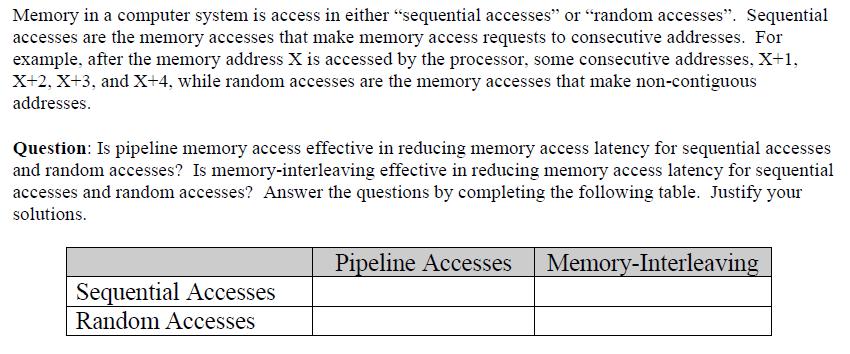
Memory in a computer system is access in either "sequential accesses" or "random accesses. Sequential accesses are the memory accesses that make memory access requests to consecutive addresses. For example, after the memory address X is accessed by the processor, some consecutive addresses, X+1, X+2, X+3, and X+4, while random accesses are the memory accesses that make non-contiguous addresses. Question: Is pipeline memory access effective in reducing memory access latency for sequential accesses and random accesses? Is memory-interleaving effective in reducing memory access latency for sequential accesses and random accesses? Answer the questions by completing the following table. Justify your solutions. Sequential Accesses Random Accesses Pipeline Accesses Memory-Interleaving
Step by Step Solution
There are 3 Steps involved in it
Sequential Accesses Pipeline memory access is effective in reducing memory access latency for sequential accessesThis is because pipeline memory access can start prefetching the next memory location w... View full answer

Get step-by-step solutions from verified subject matter experts
 Study Help