







Question: Memory is important when storing images ( textures ) on a graphics card. Quite often GPU devices have limited memory. We will look at this
Memory is important when storing images textures on
a graphics card. Quite often GPU devices have limited memory. We will look at
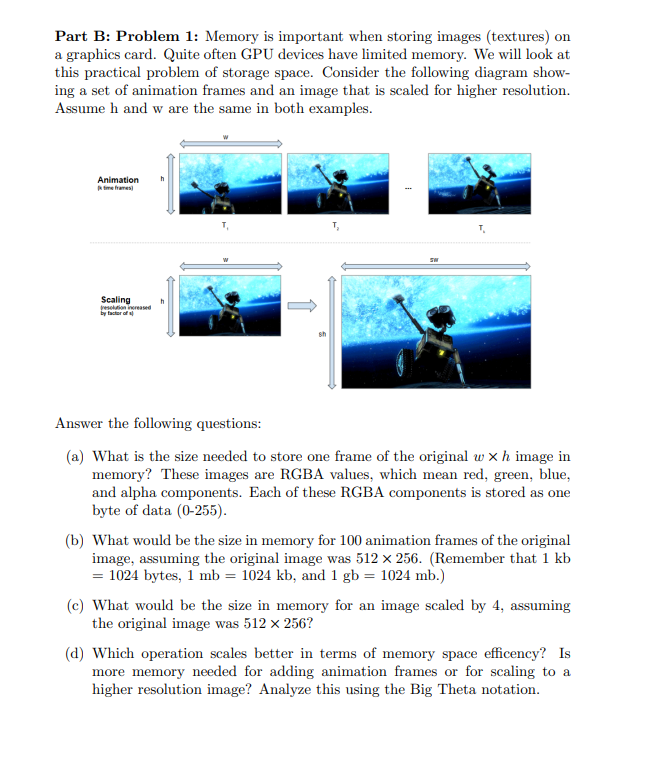
this practical problem of storage space. Consider the following diagram showing a set of animation frames and an image that is scaled for higher resolution.
Assume h and w are the same in both examples.
Answer the following questions:
a What is the size needed to store one frame of the original w times h image in
memory? These images are RGBA values, which mean red, green, blue,
and alpha components. Each of these RGBA components is stored as one
byte of data
b What would be the size in memory for animation frames of the original
image, assuming the original image was times Remember that kb
bytes, mb kb and gb mb
c What would be the size in memory for an image scaled by assuming
the original image was times
d Which operation scales better in terms of memory space efficency? Is
more memory needed for adding animation frames or for scaling to a
higher resolution image? Analyze this using the Big Theta notation. Part B: Problem : Memory is important when storing images textures on
a graphics card. Quite often GPU devices have limited memory. We will look at
this practical problem of storage space. Consider the following diagram show
ing a set of animation frames and an image that is scaled for higher resolution.
Assume h and w are the same in both examples.
Answer the following questions:
a What is the size needed to store one frame of the original image in
memory? These images are RGBA values, which mean red, green, blue,
and alpha components. Each of these RGBA components is stored as one
byte of data
b What would be the size in memory for animation frames of the original
image, assuming the original image was Remember that kb
bytes, and
c What would be the size in memory for an image scaled by assuming
the original image was
d Which operation scales better in terms of memory space efficency? Is
more memory needed for adding animation frames or for scaling to a
higher resolution image? Analyze this using the Big Theta notation.
Step by Step Solution
There are 3 Steps involved in it
1 Expert Approved Answer
Step: 1 Unlock

Question Has Been Solved by an Expert!
Get step-by-step solutions from verified subject matter experts
Step: 2 Unlock
Step: 3 Unlock
 Study Help