







Question: Metabolic Power Program are concerned with computing the metabolic power of mammals and reptiles. For Biologists example, a hibernating ground squirrel is contained in an
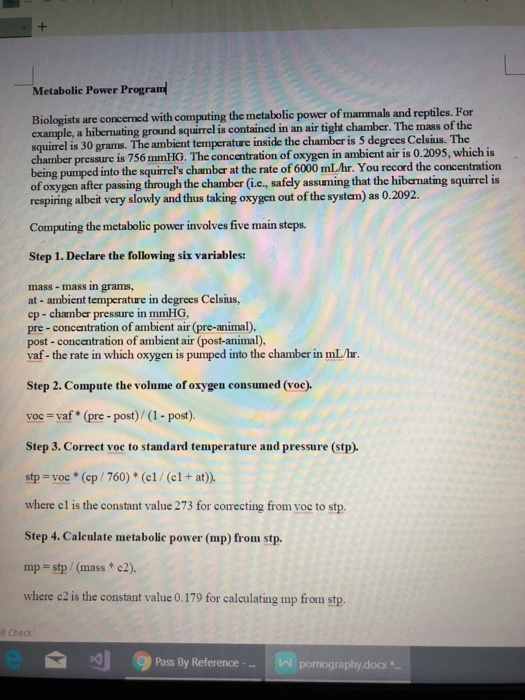
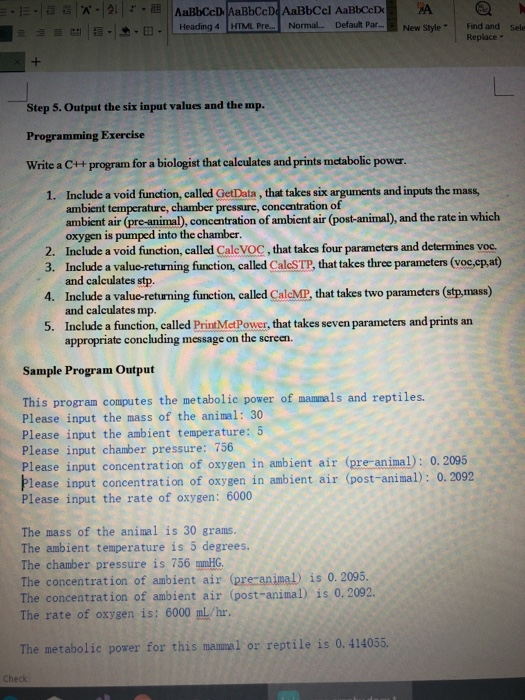
Metabolic Power Program are concerned with computing the metabolic power of mammals and reptiles. For Biologists example, a hibernating ground squirrel is contained in an air tight chamber. The mass of the squirrel is 30 grams. The ambient temperature inside the chamber is 5 degrees Celsius. The chamber pressure is 756 mmHG. The concentration of oxygen in ambient air is 0.2095, which is being pumped into the squirrel's chamber at the rate of 6000 mL/hr. You record the concentration of oxygen after passing through the chamber (i.e., safely assuming that the hibenating squirrel is respiring albeit very slowly and thus taking oxygen out of the system) as 0.2092. Computing the metabolic power involves five main steps. Step 1. Declare the following six variables: mass - mass in grams, at- ambient temperature in degrees Celsius, cp chamber pressure in mmHG pre- concentration of ambient air (pre-animal), post - concentration of ambient air (post-animal), vaf- the rate in which oxygen is pumped into the chamber in mL/hr. Step 2. Compute the volume of oxygen consumed (voc). voc vaf (pre post)/(1 - post). Step 3. Correct voc to standard temperature and pressure (stp). stp voc (cp /760) * (cl (cl+ at)) where el is the constant value 273 for conmrecting from voc to stp. Step 4. Calculate metabolie power (mp) from stp. mp stp (mass c2). where c2 is the constant value 0.179 for calculating mp from stp. Check APass By Referencepomography doo
Step by Step Solution
There are 3 Steps involved in it

Get step-by-step solutions from verified subject matter experts
 Study Help