



Question: MGTS 352 Hand-in Assignment - Inventory Management - WI2023 The 'Try to Have Just One' (THJO) sunflower seed company roasts and seasons sunflower seeds (in
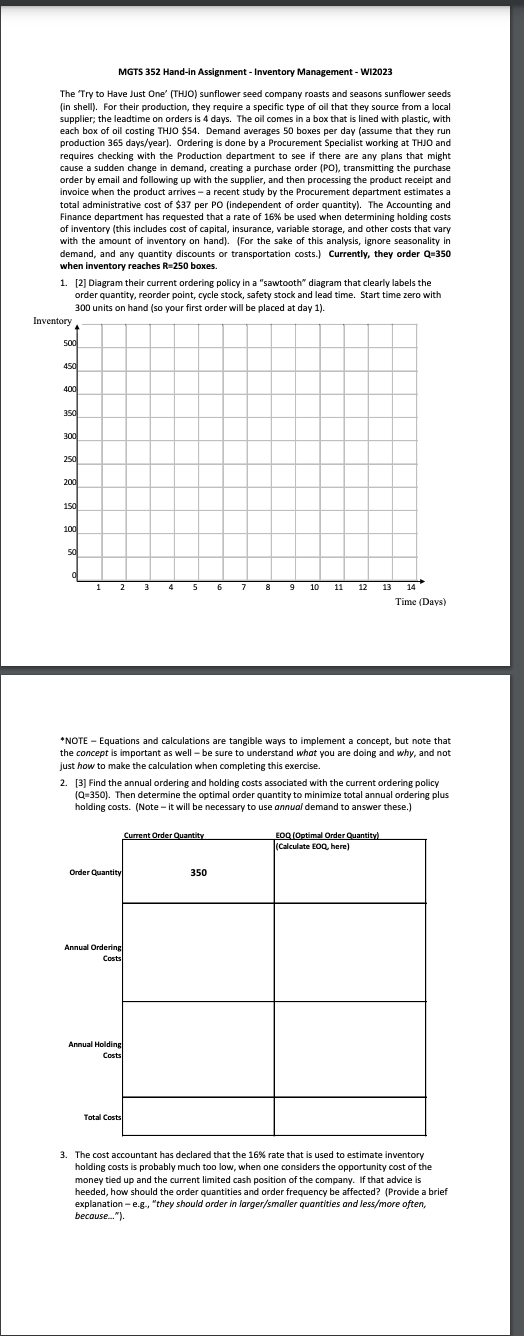
MGTS 352 Hand-in Assignment - Inventory Management - WI2023 The 'Try to Have Just One' (THJO) sunflower seed company roasts and seasons sunflower seeds (in shell). For their production, they require a specific type of oil that they source from a local supplier; the leadtime on orders is 4 days. The oil comes in a box that is lined with plastic, with each box of oil costing THJO $54. Demand averages 50 boxes per day (assume that they run production 365 days/year). Ordering is done by a Procurement Specialist working at THJO and requires checking with the Production department to see if there are any plans that might cause a sudden change in demand, creating a purchase order (PO), transmitting the purchase order by email and following up with the supplier, and then processing the product receipt and invoice when the product arrives - a recent study by the Procurement department estimates a total administrative cost of $37 per PO (independent of order quantity). The Accounting and Finance department has requested that a rate of 16% be used when determining holding costs of inventory (this includes cost of capital, insurance, variable storage, and other costs that vary with the amount of inventory on hand). (For the sake of this analysis, ignore seasonality in demand, and any quantity discounts or transportation costs.) Currently, they order Q=350 when inventory reaches R=250 boxes. 1. [2] Diagram their current ordering policy in a "sawtooth" diagram that clearly labels the order quantity, reorder point, cycle stock, safety stock and lead time. Start time zero with 300 units on hand (so your first order will be placed at day 1 ). "NOTE - Equations and calculations are tangible ways to implement a concept, but note that the concept is important as well - be sure to understand what you are doing and why, and not just how to make the calculation when completing this exercise. 2. [3] Find the annual ordering and holding costs associated with the current ordering policy (Q=350]. Then determine the optimal order quantity to minimize total annual ordering plus holding costs. (Note - it will be necessary to use annual demand to answer these.) 3. The cost accountant has declared that the 16% rate that is used to estimate inventory holding costs is probably much too low, when one considers the opportunity cost of the money tied up and the current limited cash position of the company. If that advice is heeded, how should the order quantities and order frequency be affected? (Provide a brief explanation - e.g., "they should order in larger/smaller quantities and less/more often, becouse
Step by Step Solution
There are 3 Steps involved in it
Sure lets go through the solution step by step 1 Diagram of the Current Ordering Policy To diagram the inventory policy we need to identify and label ... View full answer

Get step-by-step solutions from verified subject matter experts