







Question: Micro pA20, answer. Approach 2: The second approach uses &, and ki- as the period t state variables. We need to assume that &_, is
Micro pA20, answer.
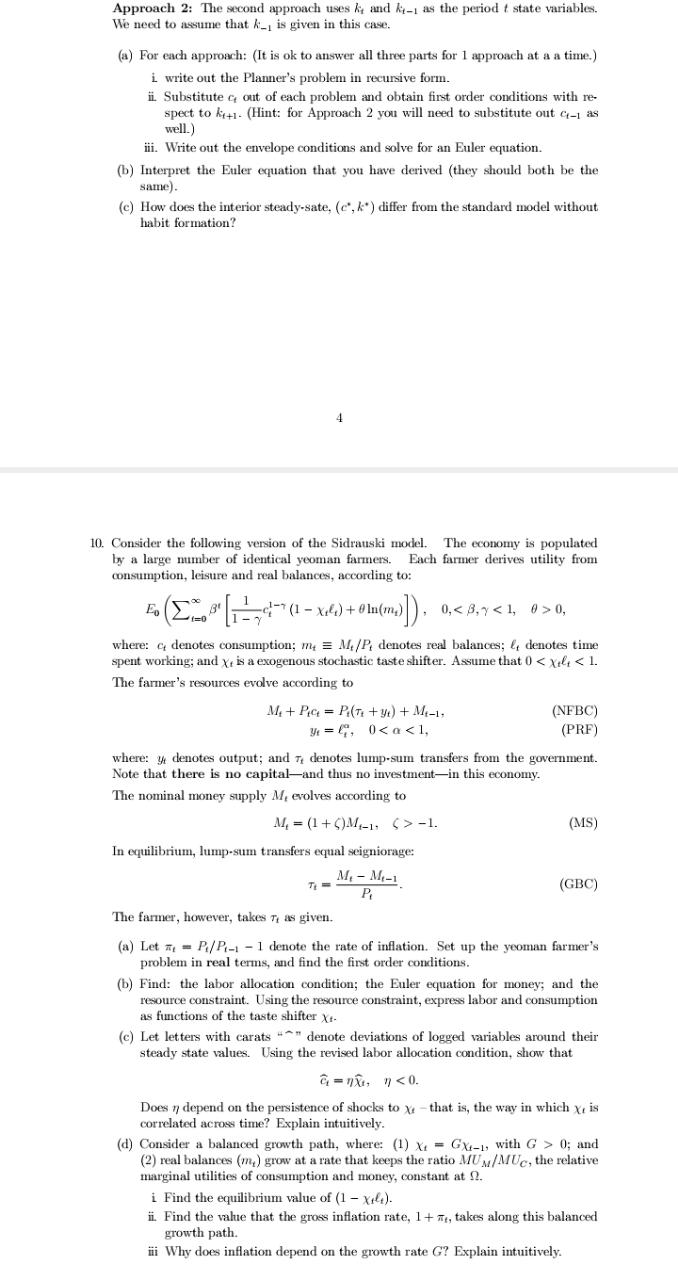
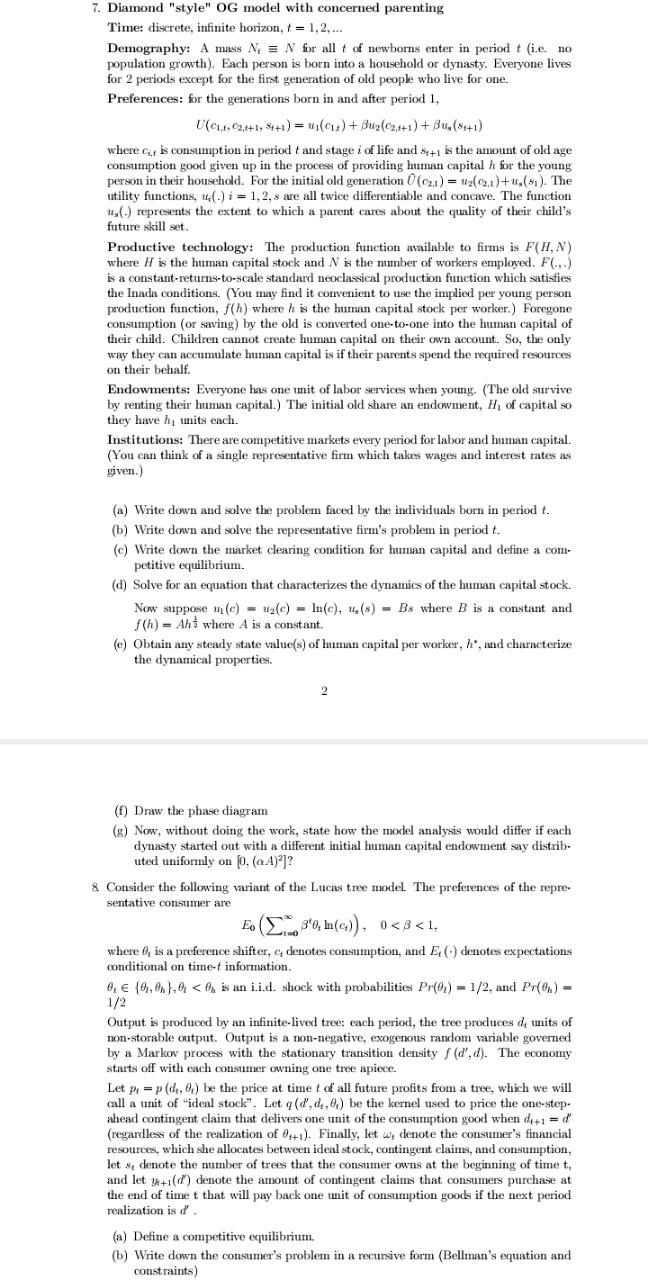
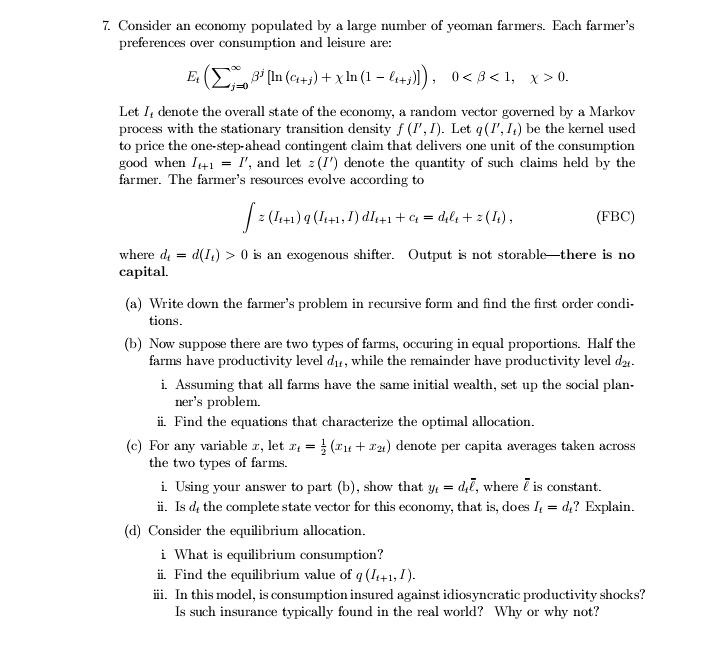
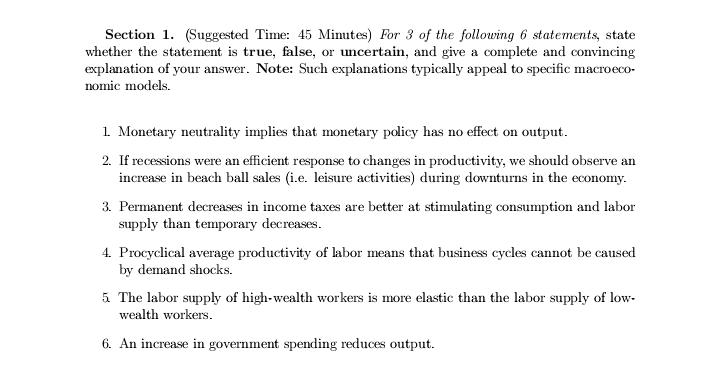
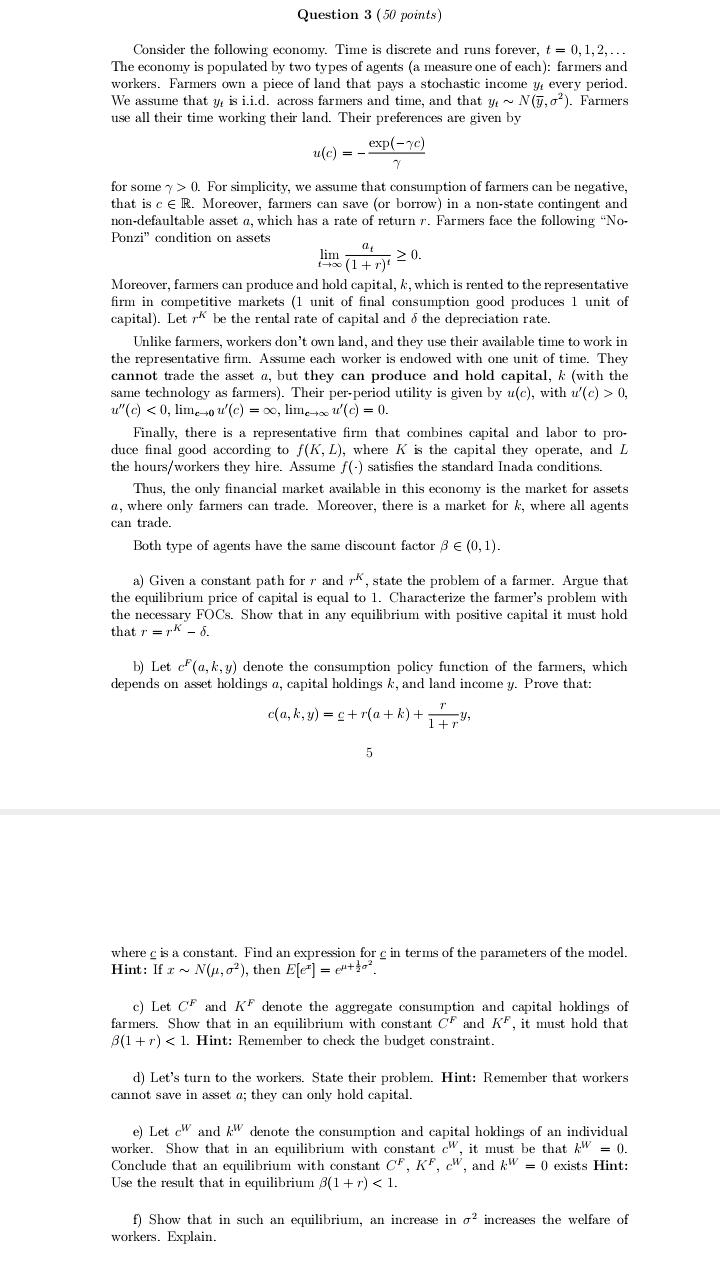
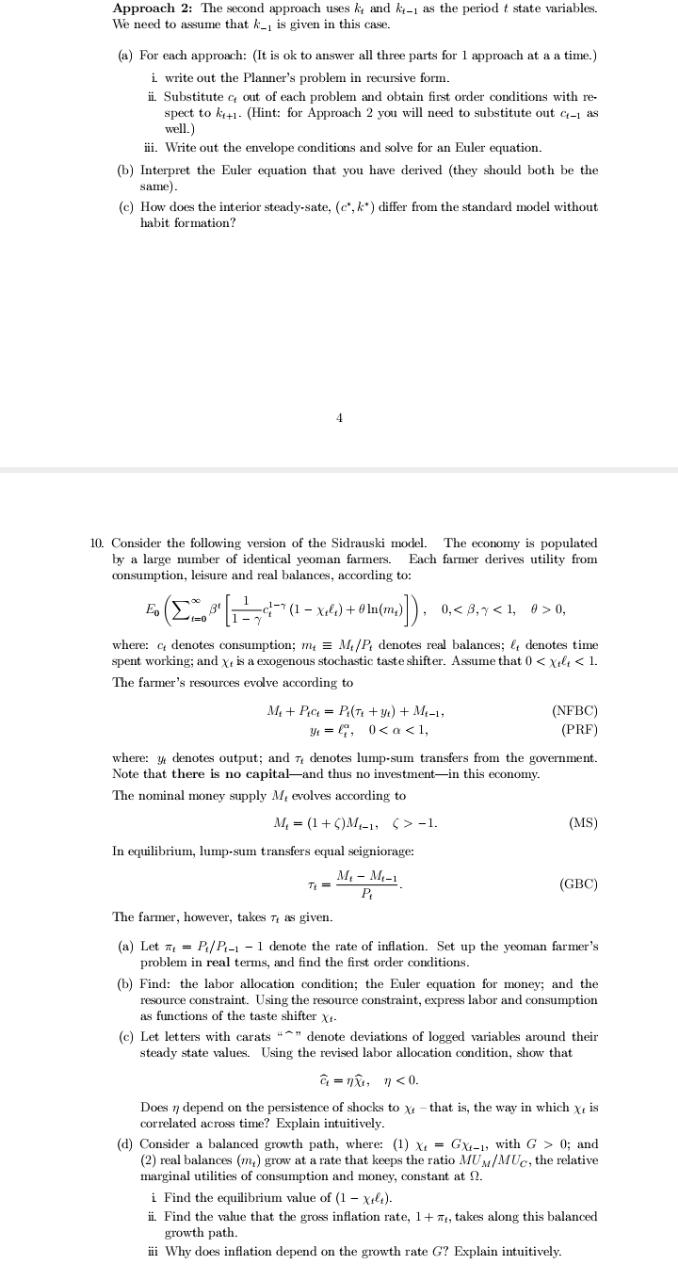
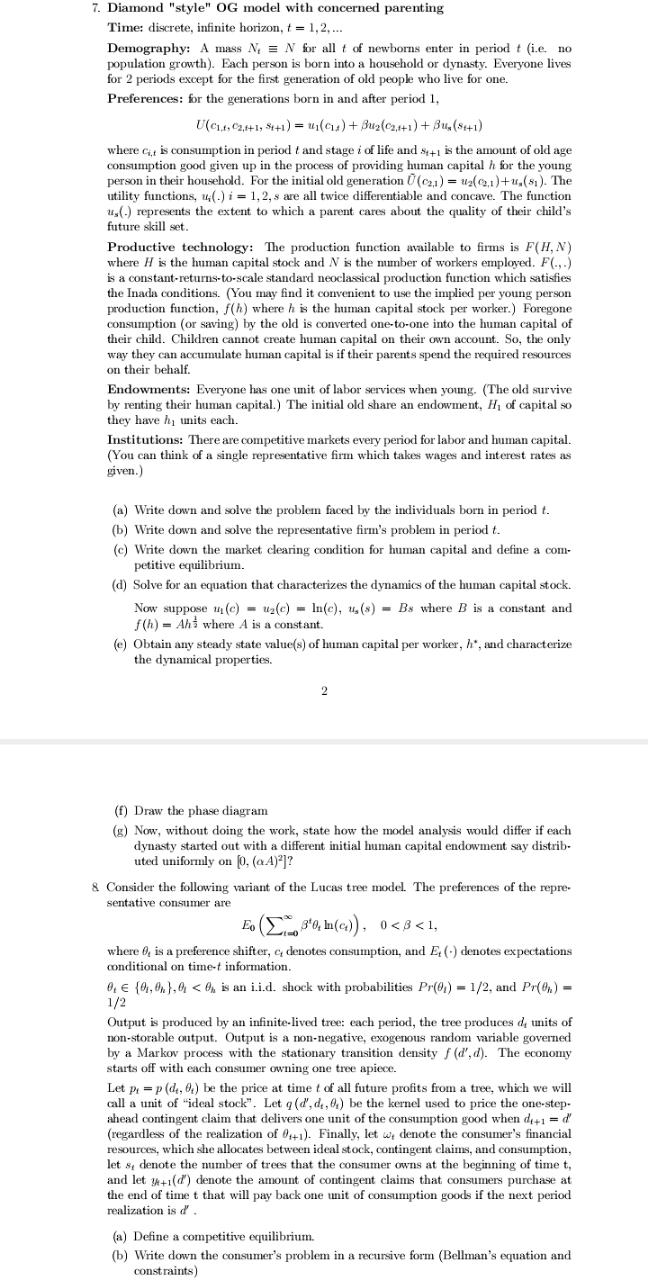
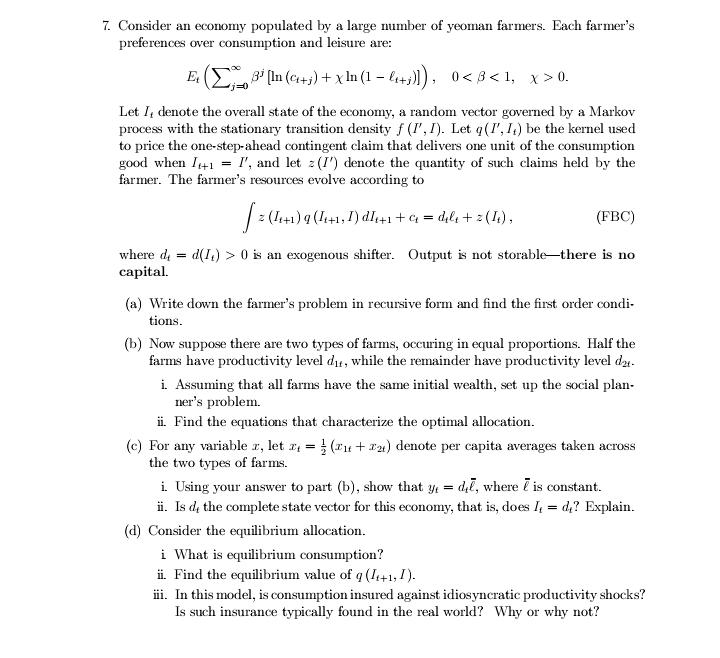
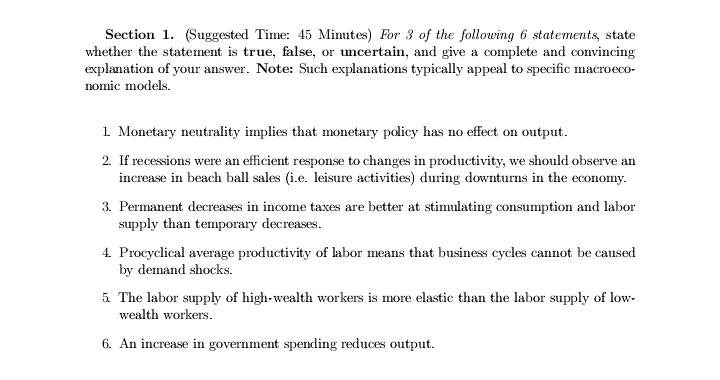
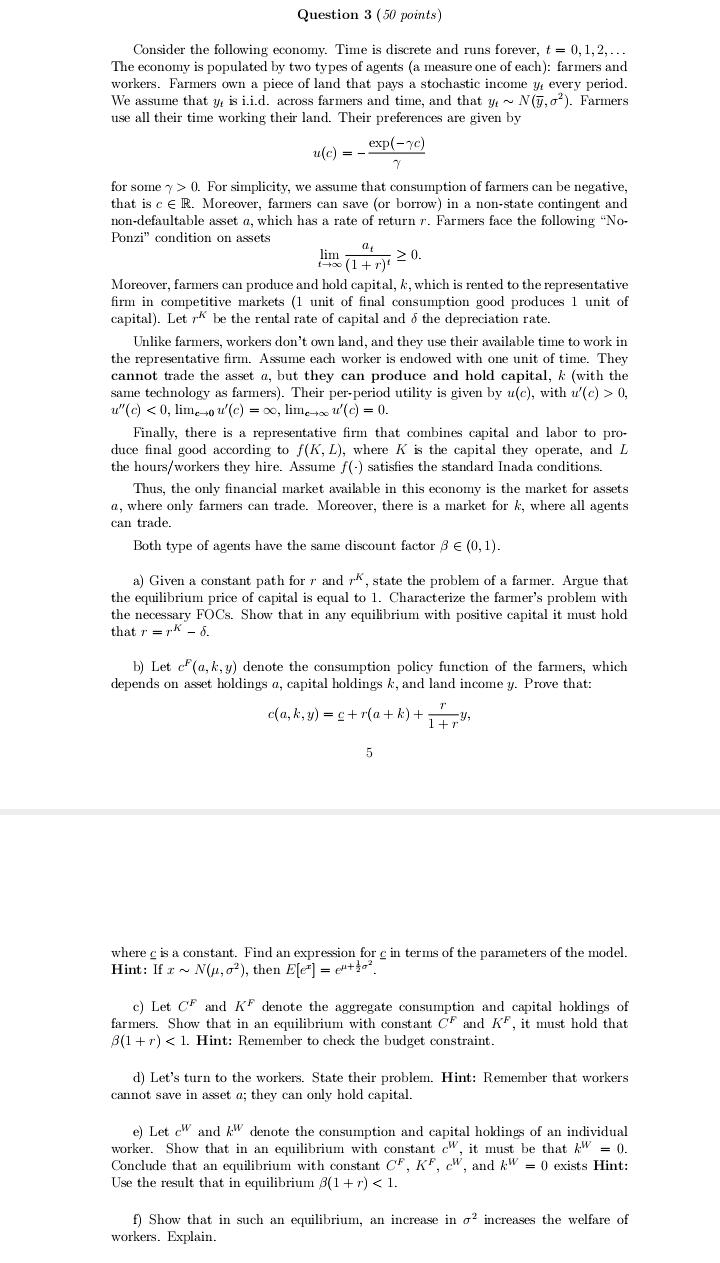
Approach 2: The second approach uses &, and ki- as the period t state variables. We need to assume that &_, is given in this case. (a) For each approach: (It is ok to answer all three parts for 1 approach at a a time.) i write out the Planner's problem in recursive form. ii Substitute c out of each problem and obtain first order conditions with re- spect to hit1- (Hint: for Approach 2 you will need to substitute out c-1 as well.) iii. Write out the envelope conditions and solve for an Euler equation. (b) Interpret the Euler equation that you have derived (they should both be the same). (c) How does the interior steady-sate, (c', k* ) differ from the standard model without habit formation? 10. Consider the following version of the Sidrauski model. The economy is populated by a large number of identical yeoman farmers. Each farmer derives utility from consumption, leisure and real balances, according to: 5. [ S' _"(1 - x () + 01(m.) ) , 0,0, where: of denotes consumption; m, = M,/P, denotes real balances; 4, denotes time spent working; and yr is a exogenous stochastic taste shifter. Assume that 0 -1. (MS) In equilibrium, lump-sum transfers equal seigniorage: M - M-1 (GBC) The farmer, however, takes 7, as given. (a) Let m = P/ Pi-1 - 1 denote the rate of inflation. Set up the yeoman farmer's problem in real terms, and find the first order conditions. (b) Find: the labor allocation condition; the Euler equation for money; and the resource constraint. Using the resource constraint, express labor and consumption as functions of the taste shifter X- (c) Let letters with carats "" denote deviations of logged variables around their steady state values. Using the revised labor allocation condition, show that a =nX, 1 0; and (2) real balances (m,) grow at a rate that keeps the ratio MUM/MUc, the relative marginal utilities of consumption and money, constant at 2. i Find the equilibrium value of (1 - xif;). ii Find the value that the gross inflation rate, 1 + me, takes along this balanced growth path. Hi Why does inflation depend on the growth rate G? Explain intuitively.7. Diamond "style" OG model with concerned parenting Time: discrete, infinite horizon, t = 1, 2, ... Demography: A mass N, = N for all t of newborns enter in period t (i.e. no population growth). Each person is born into a household or dynasty. Everyone lives for 2 periods except for the first generation of old people who live for one. Preferences: for the generations born in and after period 1, U(CIt, (2,#+1, $1+1) = UI(C) + Buz(cz,#+1) + Bu.(#+1) where car is consumption in period / and stage i of life and s,+1 is the amount of old age consumption good given up in the process of providing human capital h for the young person in their household. For the initial old generation (cz, ) = us(@,1 ) +u.(s,). The utility functions, u,(.) i = 1, 2, s are all twice differentiable and concave. The function u,(.) represents the extent to which a parent cares about the quality of their child's future skill set. Productive technology: The production function available to firms is F( H, N) where H is the human capital stock and / is the number of workers employed. F(.,.) is a constant-returns-to-scale standard neoclassical production function which satisfies the Inada conditions. (You may find it convenient to use the implied per young person production function, f(h) where h is the human capital stock per worker.) Foregone consumption (or saving) by the old is converted one-to-one into the human capital of their child. Children cannot create human capital on their own account. So, the only way they can accumulate human capital is if their parents spend the required resources on their behalf. Endowments: Everyone has one unit of labor services when young. (The old survive by renting their human capital.) The initial old share an endowment. H, of capital so they have h, units each. Institutions: There are competitive markets every period for labor and human capital. (You can think of a single representative firm which takes wages and interest rates as given.) (a) Write down and solve the problem faced by the individuals born in period t. (b) Write down and solve the representative firm's problem in period t. (c) Write down the market clearing condition for human capital and define a com- petitive equilibrium. (d) Solve for an equation that characterizes the dynamics of the human capital stock. Now suppose m (c) = u2(c) = In(c), u, (s) = Bs where B is a constant and f(h) = Ahi where A is a constant. (e) Obtain any steady state value(s) of human capital per worker, h', and characterize the dynamical properties. (f) Draw the phase diagram (g) Now, without doing the work, state how the model analysis would differ if each dynasty started out with a different initial human capital endowment say distrib uted uniformly on [0, (QA)?]? 8 Consider the following variant of the Lucas tree model. The preferences of the repre- sentative consumer are Eo (. '0, I(c.)) , 00. Let /, denote the overall state of the economy, a random vector governed by a Markov process with the stationary transition density f (/', D). Let q (/', /,) be the kernel used to price the one-step-ahead contingent claim that delivers one unit of the consumption good when /41 = I', and let = (') denote the quantity of such claims held by the farmer. The farmer's resources evolve according to (FBC) where do = d(1,) > 0 is an exogenous shifter. Output is not storable-there is no capital. (a) Write down the farmer's problem in recursive form and find the first order condi- tions. (b) Now suppose there are two types of farms, occuring in equal proportions. Half the farms have productivity level du, while the remainder have productivity level day. i. Assuming that all farms have the same initial wealth, set up the social plan- ner's problem. ii. Find the equations that characterize the optimal allocation. (c) For any variable z, let a = } (Tu + 24) denote per capita averages taken across the two types of farms. i. Using your answer to part (b), show that y, = dif, where / is constant. ii. Is de the complete state vector for this economy, that is, does I, = d,? Explain. (d) Consider the equilibrium allocation. i What is equilibrium consumption? ii. Find the equilibrium value of q (/4+1, /). iii. In this model, is consumption insured against idiosyncratic productivity shocks? Is such insurance typically found in the real world? Why or why not?Section 1. (Suggested Time: 45 Minutes) For 3 of the following 6 statements, state whether the statement is true, false, or uncertain, and give a complete and convincing explanation of your answer. Note: Such explanations typically appeal to specific macroeco- nomic models. 1. Monetary neutrality implies that monetary policy has no effect on output. 2. If recessions were an efficient response to changes in productivity, we should observe an increase in beach ball sales (i.e. leisure activities) during downturns in the economy. 3. Permanent decreases in income taxes are better at stimulating consumption and labor supply than temporary decreases. 4. Procyclical average productivity of labor means that business cycles cannot be caused by demand shocks. 5. The labor supply of high-wealth workers is more elastic than the labor supply of low- wealth workers. 6. An increase in government spending reduces output.Question 3 (50 points) Consider the following economy. Time is discrete and runs forever, t = 0, 1, 2,... The economy is populated by two types of agents (a measure one of each): farmers and workers. Farmers own a piece of land that pays a stochastic income y, every period. We assume that y, is i.i.d. across farmers and time, and that y, ~ N(y,o'). Farmers use all their time working their land. Their preferences are given by 1(c) = - exp(-7c) for some y > 0. For simplicity, we assume that consumption of farmers can be negative, that is c E R. Moreover, farmers can save (or borrow) in a non-state contingent and non-defaultable asset a, which has a rate of return r. Farmers face the following "No- Ponzi" condition on assets lim to (1+r)' - 20. Moreover, farmers can produce and hold capital, k, which is rented to the representative firm in competitive markets (1 unit of final consumption good produces 1 unit of capital). Let ," be the rental rate of capital and o the depreciation rate. Unlike farmers, workers don't own land, and they use their available time to work in the representative firm. Assume each worker is endowed with one unit of time. They cannot trade the asset a, but they can produce and hold capital, k (with the same technology as farmers). Their per-period utility is given by u(c), with a'(c) > 0, u"(c)
Step by Step Solution
There are 3 Steps involved in it

Get step-by-step solutions from verified subject matter experts
 Study Help