







Question: Microsoft Visiual Studio programming 1. Using the AddTwo program from Section 3.2 (textbook) as a reference, write a program that calculates the following expression, using
Microsoft Visiual Studio programming
1.
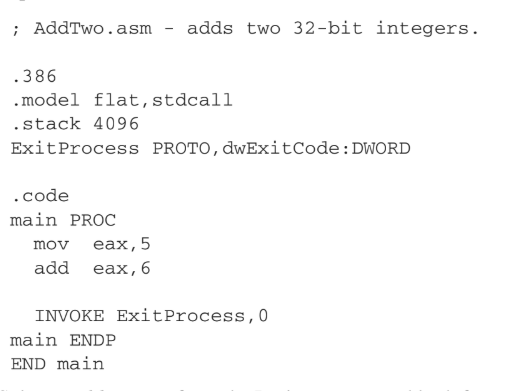
Using the AddTwo program from Section 3.2 (textbook) as a reference, write a program that calculates the following expression, using registers: varA = (varA + varB) (varC + varD), where varA, varB, etc., are variables. Assign integer values to the EAX, EBX, ECX, and EDX registers for the aforementioned variables. (Meaning, you may hardcode the inputs.) You do not need to print out the result. You may simply store the result in EAX. Debugging should reveal that the result is correctly stored in EAX. If you choose to display the result on screen, that is also fine (but again, not required).
2.
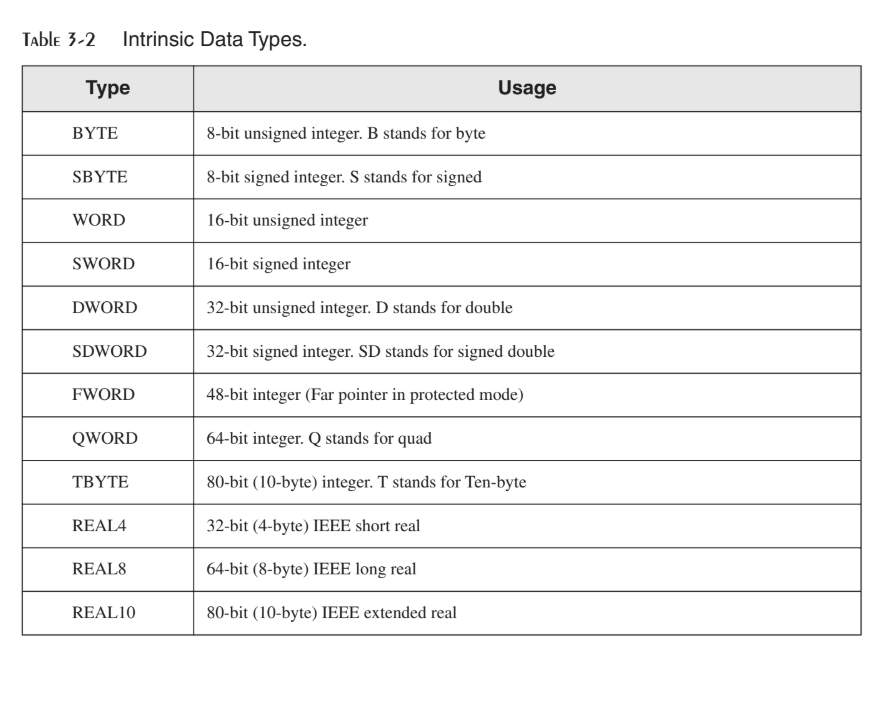
Write a program that contains a definition of each data type listed in Table 3-2 in Section 3.4 (textbook). Initialize each variable to a value that is consistent with its data type. Note that defining data is the main stress of this problem. It does not matter whether you have any operable instructions (e.g., add, sub, etc.) in your code. You may have some instructions to test your data, but those are not required.
AddTwo.asm adds two 32-bit integers 386 model flat,stdcall stack 4096 ExitProcess PROTO, dwExitCode : DWORD .code main PROC mov eax, 5 add eax,6 INVOKE ExitProcess, main ENDP END main
Step by Step Solution
There are 3 Steps involved in it

Get step-by-step solutions from verified subject matter experts
 Study Help