







Question: Mini Case, Chapter 13, Wanglaoji Tea Please review the mini case at the end of Chapter 13 titled Wanglaoji Tea in the text. You may
Mini Case, Chapter 13, Wanglaoji Tea
Please review the mini case at the end of Chapter 13 titled Wanglaoji Tea in the text. You may use the mini case questions at the end of the chapter to guide your solution to the case. Note that the answers to these questions are not solutions to the case; they are simply intended to guide your thought process. Please review the mini case solution below to assist you as you prepare your assignment.
Sample mini case solution
Formatting Guidelines (Single-spaced text, 12 point font, 1 margins all around. Case Analysis (not including any appendices and references) should not exceed 500 words (approximately 1.5 single-spaced pages). Use the Tools->Word Count option in MS -Word to count the number of words).
Each mini case solution must follow the following formatting guidelines: Three sections consisting of 1) Problem Identification 2) Quantitative Reasoning and Analysis 3) Recommendations
Problem Identification
Identify the major problems found in the case. Ensure that you distinguish between causes and symptoms. Causes may include changing customer preferences, increased competition, etc. Symptoms include declining revenues, loss of brand equity, increased customer churn, etc.
Please support your problem identification by relevant case facts along with the associated theory and concepts.
Quantitative Reasoning and Analysis
Conduct research to identify data (e.g., obtain data in the form of trends, statistics, ratings, etc. from the library and other sources) that can be utilized to provide additional insight into the case.
Draw appropriate conclusions based on the quantitative analysis of data, while recognizing the limits of this analysis.
Discussion and Recommendation
Identify and recommend a solution to the major problem in the case (there is likely to be more than one solution).
Briefly outline your solution and evaluate it in terms of its pros and cons.
Always ensure that your recommendations are supported by statistical evidence and provide spreadsheets as necessary.
Appendix and References
Please include any tables or figures that are not included but are referenced in your report.
Make sure all references are cited correctly.
Please ensure that your assignments are typed, proofread, and concise. Points will be deducted if
the length of the submission is excessive.
it does not conform to the formatting requirements
there are typos or grammatical errors
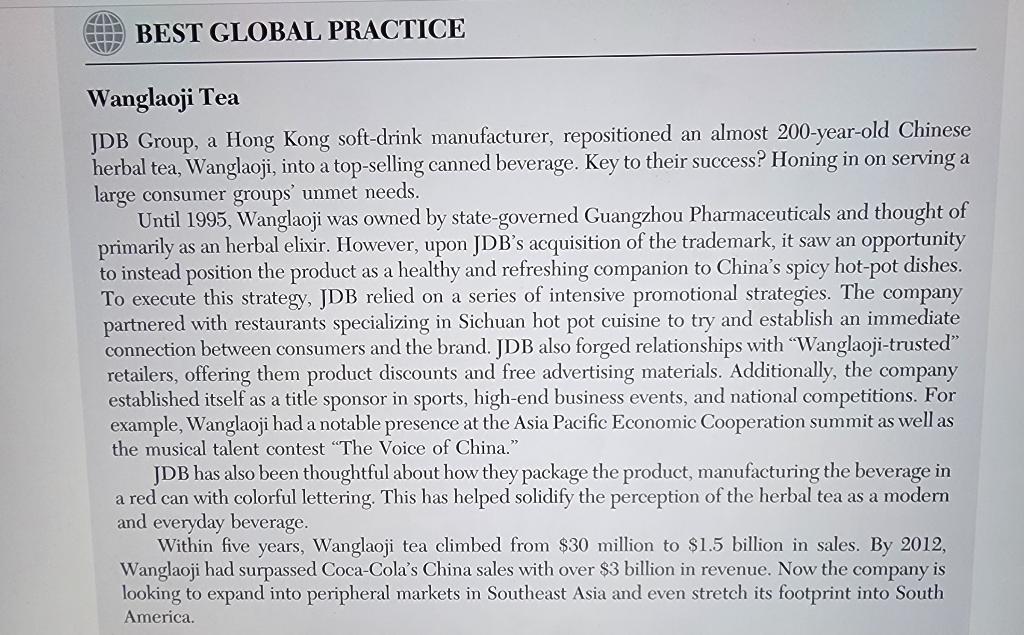
JDB Group, a Hong Kong soft-drink manufacturer, repositioned an almost 200-year-old Chinese herbal tea, Wanglaoji, into a top-selling canned beverage. Key to their success? Honing in on serving a large consumer groups' unmet needs. Until 1995, Wanglaoji was owned by state-governed Guangzhou Pharmaceuticals and thought of primarily as an herbal elixir. However, upon JDB's acquisition of the trademark, it saw an opportunity to instead position the product as a healthy and refreshing companion to China's spicy hot-pot dishes. To execute this strategy, JDB relied on a series of intensive promotional strategies. The company partnered with restaurants specializing in Sichuan hot pot cuisine to try and establish an immediate connection between consumers and the brand. JDB also forged relationships with "Wanglaoji-trusted" retailers, offering them product discounts and free advertising materials. Additionally, the company established itself as a title sponsor in sports, high-end business events, and national competitions. For example, Wanglaoji had a notable presence at the Asia Pacific Economic Cooperation summit as well as the musical talent contest "The Voice of China." JDB has also been thoughtful about how they package the product, manufacturing the beverage in a red can with colorful lettering. This has helped solidify the perception of the herbal tea as a modern and everyday beverage. Within five years, Wanglaoji tea climbed from $30 million to $1.5 billion in sales. By 2012 , Wanglaoji had surpassed Coca-Cola's China sales with over $3 billion in revenue. Now the company is looking to expand into peripheral markets in Southeast Asia and even stretch its footprint into South America
Step by Step Solution
There are 3 Steps involved in it

Get step-by-step solutions from verified subject matter experts
 Study Help