



Question: mini case D l ate Wang's taxes on these dividends. (.5 mark) Mini-Case D: (1.5 marks-.5 marks each) We are February 13, 2020. Gino is
mini case D
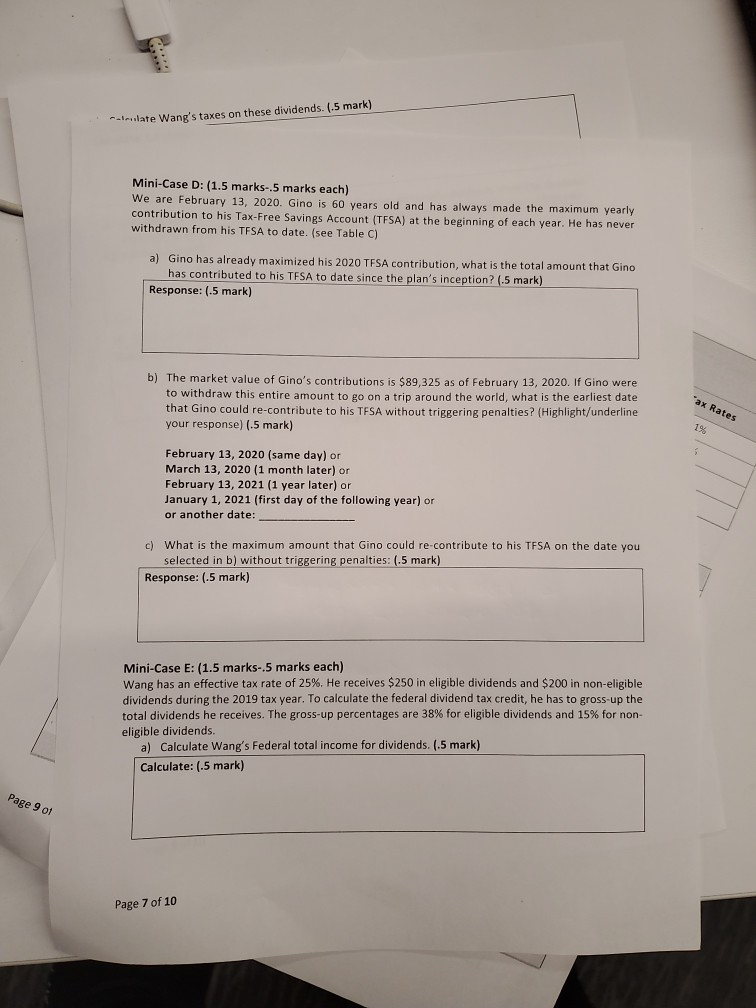
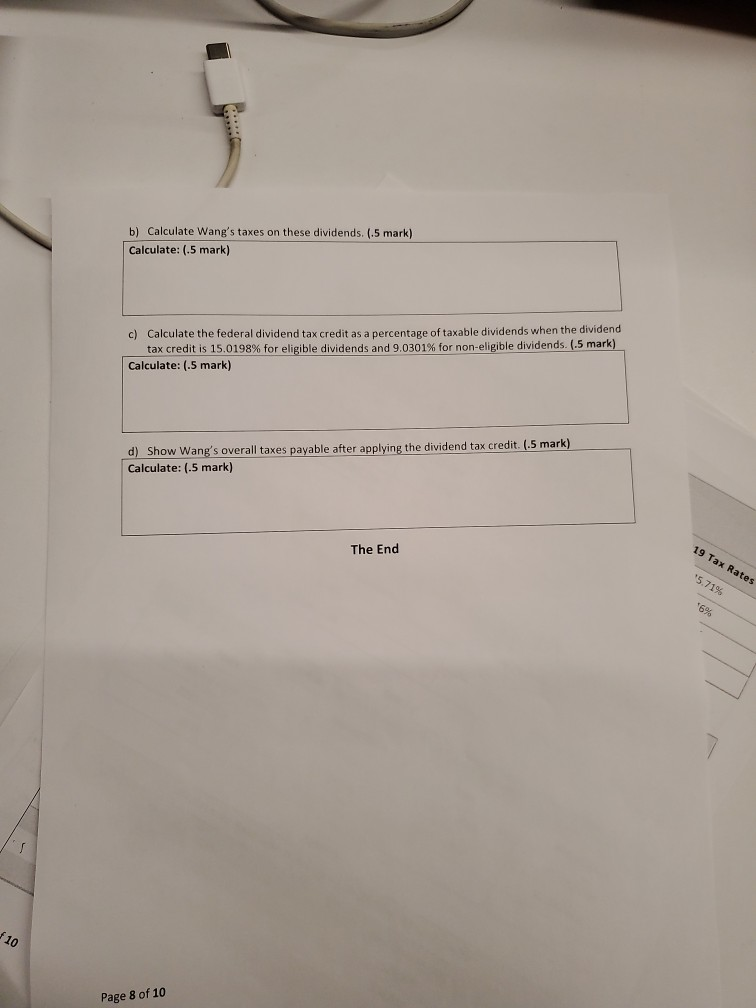
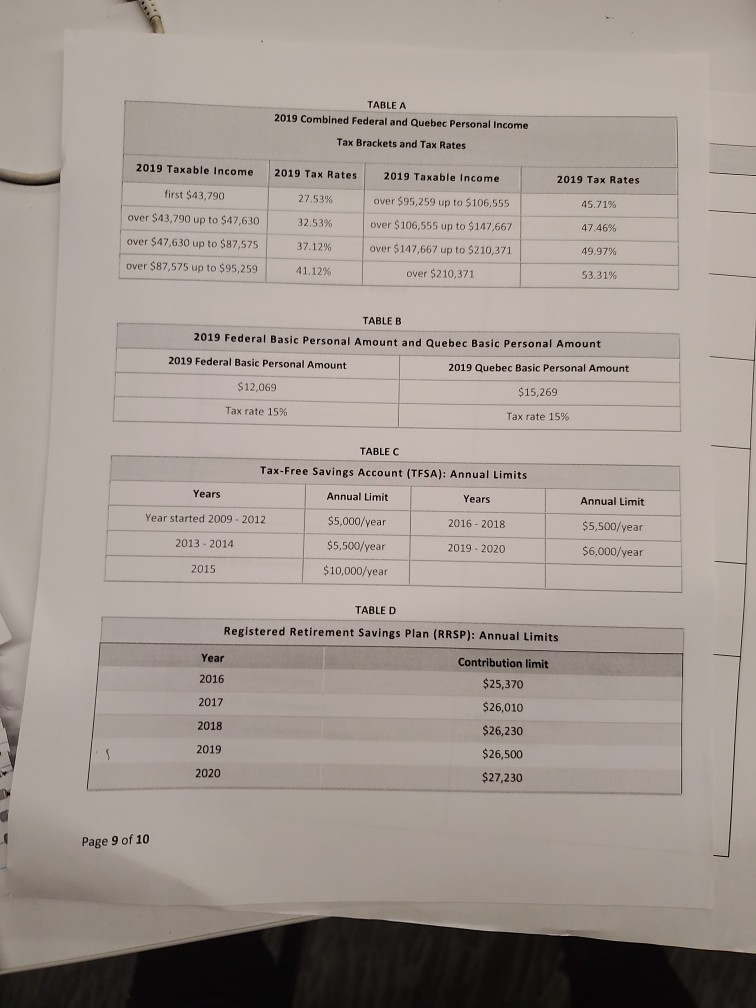
l ate Wang's taxes on these dividends. (.5 mark) Mini-Case D: (1.5 marks-.5 marks each) We are February 13, 2020. Gino is 60 years old and has always made the maximum yearly contribution to his Tax-Free Savings Account (TESA) at the beginning of each year. He has never withdrawn from his TFSA to date. (see Table C) a) Gino has already maximized his 2020 TFSA contribution, what is the total amount that Gino has contributed to his TFSA to date since the plan's inception? (.5 mark) Response: (.5 mark) b) The market value of Gino's contributions is $89,325 as of February 13, 2020. If Gino were to withdraw this entire amount to go on a trip around the world, what is the earliest date that Gino could re-contribute to his TESA without triggering penalties? (Highlight/underline your response) (-5 mark) Tax Rates February 13, 2020 (same day) or March 13, 2020 (1 month later) or February 13, 2021 (1 year later) or January 1, 2021 (first day of the following year) or or another date: c) What is the maximum amount that Gino could re-contribute to his TFSA on the date you selected in b) without triggering penalties: (.5 mark) Response: (.5 mark) Mini-Case E: (1.5 marks-.5 marks each) Wang has an effective tax rate of 25%. He receives $250 in eligible dividends and $200 in non-eligible dividends during the 2019 tax year. To calculate the federal dividend tax credit, he has to gross-up the total dividends he receives. The gross-up percentages are 38% for eligible dividends and 15% for non- eligible dividends. a) Calculate Wang's Federal total income for dividends. (.5 mark) Calculate: (-5 mark) Page 9 01 Page 7 of 10 b) Calculate Wang's taxes on these dividends. (.5 mark) Calculate:(.5 mark) c) Calculate the federal dividend tax credit as a percentage of taxable dividends when the dividend tax credit is 15.0198% for eligible dividends and 9.0301% for non-eligible dividends. (.5 mark) Calculate:(.5 mark) d) Show Wang's overall taxes payable after applying the dividend tax credit. (.5 mark) Calculate: (.5 mark) The End 19 Tax Rates *5.71% 6 . Page 8 of 10 TABLE A 2019 Combined Federal and Quebec Personal Income Tax Brackets and Tax Rates 2019 Taxable income 2019 Tax Rates 2019 Taxable income 2019 Tax Rates first $43,790 27.53% 45.71% over $43,790 up to $47,630 32.53% 47.46% over $95,259 up to $106,555 over $106,555 up to $147,667 over $147,667 up to $210,371 over $210,371 over $47,630 up to $87,575 37.12% 49.97% over $87,575 up to $95,259 41.12% 53.31% TABLE B 2019 Federal Basic Personal Amount and Quebec Basic Personal Amount 2019 Federal Basic Personal Amount 2019 Quebec Basic Personal Amount $12,069 $15,269 Tax rate 15% Tax rate 15% TABLE C Tax-Free Savings Account (TFSA): Annual Limits Years Annual Limit Years Annual Limit Year started 2009-2012 2016 - 2018 $5,500/year 2013 - 2014 $5,000/year $5,500/year $10,000/year 2019-2020 $6,000/year 2015 TABLED Registered Retirement Savings Plan (RRSP): Annual Limits Year 2016 2017 Contribution limit $25,370 $26,010 $26,230 2018 2019 $26,500 $27,230 2020 Page 9 of 10 l ate Wang's taxes on these dividends. (.5 mark) Mini-Case D: (1.5 marks-.5 marks each) We are February 13, 2020. Gino is 60 years old and has always made the maximum yearly contribution to his Tax-Free Savings Account (TESA) at the beginning of each year. He has never withdrawn from his TFSA to date. (see Table C) a) Gino has already maximized his 2020 TFSA contribution, what is the total amount that Gino has contributed to his TFSA to date since the plan's inception? (.5 mark) Response: (.5 mark) b) The market value of Gino's contributions is $89,325 as of February 13, 2020. If Gino were to withdraw this entire amount to go on a trip around the world, what is the earliest date that Gino could re-contribute to his TESA without triggering penalties? (Highlight/underline your response) (-5 mark) Tax Rates February 13, 2020 (same day) or March 13, 2020 (1 month later) or February 13, 2021 (1 year later) or January 1, 2021 (first day of the following year) or or another date: c) What is the maximum amount that Gino could re-contribute to his TFSA on the date you selected in b) without triggering penalties: (.5 mark) Response: (.5 mark) Mini-Case E: (1.5 marks-.5 marks each) Wang has an effective tax rate of 25%. He receives $250 in eligible dividends and $200 in non-eligible dividends during the 2019 tax year. To calculate the federal dividend tax credit, he has to gross-up the total dividends he receives. The gross-up percentages are 38% for eligible dividends and 15% for non- eligible dividends. a) Calculate Wang's Federal total income for dividends. (.5 mark) Calculate: (-5 mark) Page 9 01 Page 7 of 10 b) Calculate Wang's taxes on these dividends. (.5 mark) Calculate:(.5 mark) c) Calculate the federal dividend tax credit as a percentage of taxable dividends when the dividend tax credit is 15.0198% for eligible dividends and 9.0301% for non-eligible dividends. (.5 mark) Calculate:(.5 mark) d) Show Wang's overall taxes payable after applying the dividend tax credit. (.5 mark) Calculate: (.5 mark) The End 19 Tax Rates *5.71% 6 . Page 8 of 10 TABLE A 2019 Combined Federal and Quebec Personal Income Tax Brackets and Tax Rates 2019 Taxable income 2019 Tax Rates 2019 Taxable income 2019 Tax Rates first $43,790 27.53% 45.71% over $43,790 up to $47,630 32.53% 47.46% over $95,259 up to $106,555 over $106,555 up to $147,667 over $147,667 up to $210,371 over $210,371 over $47,630 up to $87,575 37.12% 49.97% over $87,575 up to $95,259 41.12% 53.31% TABLE B 2019 Federal Basic Personal Amount and Quebec Basic Personal Amount 2019 Federal Basic Personal Amount 2019 Quebec Basic Personal Amount $12,069 $15,269 Tax rate 15% Tax rate 15% TABLE C Tax-Free Savings Account (TFSA): Annual Limits Years Annual Limit Years Annual Limit Year started 2009-2012 2016 - 2018 $5,500/year 2013 - 2014 $5,000/year $5,500/year $10,000/year 2019-2020 $6,000/year 2015 TABLED Registered Retirement Savings Plan (RRSP): Annual Limits Year 2016 2017 Contribution limit $25,370 $26,010 $26,230 2018 2019 $26,500 $27,230 2020 Page 9 of 10
Step by Step Solution
There are 3 Steps involved in it

Get step-by-step solutions from verified subject matter experts