







Question: Mini Case Studies 24 Finance Why the rules are the rules 25 Mini Case Studies Finance: Why the rules are the rules $ Finance: Why
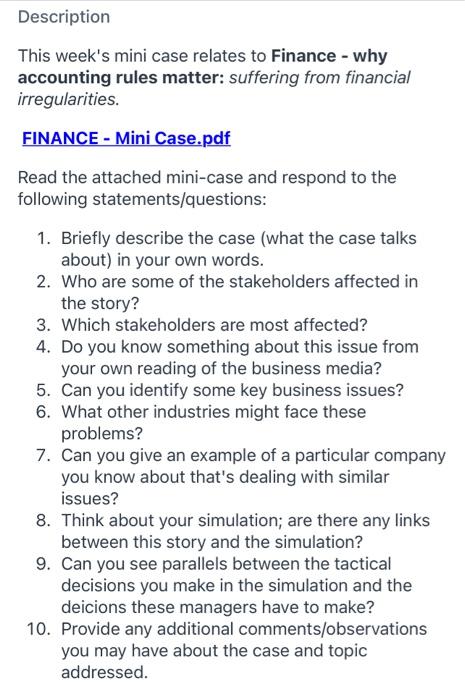
Mini Case Studies 24 Finance Why the rules are the rules 25 Mini Case Studies Finance: Why the rules are the rules $ Finance: Why the rules are the rules According to the Organic Trade Association, sales of organic food steadily growing since 2012. Americans spent $43.3 billion on organic products in 2015. One company riding that wave is Hains Celestial Group which sells organic food and personal care products through distributors to thousands of retailers. For the first half of 2016. Hains Celestial saw its share price increase 32%. Then, in August, it lost $1.3 billion from its market value overnight. after announcing profit targets would not be met for the fiscal year to June 30th and year-end results would be delayed. All because of accounting Is it the market, or the reporting? Some commentators speculated Hains problems may flag a softening in the market for consumer organics. Others said the loss of value was a temporary setback, making it a good time to buy Hains Celestial shares. Whatever the final fallout, a company growing strongly and selling some of the hottest products in the food industry hit a roadblock because of accounting anomalies -- and it is far from the first The problem stemmed from the timing of Hains' revenue reporting. When the company ships product to a distributor, it books the revenue. Distributors receive concessions that Hains applies according to a formula, rewarding them for high volumes sold in shorter periods. "Since Hain recognizes revenue before the goods are sold, it needs to make an estimate of how big those concessions will be," said Fortune Magazine. According to the Wall St Journal It is reviewing whether revenue associated with the concessions should continue to be reported when products are shipped to distributors or recorded when the distributors sell them to retailers." Perhaps more worrying is the company's admission that it needs to assess its internal controls over financial reporting." Some scope for flexibility Forbes pointed to another organic food company, Annie's, that faced similar problems due to accounting irregularities in 2014 but recovered quickly, and was bought by General Mills soon after While there is some scope for individual companies and industries to incorporate unique aspects of their businesses in their financial reporting, the rules of accounting - laid out in the Generally Accepted Accounting Principles (GAAP) - are very strict Clear rules means that stakeholders - including shareholders, potential buyers and even governments - can make consistent evaluations over time and between different companies "It is no longer sufficient merely to comply with accounting rules so that there is no technical breach; 26 Mini Case Studies Finance: Why the rules are the rules to restore confidence in the markets, investors also want companies to respect the spirit of the standards." Investors require valid information "Investors do not like to be misled by fraudulent or dishonest managers who are economical with the truth or bend it to their advantage," warns Jenny Rayner, in Managing Reputational Risk: Curbing Threats, Leveraging Opportunities (Wiley, September 11, 2003). It is no longer sufficient merely to comply with accounting rules so that there is no technical breach to restore confidence in the markets, investors also want companies to respect the spirit of the standards. After the accounting and audit scandals that bankrupted Enron and World Com in the early 2000's, new legislation in the U.S., the Sarbanes-Oxley Act, increased penalties for destroying. altering or fabricating records in federal investigations or for attempting to defraud shareholders. The act also increased the accountability of auditing firms to remain unbiased and independent of their clients. That makes it more difficult for fraud to go unpunished, but as Hains Celestial discovered (to its detriment) any accounting irregularities can have serious implications in the marketplace. Business issue: Getting familiar with financial reports Accounting statements "normalize financial information so companies that who are very different can be compared, and a single company's results from period to period can be tracked with consistency The financial reports are the scorecard for every business. They show what it owns and what it owes (the Balance Sheet); whether or not it's making a profit (Income Statement or Profit and Loss), and how cash moves through the business (Cash Flow Statement). Every businessperson needs to be comfortable reading the information in the statements. Accounting may just be a set of man-made rules, and at times they seem illogical, but they're critical because they allow for consistent evaluation Accounting is based on basic principles described as GAAP. It has some basic rules like Historical Cost and the Matching Principle. Historical Cost accounts for the value of a company's assets, requiring every asset be listed at its original price, then written off over time according to a fixed depreciation schedule. Depreciation is just a way of modeling the way assets get old and lose their value. It's not an accurate representation of what's happening in the real world. There are different approaches to depreciation and types of schedules, depending on local tax laws and other considerations. The Matching Principle, like Historical Cost, isn't an accurate reflection of what really happens but it helps standardize the company's financial reports. Under the Matching Principle, a business matches every revenue to the costs associated with generating it, at the same time. When you sell a product or service. you record the cost of the materials and labor required to 27 Mini Case Studies Finance Why the rules are the rules produce it. You may have bought the materials a long time before the sale, you've certainly already paid your workers, but you only report those inputs at the time you make the sale. Why? Because it's only by matching up what you earn from the service or product with what it cost you to offer it that allows you to figure out if you're making a profit. If the revenue you put in the books (in Hains' case for products shipped but not sold) is matched with all the costs for those product, but then the revenue doesn't actually come in because products are unsold, there's a real problem determining profit. And what's the only way a company can grow? By demonstrating that it can make a profit. Application in CapsimCore You can see the effect of the matching principle on your CapsimCore Income Statement When you sell products, the amount you paid for the materials and labor - even though your company paid those bills earlier - will turn up in the variable cost column on the income Statement. They are matched to the sales. When you buy additional capacity for your plant or add points to your automation rating. your investment in these assets will show up on the Balance Sheet under fixed assets as a positive number. That same amount will show up on the Cash Flow statement (as a negative number) under Cash from Investing because the cash went out of the business for the equipment As you make decisions through the rounds of the simulation you will get more and more familiar with analyzing how your decisions show up on the various financial statements. It will help you to get a feel for how the operational decisions in a business are modeled in the statements Don't worry, there's no risk of you going to jail for accounting fraud in your simulation-even if you try to cook the books your CapsimCore accounting department goes strictly by the rules. Description This week's mini case relates to Finance - why accounting rules matter: suffering from financial irregularities. FINANCE - Mini Case.pdf Read the attached mini-case and respond to the following statements/questions: 1. Briefly describe the case (what the case talks about) in your own words. 2. Who are some of the stakeholders affected in the story? 3. Which stakeholders are most affected? 4. Do you know something about this issue from your own reading of the business media? 5. Can you identify some key business issues? 6. What other industries might face these problems? 7. Can you give an example of a particular company you know about that's dealing with similar issues? 8. Think about your simulation; are there any links between this story and the simulation? 9. Can you see parallels between the tactical decisions you make in the simulation and the deicions these managers have to make? 10. Provide any additional comments/observations you may have about the case and topic addressed. Mini Case Studies 24 Finance Why the rules are the rules 25 Mini Case Studies Finance: Why the rules are the rules $ Finance: Why the rules are the rules According to the Organic Trade Association, sales of organic food steadily growing since 2012. Americans spent $43.3 billion on organic products in 2015. One company riding that wave is Hains Celestial Group which sells organic food and personal care products through distributors to thousands of retailers. For the first half of 2016. Hains Celestial saw its share price increase 32%. Then, in August, it lost $1.3 billion from its market value overnight. after announcing profit targets would not be met for the fiscal year to June 30th and year-end results would be delayed. All because of accounting Is it the market, or the reporting? Some commentators speculated Hains problems may flag a softening in the market for consumer organics. Others said the loss of value was a temporary setback, making it a good time to buy Hains Celestial shares. Whatever the final fallout, a company growing strongly and selling some of the hottest products in the food industry hit a roadblock because of accounting anomalies -- and it is far from the first The problem stemmed from the timing of Hains' revenue reporting. When the company ships product to a distributor, it books the revenue. Distributors receive concessions that Hains applies according to a formula, rewarding them for high volumes sold in shorter periods. "Since Hain recognizes revenue before the goods are sold, it needs to make an estimate of how big those concessions will be," said Fortune Magazine. According to the Wall St Journal It is reviewing whether revenue associated with the concessions should continue to be reported when products are shipped to distributors or recorded when the distributors sell them to retailers." Perhaps more worrying is the company's admission that it needs to assess its internal controls over financial reporting." Some scope for flexibility Forbes pointed to another organic food company, Annie's, that faced similar problems due to accounting irregularities in 2014 but recovered quickly, and was bought by General Mills soon after While there is some scope for individual companies and industries to incorporate unique aspects of their businesses in their financial reporting, the rules of accounting - laid out in the Generally Accepted Accounting Principles (GAAP) - are very strict Clear rules means that stakeholders - including shareholders, potential buyers and even governments - can make consistent evaluations over time and between different companies "It is no longer sufficient merely to comply with accounting rules so that there is no technical breach; 26 Mini Case Studies Finance: Why the rules are the rules to restore confidence in the markets, investors also want companies to respect the spirit of the standards." Investors require valid information "Investors do not like to be misled by fraudulent or dishonest managers who are economical with the truth or bend it to their advantage," warns Jenny Rayner, in Managing Reputational Risk: Curbing Threats, Leveraging Opportunities (Wiley, September 11, 2003). It is no longer sufficient merely to comply with accounting rules so that there is no technical breach to restore confidence in the markets, investors also want companies to respect the spirit of the standards. After the accounting and audit scandals that bankrupted Enron and World Com in the early 2000's, new legislation in the U.S., the Sarbanes-Oxley Act, increased penalties for destroying. altering or fabricating records in federal investigations or for attempting to defraud shareholders. The act also increased the accountability of auditing firms to remain unbiased and independent of their clients. That makes it more difficult for fraud to go unpunished, but as Hains Celestial discovered (to its detriment) any accounting irregularities can have serious implications in the marketplace. Business issue: Getting familiar with financial reports Accounting statements "normalize financial information so companies that who are very different can be compared, and a single company's results from period to period can be tracked with consistency The financial reports are the scorecard for every business. They show what it owns and what it owes (the Balance Sheet); whether or not it's making a profit (Income Statement or Profit and Loss), and how cash moves through the business (Cash Flow Statement). Every businessperson needs to be comfortable reading the information in the statements. Accounting may just be a set of man-made rules, and at times they seem illogical, but they're critical because they allow for consistent evaluation Accounting is based on basic principles described as GAAP. It has some basic rules like Historical Cost and the Matching Principle. Historical Cost accounts for the value of a company's assets, requiring every asset be listed at its original price, then written off over time according to a fixed depreciation schedule. Depreciation is just a way of modeling the way assets get old and lose their value. It's not an accurate representation of what's happening in the real world. There are different approaches to depreciation and types of schedules, depending on local tax laws and other considerations. The Matching Principle, like Historical Cost, isn't an accurate reflection of what really happens but it helps standardize the company's financial reports. Under the Matching Principle, a business matches every revenue to the costs associated with generating it, at the same time. When you sell a product or service. you record the cost of the materials and labor required to 27 Mini Case Studies Finance Why the rules are the rules produce it. You may have bought the materials a long time before the sale, you've certainly already paid your workers, but you only report those inputs at the time you make the sale. Why? Because it's only by matching up what you earn from the service or product with what it cost you to offer it that allows you to figure out if you're making a profit. If the revenue you put in the books (in Hains' case for products shipped but not sold) is matched with all the costs for those product, but then the revenue doesn't actually come in because products are unsold, there's a real problem determining profit. And what's the only way a company can grow? By demonstrating that it can make a profit. Application in CapsimCore You can see the effect of the matching principle on your CapsimCore Income Statement When you sell products, the amount you paid for the materials and labor - even though your company paid those bills earlier - will turn up in the variable cost column on the income Statement. They are matched to the sales. When you buy additional capacity for your plant or add points to your automation rating. your investment in these assets will show up on the Balance Sheet under fixed assets as a positive number. That same amount will show up on the Cash Flow statement (as a negative number) under Cash from Investing because the cash went out of the business for the equipment As you make decisions through the rounds of the simulation you will get more and more familiar with analyzing how your decisions show up on the various financial statements. It will help you to get a feel for how the operational decisions in a business are modeled in the statements Don't worry, there's no risk of you going to jail for accounting fraud in your simulation-even if you try to cook the books your CapsimCore accounting department goes strictly by the rules. Description This week's mini case relates to Finance - why accounting rules matter: suffering from financial irregularities. FINANCE - Mini Case.pdf Read the attached mini-case and respond to the following statements/questions: 1. Briefly describe the case (what the case talks about) in your own words. 2. Who are some of the stakeholders affected in the story? 3. Which stakeholders are most affected? 4. Do you know something about this issue from your own reading of the business media? 5. Can you identify some key business issues? 6. What other industries might face these problems? 7. Can you give an example of a particular company you know about that's dealing with similar issues? 8. Think about your simulation; are there any links between this story and the simulation? 9. Can you see parallels between the tactical decisions you make in the simulation and the deicions these managers have to make? 10. Provide any additional comments/observations you may have about the case and topic addressed
Step by Step Solution
There are 3 Steps involved in it

Get step-by-step solutions from verified subject matter experts
 Study Help