







Question: Mini Case: Using Conjoint Experiments to Tailor New Product Offerings Many products that marketers sell can be thought of as a bundle of features.
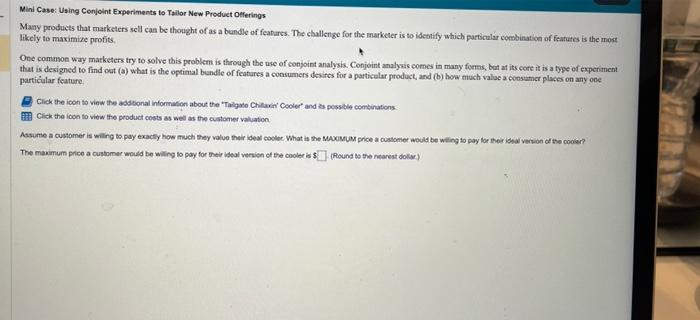
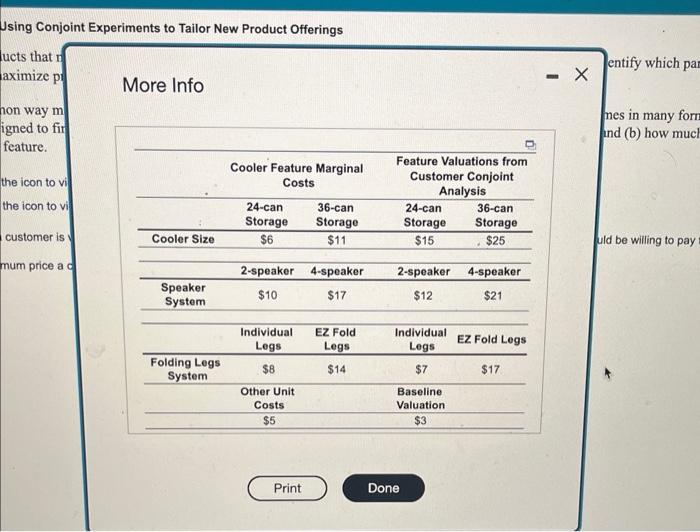
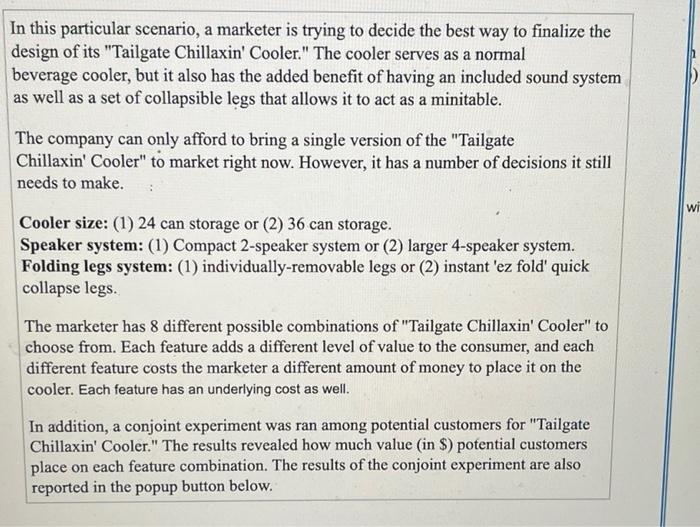
Mini Case: Using Conjoint Experiments to Tailor New Product Offerings Many products that marketers sell can be thought of as a bundle of features. The challenge for the marketer is to identify which particular combination of features is the most likely to maximize profits. One common way marketers try to solve this problem is through the use of conjoint analysis. Conjoint analysis comes in many forms, but at its core it is a type of experiment that is designed to find out (a) what is the optimal bundle of features a consumers desires for a particular product, and (b) how much value a consumer places on any one particular feature. Click the icon to view the additional information about the "Tailgate Chillaxin' Cooler" and its possible combinations. Click the icon to view the product costs as well as the customer valuation Assume a customer is willing to pay exactly how much they value their ideal cooler. What is the MAXIMUM price a customer would be willing to pay t The maximum price a customer would be willing to pay for their ideal version of the cooler is $ (Round to the nearest dollar.) I version of the cooler? Using Conjoint Experiments to Tailor New Product Offerings ucts that n aximize p non way m igned to fir feature. More Info Feature Valuations from Customer Conjoint Analysis - X entify which pam mes in many form and (b) how much the icon to vi Cooler Feature Marginal Costs the icon to vi 24-can 36-can 24-can 36-can Storage Storage Storage Storage customer is Cooler Size $6 $11 $15 $25 uld be willing to pay mum price a c 2-speaker 4-speaker 2-speaker 4-speaker Speaker System $10 $17 $12 $21 Individual Legs EZ Fold Legs Individual Legs EZ Fold Legs Folding Legs System $8 $14 $7 $17 Other Unit Costs $5 Baseline Valuation $3 Print Done In this particular scenario, a marketer is trying to decide the best way to finalize the design of its "Tailgate Chillaxin' Cooler." The cooler serves as a normal beverage cooler, but it also has the added benefit of having an included sound system as well as a set of collapsible legs that allows it to act as a minitable. The company can only afford to bring a single version of the "Tailgate Chillaxin' Cooler" to market right now. However, it has a number of decisions it still needs to make. Cooler size: (1) 24 can storage or (2) 36 can storage. Speaker system: (1) Compact 2-speaker system or (2) larger 4-speaker system. Folding legs system: (1) individually-removable legs or (2) instant 'ez fold' quick collapse legs. The marketer has 8 different possible combinations of "Tailgate Chillaxin' Cooler" to choose from. Each feature adds a different level of value to the consumer, and each different feature costs the marketer a different amount of money to place it on the cooler. Each feature has an underlying cost as well. In addition, a conjoint experiment was ran among potential customers for "Tailgate Chillaxin' Cooler." The results revealed how much value (in $) potential customers place on each feature combination. The results of the conjoint experiment are also reported in the popup button below. wi Mini Case: Using Conjoint Experiments to Tailor New Product Offerings Many products that marketers sell can be thought of as a bundle of features. The challenge for the marketer is to identify which particular combination of features is the most likely to maximize profits. One common way marketers try to solve this problem is through the use of conjoint analysis. Conjoint analysis comes in many forms, but at its core it is a type of experiment that is designed to find out (a) what is the optimal bundle of features a consumers desires for a particular product, and (b) how much value a consumer places on any one particular feature. Click the icon to view the additional information about the "Tailgate Chillaxin' Cooler" and its possible combinations Click the icon to view the product costs as well as the customer valuation. Assume a customer is willing to pay exactly how much they value their ideal cooler. What is the MAXIMUM price a customer would be willing to pay for their ideal version of the cooler? The maximum price a customer would be willing to pay for their ideal version of the cooler is $(Round to the nearest dollar)
Step by Step Solution
There are 3 Steps involved in it

Get step-by-step solutions from verified subject matter experts
 Study Help