



Question: Minimizing Carbon Emissions in a Global Electronics Supply Chain The World Economic Forum ( WEF ) issued a 2 0 2 1 report entitled Net
Minimizing Carbon Emissions in a Global Electronics Supply Chain
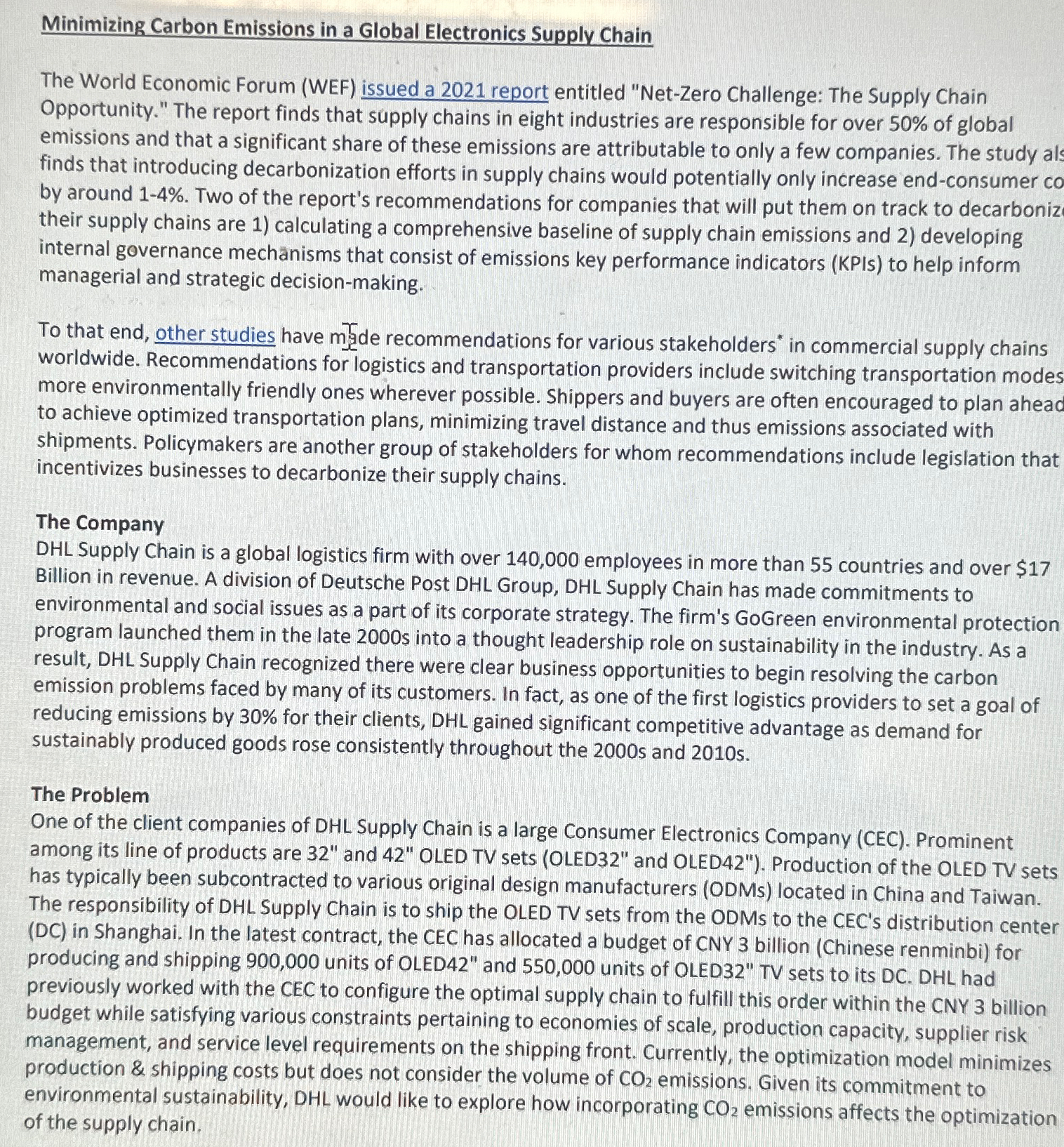
The World Economic Forum WEF issued a report entitled "NetZero Challenge: The Supply Chain Opportunity." The report finds that supply chains in eight industries are responsible for over of global emissions and that a significant share of these emissions are attributable to only a few companies. The study als finds that introducing decarbonization efforts in supply chains would potentially only increase endconsumer co by around Two of the report's recommendations for companies that will put them on track to decarboniz their supply chains are calculating a comprehensive baseline of supply chain emissions and developing internal governance mechnisms that consist of emissions key performance indicators KPIs to help inform managerial and strategic decisionmaking. worldwide. Recommendations for logistics and transportation providers include switching transportation modes more environmentally friendly ones wherever possible. Shippers and buyers are often encouraged to plan aheac to achieve optimized transportation plans, minimizing travel distance and thus emissions associated with shipments. Policymakers are another group of stakeholders for whom recommendations include legislation that incentivizes businesses to decarbonize their supply chains.
The Company
DHL Supply Chain is a global logistics firm with over employees in more than countries and over $ Billion in revenue. A division of Deutsche Post DHL Group, DHL Supply Chain has made commitments to environmental and social issues as a part of its corporate strategy. The firm's GoGreen environmental protection program launched them in the late s into a thought leadership role on sustainability in the industry. As a result, DHL Supply Chain recognized there were clear business opportunities to begin resolving the carbon emission problems faced by many of its customers. In fact, as one of the first logistics providers to set a goal of reducing emissions by for their clients, DHL gained significant competitive advantage as demand for sustainably produced goods rose consistently throughout the s and s
The Problem
One of the client companies of DHL Supply Chain is a large Consumer Electronics Company CEC Prominent among its line of products are and OLED TV sets OLED and OLED Production of the OLED TV sets has typically been subcontracted to various original design manufacturers ODMs located in China and Taiwan. The responsibility of DHL Supply Chain is to ship the OLED TV sets from the ODMs to the CEC's distribution center DC in Shanghai. In the latest contract, the CEC has allocated a budget of CNY billion Chinese renminbi for producing and shipping units of OLED and units of OLED TV sets to its DC DHL had previously worked with the CEC to configure the optimal supply chain to fulfill this order within the CNY billion budget while satisfying various constraints pertaining to economies of scale, production capacity, supplier risk management, and service level requirements on the shipping front. Currently, the optimization model minimizes production & shipping costs but does not consider the volume of emissions. Given its commitment to environmental sustainability, DHL would like to explore how incorporating emissions affects the optimization of the supply chain.
Step by Step Solution
There are 3 Steps involved in it
1 Expert Approved Answer
Step: 1 Unlock

Question Has Been Solved by an Expert!
Get step-by-step solutions from verified subject matter experts
Step: 2 Unlock
Step: 3 Unlock