







Question: minimum 250 words What Would You Do? Case Assignment SAS Cary, North Carolina SAS (pronounced sass), which is short for Statistical Analysis System, began when
minimum 250 words 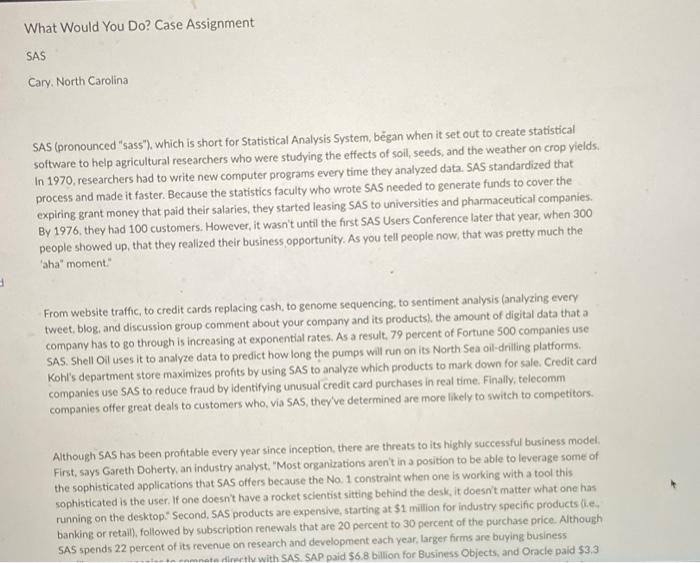
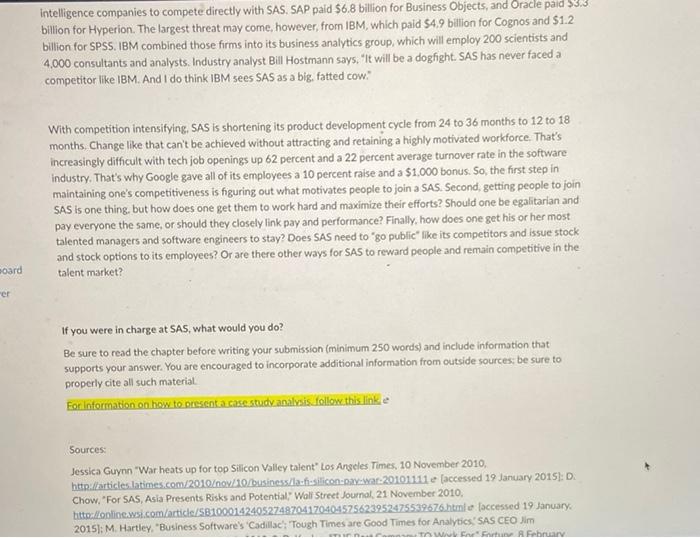
What Would You Do? Case Assignment SAS Cary, North Carolina SAS (pronounced "sass"), which is short for Statistical Analysis System, began when it set out to create statistical software to help agricultural researchers who were studying the effects of soil, seeds, and the weather on crop yields. In 1970, researchers had to write new computer programs every time they analyzed data. SAS standardized that process and made it faster. Because the statistics faculty who wrote SAS needed to generate funds to cover the expiring grant money that paid their salaries, they started leasing SAS to universities and pharmaceutical companies. By 1976, they had 100 customers. However, it wasn't until the first SAS Users Conference later that year, when 300 people showed up, that they realized their business opportunity. As you tell people now, that was pretty much the ahal moment." From website traffic, to credit cards replacing cash to genome sequencing, to sentiment analysis (analyzing every tweet blog, and discussion group comment about your company and its products), the amount of digital data that a company has to go through is increasing at exponential rates. As a result 79 percent of Fortune 500 companies use SAS Shell oil uses it to analyze data to predict how long the pumps will run on its North Sea oil-drilling platforms Kohl's department store maximizes profits by using SAS to analyze which products to mark down for sale. Credit card companies use SAS to reduce fraud by identifying unusual credit card purchases in real time. Finally, telecomm companies offer great deals to customers who, via SAS, they ve determined are more likely to switch to competitors. Although SAS has been profitable every year since inception, there are threats to its highly successful business model, First, says Gareth Doherty, an industry analyst. "Most organizations aren't in a position to be able to leverage some of the sophisticated applications that SAS offers because the No. 1 constraint when one is working with a tool this sophisticated is the user. If one doesn't have a rocket scientist sitting behind the desk, it doesn't matter what one has running on the desktop. Second, SAS products are expensive, starting at $1 million for industry specific products (ie banking or retail), followed by subscription renewals that are 20 percent to 30 percent of the purchase price. Although SAS spends 22 percent of its revenue on research and development each year larger firms are buying business mnata dal with SAS, SAP paid $6.8 billion for Business Objects, and Oracle paid $3.3 intelligence companies to compete directly with SAS, SAP paid $6.8 billion for Business Objects, and Oracle paid $3.3 billion for Hyperion. The largest threat may come, however, from IBM, which paid $4.9 billion for Cognos and $1.2 billion for SPSS. IBM combined those firms into its business analytics group, which will employ 200 scientists and 4,000 consultants and analysts. Industry analyst Bill Hostmann says. "It will be a dogfight. SAS has never faced a competitor like IBM. And I do think IBM sees SAS as a big fatted cow." With competition intensifying, SAS is shortening its product development cycle from 24 to 36 months to 12 to 18 months. Change like that can't be achieved without attracting and retaining a highly motivated workforce. That's increasingly difficult with tech job openings up 62 percent and a 22 percent average turnover rate in the software industry. That's why Google gave all of its employees a 10 percent raise and a $1.000 bonus. So, the first step in maintaining one's competitiveness is figuring out what motivates people to join a SAS. Second, getting people to join SAS is one thing, but how does one get them to work hard and maximize their efforts? Should one be egalitarian and pay everyone the same, or should they closely link pay and performance? Finally, how does one get his or her most talented managers and software engineers to stay? Does SAS need to "go public" like its competitors and issue stock and stock options to its employees? Or are there other ways for SAS to reward people and remain competitive in the talent market? Board -er If you were in charge at SAS, what would you do? Be sure to read the chapter before writing your submission (minimum 250 words) and include information that supports your answer. You are encouraged to incorporate additional information from outside sources, be sure to properly cite all such material For Information on how to presenta case study analysis follow this linke Sources: Jessica Guynn "War heats up for top Silicon Valley talent Los Angeles Times, 10 November 2010 http://articles latimes.com/2010ov/10/business/lahsilicon-Day-War: 20101111e (accessed 19 January 2015): D. Chow, "For SAS, Asia Presents Risks and Potential Wall Street Journal 21 November 2010 http://onlinews.com/article/S010001424052748704170404575623952475539576.htme (accessed 19 January 2015): M. Hartley, "Business Software's 'Cadillac Tough Times are Good Times for Analytics SAS CEO im TOMAS A February Step by Step Solution
There are 3 Steps involved in it
1 Expert Approved Answer
Step: 1 Unlock

Question Has Been Solved by an Expert!
Get step-by-step solutions from verified subject matter experts
Step: 2 Unlock
Step: 3 Unlock
 Study Help