







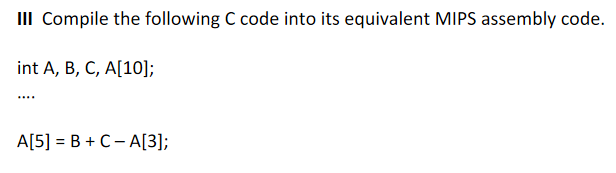
Question: MIPS Instruction =>> Example of C code into MIPS III Compile the following C code into its equivalent MIPS assembly code. intA,B,C,A[10]A[5]=B+CA[3] Elaboration: Some recursive
MIPS Instruction =>>
![the following C code into its equivalent MIPS assembly code. intA,B,C,A[10]A[5]=B+CA[3] Elaboration:](https://dsd5zvtm8ll6.cloudfront.net/si.experts.images/questions/2024/09/66efa5131ff74_39466efa51296188.jpg)
Example of C code into MIPS
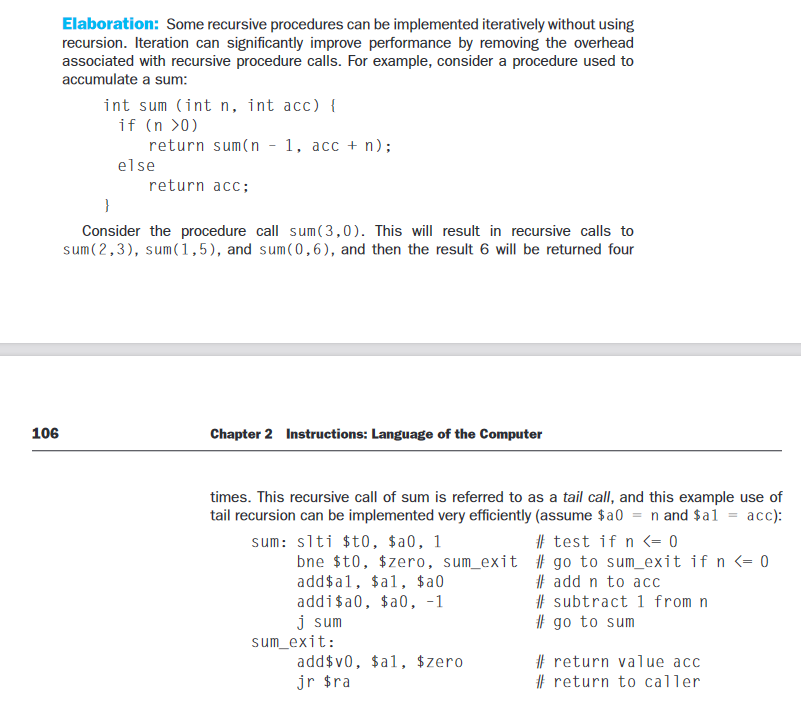
III Compile the following C code into its equivalent MIPS assembly code. intA,B,C,A[10]A[5]=B+CA[3] Elaboration: Some recursive procedures can be implemented iteratively without using recursion. Iteration can significantly improve performance by removing the overhead associated with recursive procedure calls. For example, consider a procedure used to accumulate a sum: int sum ( int n, int acc ){ if (n>0) return sum(n1,acc+n); else return acc Consider the procedure call sum (3,0). This will result in recursive calls to sum (2,3), sum(1,5), and sum (0,6), and then the result 6 will be returned four Chapter 2 Instructions: Language of the Computer times. This recursive call of sum is referred to as a tail call, and this example use of tail recursion can be implemented very efficiently (assume $a0=n and $a1=acc ): \( \begin{array}{ll}\text { sum: slti } \$ \text { t0, } \$ a 0,1 & \text { \# test if } n III Compile the following C code into its equivalent MIPS assembly code. intA,B,C,A[10]A[5]=B+CA[3] Elaboration: Some recursive procedures can be implemented iteratively without using recursion. Iteration can significantly improve performance by removing the overhead associated with recursive procedure calls. For example, consider a procedure used to accumulate a sum: int sum ( int n, int acc ){ if (n>0) return sum(n1,acc+n); else return acc Consider the procedure call sum (3,0). This will result in recursive calls to sum (2,3), sum(1,5), and sum (0,6), and then the result 6 will be returned four Chapter 2 Instructions: Language of the Computer times. This recursive call of sum is referred to as a tail call, and this example use of tail recursion can be implemented very efficiently (assume $a0=n and $a1=acc ): \( \begin{array}{ll}\text { sum: slti } \$ \text { t0, } \$ a 0,1 & \text { \# test if } n
Step by Step Solution
There are 3 Steps involved in it

Get step-by-step solutions from verified subject matter experts
 Study Help