Question: MKB2705: Research Methods and Analysis Workshop 5 & Mini-task #4: Questionnaire and Form Design; Sampling Procedures The topic for this workshop discussion is to develop
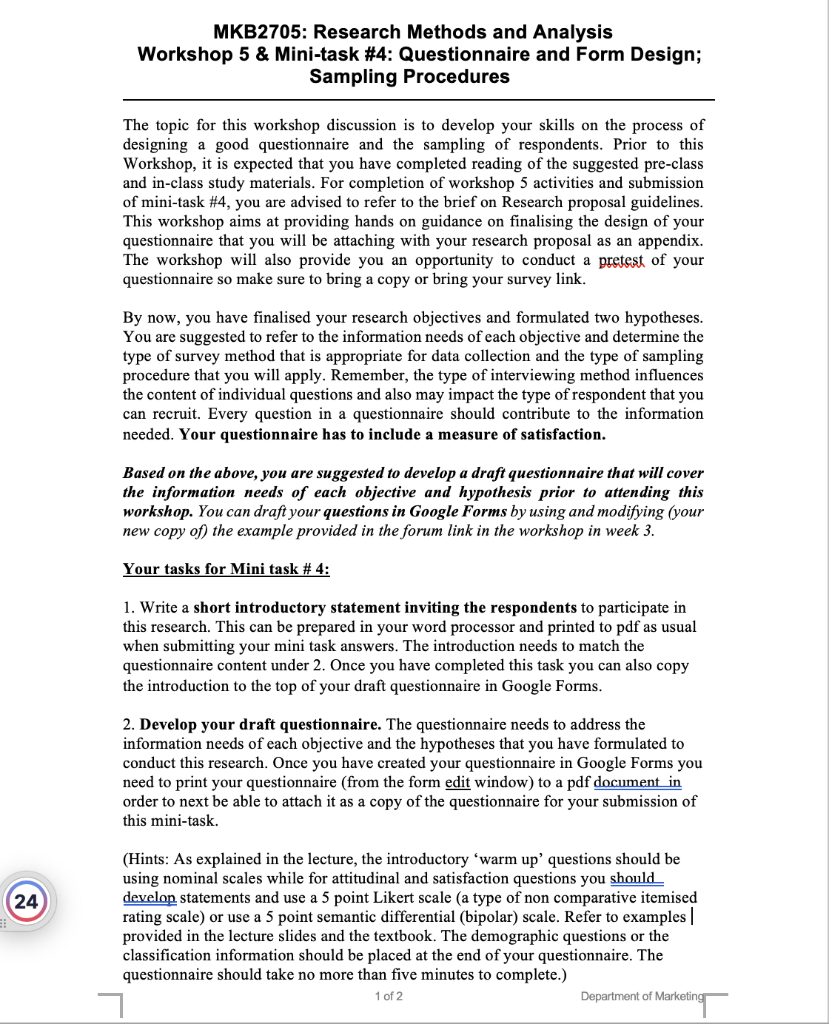
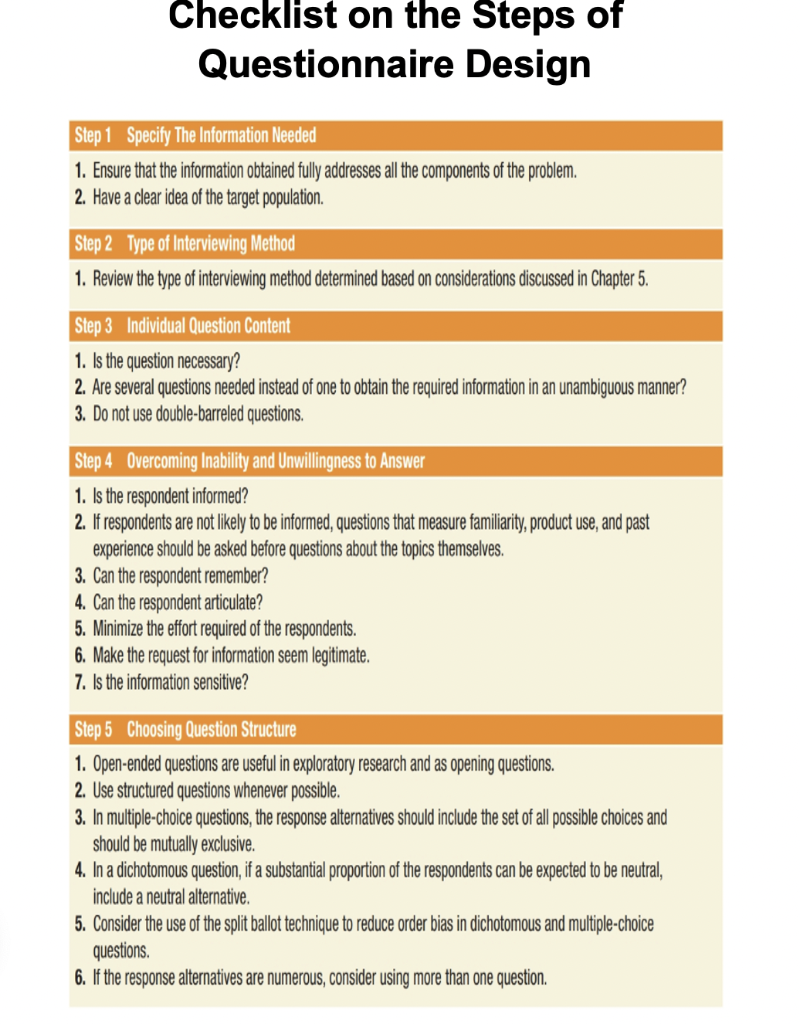
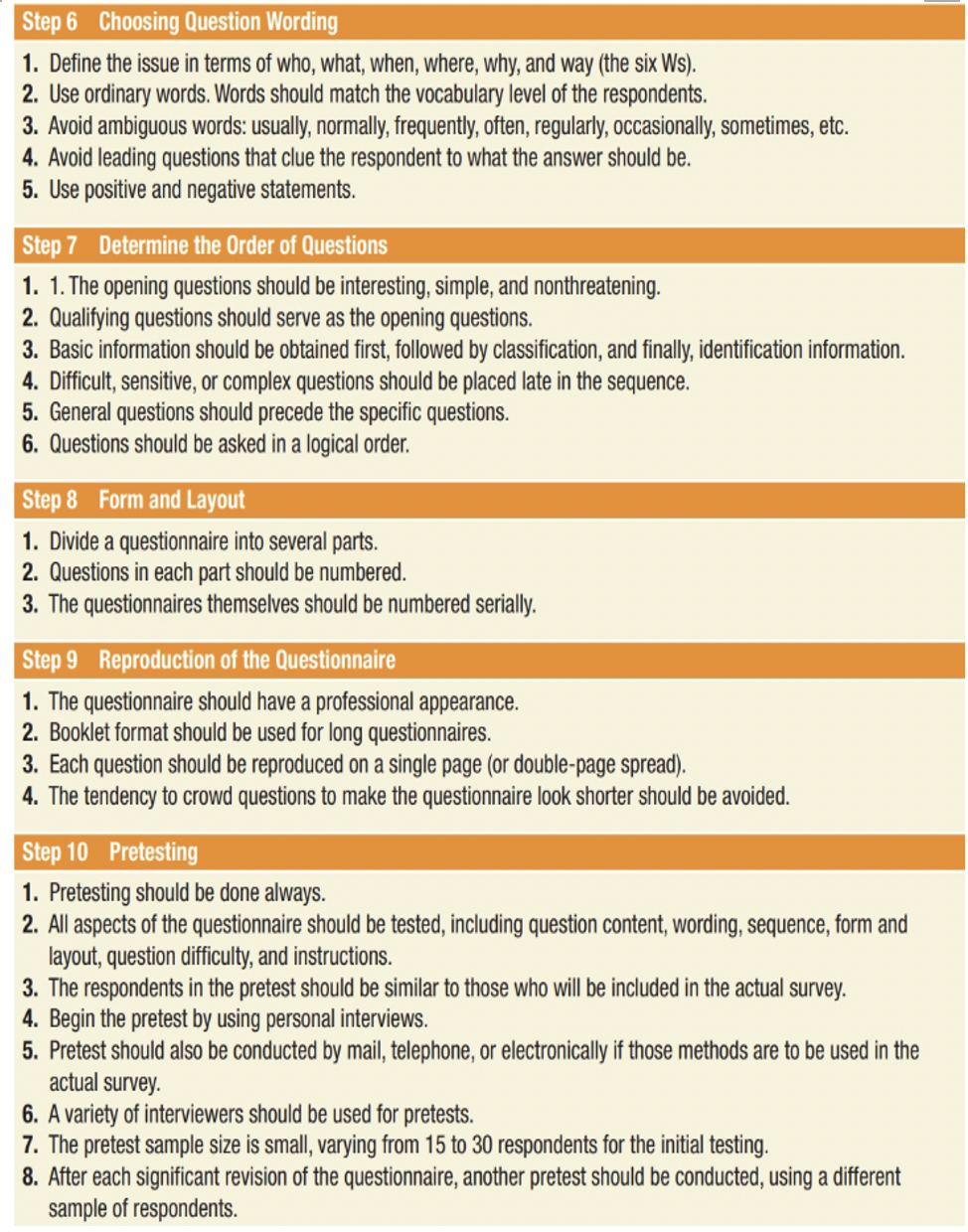
MKB2705: Research Methods and Analysis Workshop 5 \& Mini-task #4: Questionnaire and Form Design; Sampling Procedures The topic for this workshop discussion is to develop your skills on the process of designing a good questionnaire and the sampling of respondents. Prior to this Workshop, it is expected that you have completed reading of the suggested pre-class and in-class study materials. For completion of workshop 5 activities and submission of mini-task #4, you are advised to refer to the brief on Research proposal guidelines. This workshop aims at providing hands on guidance on finalising the design of your questionnaire that you will be attaching with your research proposal as an appendix. The workshop will also provide you an opportunity to conduct a pretest of your questionnaire so make sure to bring a copy or bring your survey link. By now, you have finalised your research objectives and formulated two hypotheses. You are suggested to refer to the information needs of each objective and determine the type of survey method that is appropriate for data collection and the type of sampling procedure that you will apply. Remember, the type of interviewing method influences the content of individual questions and also may impact the type of respondent that you can recruit. Every question in a questionnaire should contribute to the information needed. Your questionnaire has to include a measure of satisfaction. Based on the above, you are suggested to develop a draft questionnaire that will cover the information needs of each objective and hypothesis prior to attending this workshop. You can draft your questions in Google Forms by using and modifying (your new copy of) the example provided in the forum link in the workshop in week 3. Your tasks for Mini task # 4: 1. Write a short introductory statement inviting the respondents to participate in this research. This can be prepared in your word processor and printed to pdf as usual when submitting your mini task answers. The introduction needs to match the questionnaire content under 2. Once you have completed this task you can also copy the introduction to the top of your draft questionnaire in Google Forms. 2. Develop your draft questionnaire. The questionnaire needs to address the information needs of each objective and the hypotheses that you have formulated to conduct this research. Once you have created your questionnaire in Google Forms you need to print your questionnaire (from the form edit window) to a pdf document in order to next be able to attach it as a copy of the questionnaire for your submission of this mini-task. (Hints: As explained in the lecture, the introductory 'warm up' questions should be using nominal scales while for attitudinal and satisfaction questions you should develon statements and use a 5 point Likert scale (a type of non comparative itemised rating scale) or use a 5 point semantic differential (bipolar) scale. Refer to examples | provided in the lecture slides and the textbook. The demographic questions or the classification information should be placed at the end of your questionnaire. The questionnaire should take no more than five minutes to complete.) Checklist on the Steps of Questionnaire Design Step 1 Specify The Information Needed 1. Ensure that the information obtained fully addresses all the components of the problem. 2. Have a clear idea of the target population. Step 2 Type of Interviewing Method 1. Review the type of interviewing method determined based on considerations discussed in Chapter 5. Step 3 Individual Question Content 1. Is the question necessary? 2. Are several questions needed instead of one to obtain the required information in an unambiguous manner? 3. Do not use double-barreled questions. Step 4 Overcoming Inability and Unwillingness to Answer 1. Is the respondent informed? 2. If respondents are not likely to be informed, questions that measure familiarity, product use, and past experience should be asked before questions about the topics themselves. 3. Can the respondent remember? 4. Can the respondent articulate? 5. Minimize the effort required of the respondents. 6. Make the request for information seem legitimate. 7. Is the information sensitive? Step 5 Choosing Question Structure 1. Open-ended questions are useful in exploratory research and as opening questions. 2. Use structured questions whenever possible. 3. In muttiple-choice questions, the response alternatives should include the set of all possible choices and should be mutually exclusive. 4. In a dichotomous question, if a substantial proportion of the respondents can be expected to be neutral, include a neutral alternative. 5. Consider the use of the split ballot technique to reduce order bias in dichotomous and multiple-choice questions. 6. If the response atternatives are numerous, consider using more than one question. Step 6 Choosing Question Wording 1. Define the issue in terms of who, what, when, where, why, and way (the six Ws). 2. Use ordinary words. Words should match the vocabulary level of the respondents. 3. Avoid ambiguous words: usually, normally, frequently, often, regularly, occasionally, sometimes, etc. 4. Avoid leading questions that clue the respondent to what the answer should be. 5. Use positive and negative statements. Step 7 Determine the Order of Questions 1. 1. The opening questions should be interesting, simple, and nonthreatening. 2. Qualifying questions should serve as the opening questions. 3. Basic information should be obtained first, followed by classification, and finally, identification information. 4. Difficult, sensitive, or complex questions should be placed late in the sequence. 5. General questions should precede the specific questions. 6. Questions should be asked in a logical order. Step 8 Form and Layout 1. Divide a questionnaire into several parts. 2. Questions in each part should be numbered. 3. The questionnaires themselves should be numbered serially. Step 9 Reproduction of the Questionnaire 1. The questionnaire should have a professional appearance. 2. Booklet format should be used for long questionnaires. 3. Each question should be reproduced on a single page (or double-page spread). 4. The tendency to crowd questions to make the questionnaire look shorter should be avoided. Step 10 Pretesting 1. Pretesting should be done always. 2. All aspects of the questionnaire should be tested, including question content, wording, sequence, form and layout, question difficulty, and instructions. 3. The respondents in the pretest should be similar to those who will be included in the actual survey. 4. Begin the pretest by using personal interviews. 5. Pretest should also be conducted by mail, telephone, or electronically if those methods are to be used in the actual survey. 6. A variety of interviewers should be used for pretests. 7. The pretest sample size is small, varying from 15 to 30 respondents for the initial testing. 8. After each significant revision of the questionnaire, another pretest should be conducted, using a different sample of respondents. MKB2705: Research Methods and Analysis Workshop 5 \& Mini-task #4: Questionnaire and Form Design; Sampling Procedures The topic for this workshop discussion is to develop your skills on the process of designing a good questionnaire and the sampling of respondents. Prior to this Workshop, it is expected that you have completed reading of the suggested pre-class and in-class study materials. For completion of workshop 5 activities and submission of mini-task #4, you are advised to refer to the brief on Research proposal guidelines. This workshop aims at providing hands on guidance on finalising the design of your questionnaire that you will be attaching with your research proposal as an appendix. The workshop will also provide you an opportunity to conduct a pretest of your questionnaire so make sure to bring a copy or bring your survey link. By now, you have finalised your research objectives and formulated two hypotheses. You are suggested to refer to the information needs of each objective and determine the type of survey method that is appropriate for data collection and the type of sampling procedure that you will apply. Remember, the type of interviewing method influences the content of individual questions and also may impact the type of respondent that you can recruit. Every question in a questionnaire should contribute to the information needed. Your questionnaire has to include a measure of satisfaction. Based on the above, you are suggested to develop a draft questionnaire that will cover the information needs of each objective and hypothesis prior to attending this workshop. You can draft your questions in Google Forms by using and modifying (your new copy of) the example provided in the forum link in the workshop in week 3. Your tasks for Mini task # 4: 1. Write a short introductory statement inviting the respondents to participate in this research. This can be prepared in your word processor and printed to pdf as usual when submitting your mini task answers. The introduction needs to match the questionnaire content under 2. Once you have completed this task you can also copy the introduction to the top of your draft questionnaire in Google Forms. 2. Develop your draft questionnaire. The questionnaire needs to address the information needs of each objective and the hypotheses that you have formulated to conduct this research. Once you have created your questionnaire in Google Forms you need to print your questionnaire (from the form edit window) to a pdf document in order to next be able to attach it as a copy of the questionnaire for your submission of this mini-task. (Hints: As explained in the lecture, the introductory 'warm up' questions should be using nominal scales while for attitudinal and satisfaction questions you should develon statements and use a 5 point Likert scale (a type of non comparative itemised rating scale) or use a 5 point semantic differential (bipolar) scale. Refer to examples | provided in the lecture slides and the textbook. The demographic questions or the classification information should be placed at the end of your questionnaire. The questionnaire should take no more than five minutes to complete.) Checklist on the Steps of Questionnaire Design Step 1 Specify The Information Needed 1. Ensure that the information obtained fully addresses all the components of the problem. 2. Have a clear idea of the target population. Step 2 Type of Interviewing Method 1. Review the type of interviewing method determined based on considerations discussed in Chapter 5. Step 3 Individual Question Content 1. Is the question necessary? 2. Are several questions needed instead of one to obtain the required information in an unambiguous manner? 3. Do not use double-barreled questions. Step 4 Overcoming Inability and Unwillingness to Answer 1. Is the respondent informed? 2. If respondents are not likely to be informed, questions that measure familiarity, product use, and past experience should be asked before questions about the topics themselves. 3. Can the respondent remember? 4. Can the respondent articulate? 5. Minimize the effort required of the respondents. 6. Make the request for information seem legitimate. 7. Is the information sensitive? Step 5 Choosing Question Structure 1. Open-ended questions are useful in exploratory research and as opening questions. 2. Use structured questions whenever possible. 3. In muttiple-choice questions, the response alternatives should include the set of all possible choices and should be mutually exclusive. 4. In a dichotomous question, if a substantial proportion of the respondents can be expected to be neutral, include a neutral alternative. 5. Consider the use of the split ballot technique to reduce order bias in dichotomous and multiple-choice questions. 6. If the response atternatives are numerous, consider using more than one question. Step 6 Choosing Question Wording 1. Define the issue in terms of who, what, when, where, why, and way (the six Ws). 2. Use ordinary words. Words should match the vocabulary level of the respondents. 3. Avoid ambiguous words: usually, normally, frequently, often, regularly, occasionally, sometimes, etc. 4. Avoid leading questions that clue the respondent to what the answer should be. 5. Use positive and negative statements. Step 7 Determine the Order of Questions 1. 1. The opening questions should be interesting, simple, and nonthreatening. 2. Qualifying questions should serve as the opening questions. 3. Basic information should be obtained first, followed by classification, and finally, identification information. 4. Difficult, sensitive, or complex questions should be placed late in the sequence. 5. General questions should precede the specific questions. 6. Questions should be asked in a logical order. Step 8 Form and Layout 1. Divide a questionnaire into several parts. 2. Questions in each part should be numbered. 3. The questionnaires themselves should be numbered serially. Step 9 Reproduction of the Questionnaire 1. The questionnaire should have a professional appearance. 2. Booklet format should be used for long questionnaires. 3. Each question should be reproduced on a single page (or double-page spread). 4. The tendency to crowd questions to make the questionnaire look shorter should be avoided. Step 10 Pretesting 1. Pretesting should be done always. 2. All aspects of the questionnaire should be tested, including question content, wording, sequence, form and layout, question difficulty, and instructions. 3. The respondents in the pretest should be similar to those who will be included in the actual survey. 4. Begin the pretest by using personal interviews. 5. Pretest should also be conducted by mail, telephone, or electronically if those methods are to be used in the actual survey. 6. A variety of interviewers should be used for pretests. 7. The pretest sample size is small, varying from 15 to 30 respondents for the initial testing. 8. After each significant revision of the questionnaire, another pretest should be conducted, using a different sample of respondents









 Study Help