







Question: MKT 2105 Jan 2020 / Page 2 of 4 Case Study 1: A Brand New Wave of Subway Advertising Since 1999, a new segment of
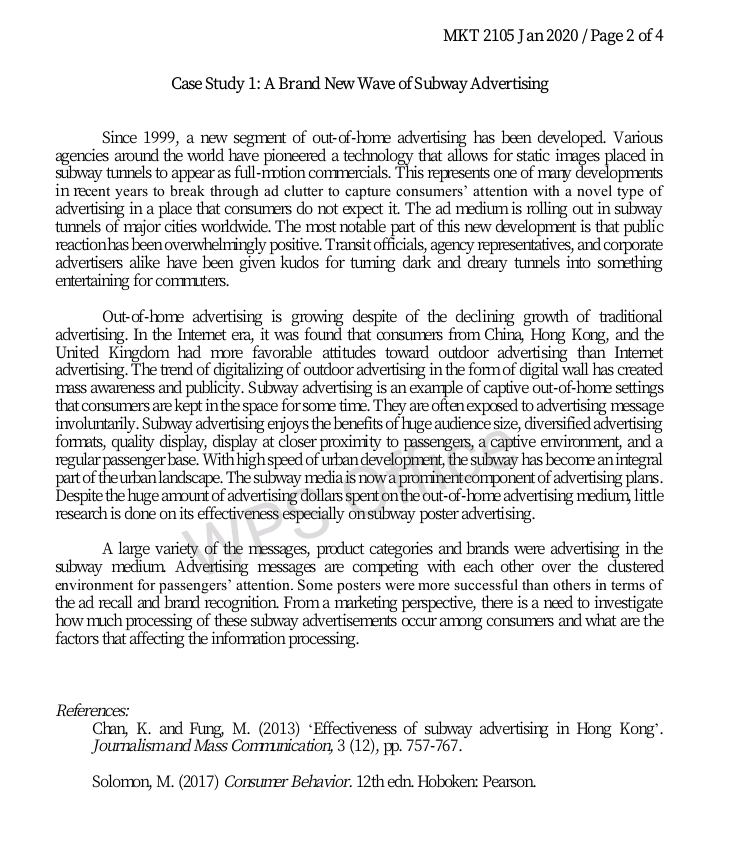
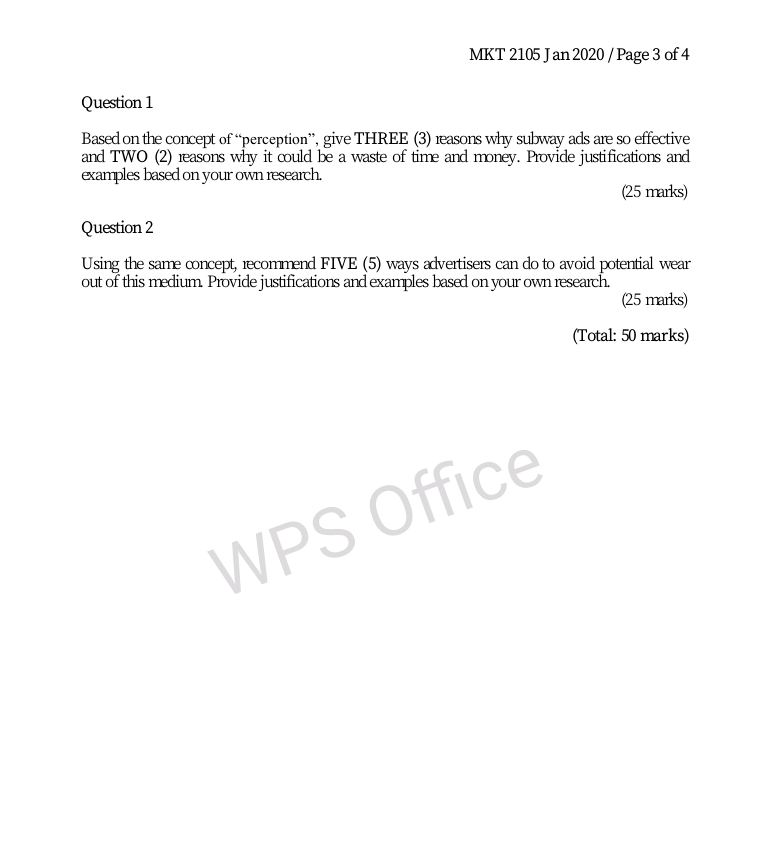
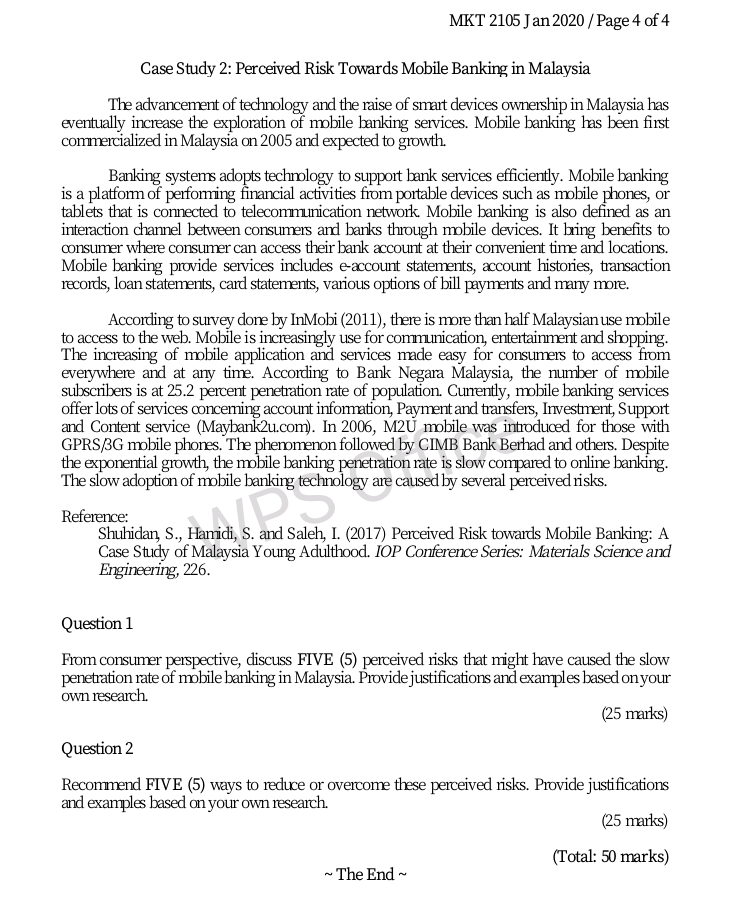
MKT 2105 Jan 2020 / Page 2 of 4 Case Study 1: A Brand New Wave of Subway Advertising Since 1999, a new segment of out-of-home advertising has been developed. Various agencies around the world have pioneered a technology that allows for static images placed in subway tunnels to appear as full-mption commercials. This represents one of many developments in recent years to break through ad clutter to capture consumers' attention with a novel type of advertising in a place that consumers do not expect it. The ad medium is rolling out in subway tunnels of major cities worldwide. The most notable part of this new development is that public reaction has been overwhelmingly positive. Transit officials, agency representatives, and corporate advertisers alike have been given kudos for tuming dark and dreary tunnels into something entertaining for commuters. Out-of-home advertising is growing despite of the declining growth of traditional advertising. In the Intemet era, it was found that consumers from China Hong Kong, and the United Kingdom had more favorable attitudes toward outdoor advertising than Intemet advertising. The trend of digitalizing of outdoor advertising in the form of digital wall has created mass awareness and publicity. Subway advertising is an example of captive out-of-home settings that consumers are kept in the space for some time. They are often exposed to advertising message involuntarily. Subway advertising enjoys the benefits of huge audience size, diversified advertising formats, quality display, display at closer proximity to passengers, a captive environment, and a regular passenger base. With high speed of urban development, the subway has become an integral part of the urban landscape. The subway media is now a prominentcomponent of advertising plans. Despite the huge amount of advertising dollars spent on the out-of-home advertising medium, little research is done on its effectiveness especially on subway poster advertising. A large variety of the messages, product categories and brands were advertising in the subway medium Advertising messages are competing with each other over the dustered environment for passengers' attention. Some posters were more successful than others in terms of the ad recall and brand recognition. From a marketing perspective, there is a need to investigate how much processing of these subway advertisements occur among consumers and what are the factors that affecting the information processing. References: Chan, K. and Fung, M. (2013) 'Effectiveness of subway advertising in Hong Kong. Journalismand Mass Communication, 3 (12), pp. 757-767. Solomon, M. (2017) Consumer Behavior. 12th edn. Hoboken: Pearson. MKT 2105 Jan 2020 / Page 3 of 4 Question 1 Based on the concept of perception, give THREE (3) reasons why subway ads are so effective and TWO (2) reasons why it could be a waste of time and money. Provide justifications and examples based on your own research. (25 marks) Question 2 Using the same concept, recommend FIVE (5) ways advertisers can do to avoid potential wear out of this medium Provide justifications and examples based on your own research. (25 marks) (Total: 50 marks) WPS Office MKT 2105 Jan 2020 / Page 4 of 4 Case Study 2: Perceived Risk Towards Mobile Banking in Malaysia The advancement of technology and the raise of smart devices ownership in Malaysia has eventually increase the exploration of mobile banking services. Mobile banking has been first commercialized in Malaysia on 2005 and expected to growth. Banking systems adopts technology to support bank services efficiently. Mobile banking is a platform of performing financial activities from portable devices such as mobile phones, or tablets that is connected to telecommunication network. Mobile banking is also defined as an interaction channel between consumers and banks through mobile devices. It bring benefits to consumer where consumer can access their bank account at their convenient time and locations. Mobile banking provide services includes e-account statements, account histories, transaction records, loan statements, card statements, various options of bill payments and many more. According to survey done by InMobi (2011), there is more than half Malaysian use mobile to access to the web. Mobile is increasingly use for communication, entertainment and shopping. The increasing of mobile application and services made easy for consumers to access from everywhere and at any time. According to Bank Negara Malaysia, the number of mobile subscribers is at 25.2 percent penetration rate of population. Currently, mobile banking services offer lots of services concerning account information, Payment and transfers, Investment, Support and Content service (Maybank2u.com). In 2006, M2U mobile was introduced for those with GPRS/3G mobile phones. The phenomenon followed by CIMB Bank Berhad and others. Despite the exponential growth, the mobile banking penetration rate is slow compared to online banking. The slow adoption of mobile banking technology are caused by several perceived risks. Reference: Shuhidan, S., Hamidi, S. and Saleh, I. (2017) Perceived Risk towards Mobile Banking: A Case Study of Malaysia Young Adulthood. IOP Conference Series: Materials Science and Engineering, 226. terad s Question 1 From consumer perspective, discuss FIVE (5) perceived risks that might have caused the slow penetration rate of mobile banking in Malaysia. Provide justifications and examples based on your own research (25 marks) Question 2 Recommend FIVE (5) ways to reduce or overcome these perceived risks. Provide justifications and examples based on your own research. (25 marks) (Total: 50 marks) The End n
Step by Step Solution
There are 3 Steps involved in it
1 Expert Approved Answer
Step: 1 Unlock

Question Has Been Solved by an Expert!
Get step-by-step solutions from verified subject matter experts
Step: 2 Unlock
Step: 3 Unlock
 Study Help