







Question: Mobius transformations and complex, harmonic functions. Find aMdbius Transform HI = (Me) from D = {|z| 1} to W = {|n| 0}, where z =
Mobius transformations and complex, harmonic functions.
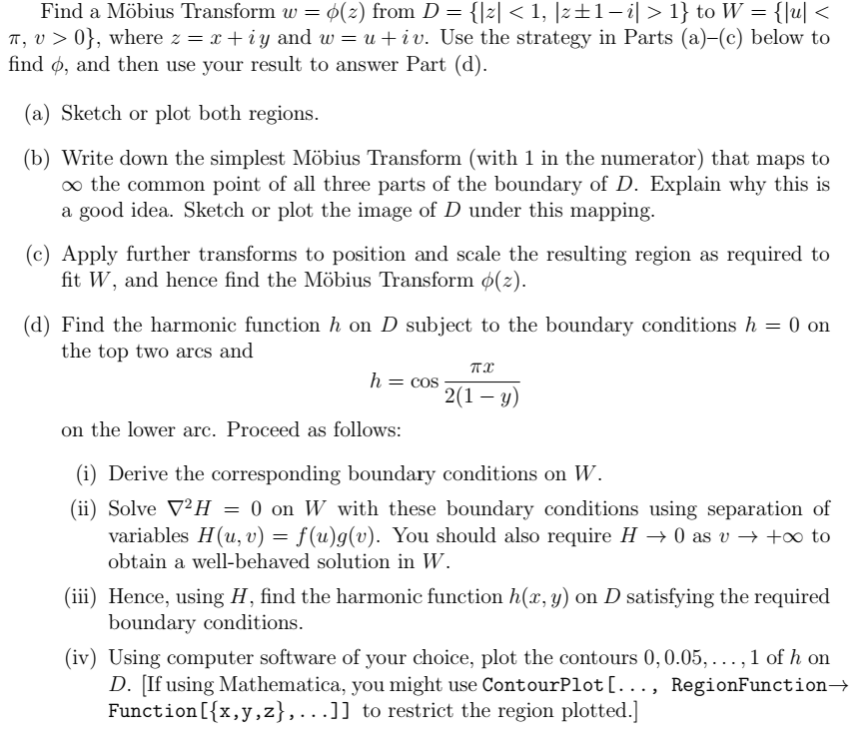
Find aMdbius Transform HI = (Me) from D = {|z| <: i> 1} to W = {|n| 0}, where z = :r + iy and w = u + in. Use the strategy in Parts (a)(c) below to nd at, and then use your result to answer Part (d)- (a) Sketch or plot both regions. {b} Write down the simplest Mobius Transform (with l in the numerator) that maps to co the common point of all three parts of the boundary of D. Expiain why this is a good idea. Sketch or plot the image of D under this mapping. (c) Apply further transforms to position and scale the resulting region as required to t W, and hence nd the Mobius Transform 46(2). {(1) Find the harmonic function h on D subject to the boundary conditions it = l) on the top two arcs and 1m: 2(1y) h=cos on the lower are. Proceed as follows: (i) Derive the corresponding boundary conditions on W. (ii) Solve V\"! = 0 on W with these boundary conditions using separation of variables H(n,-v) = f(u)g{v). You should also require H } U as v > +00 to obtain a well-behaved solution in W. (iii) Hence, using H , nd the harmonic function h.(:r, 3;) on D satisfying the required boundary conditions. (iv) Using computer software of your choice, plot the contours (l, 0.05, . . . , 1 of h on D. [If using Mathematics, you might use ContourPlot [. . . , RegionFunctionl Function [{x,y,z} , . . .]] to restrict the region plotted]
Step by Step Solution
There are 3 Steps involved in it

Get step-by-step solutions from verified subject matter experts
 Study Help