



Question: Model 5: Hydrogen Bonding The dotted lines in Figures 4.1 and 42 represent the strongest type of dipole-dipole attractive force called a hydrogen bond. A
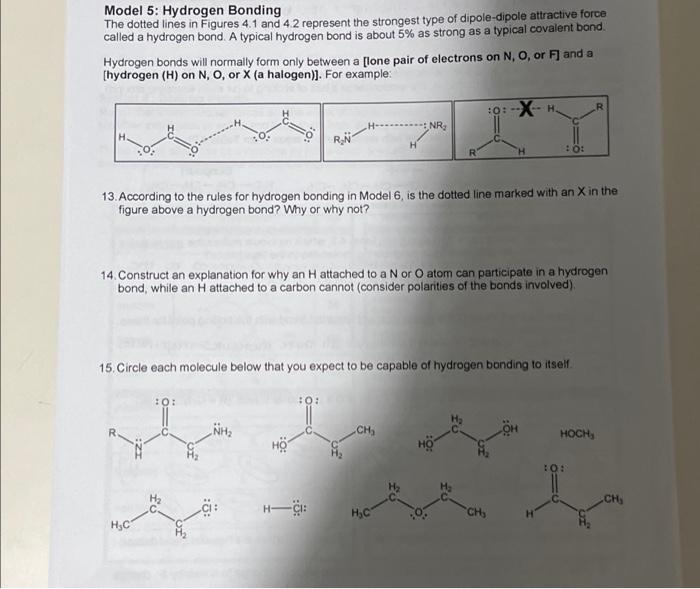
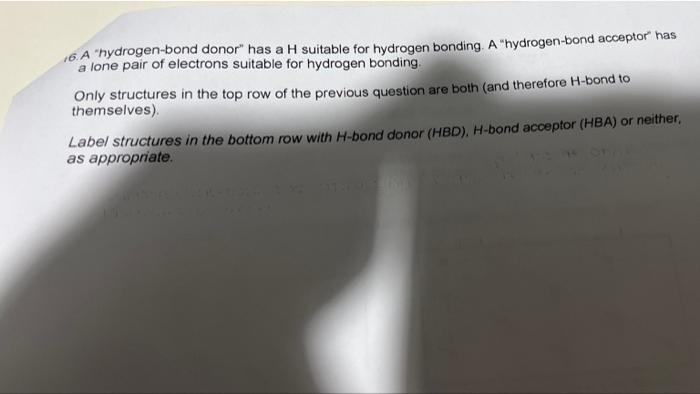
Model 5: Hydrogen Bonding The dotted lines in Figures 4.1 and 42 represent the strongest type of dipole-dipole attractive force called a hydrogen bond. A typical hydrogen bond is about 5% as strong as a typical covalent bond. Hydrogen bonds will normally form only between a [lone pair of electrons on N, O, or F) and a [hydrogen (H) on N, O, or X (a halogen)). For example: :0:-X- NR R 10: 13. According to the rules for hydrogen bonding in Model 6, is the dotted line marked with an X in the figure above a hydrogen bond? Why or why not? 14. Construct an explanation for why an H attached to a N or O atom can participate in a hydrogen bond, while an H attached to a carbon cannot consider polarities of the bonds involved) 15. Circle each molecule below that you expect to be capable of hydrogen bonding to itself :0: :0: NH CH OH HOCH, 10: Io CH H- HC CH " 16.A hydrogen-bond donor" has a H suitable for hydrogen bonding. A "hydrogen-bond acceptor" has a lone pair of electrons suitable for hydrogen bonding Only structures in the top row of the previous question are both (and therefore H-bond to themselves) Label structures in the bottom row with H-bond donor (HBD), H-bond acceptor (HBA) or neither, as appropriate
Step by Step Solution
There are 3 Steps involved in it

Get step-by-step solutions from verified subject matter experts