







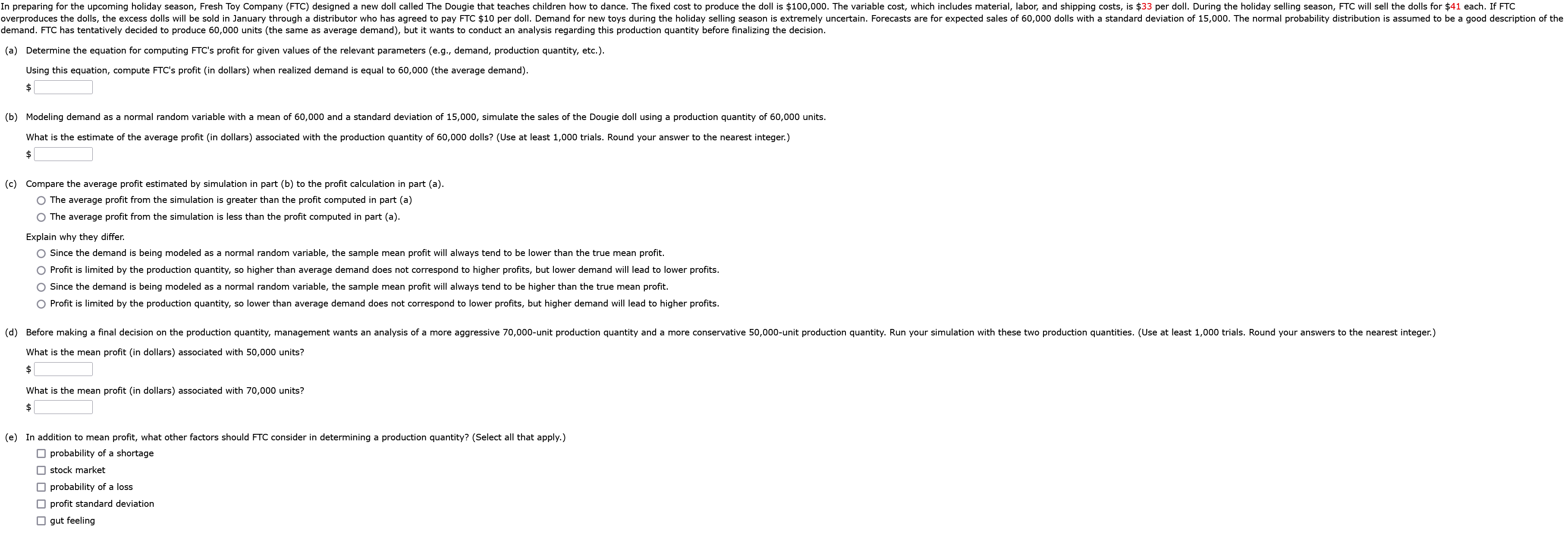
Question: model file: Fresh Toy Co. Parameters Fixed Cost $100,000 Variable Cost Retail Price Demand (Normal) Clearance Price $10 Average 60,000 Demand Standard Deviation 15,000 Model
model file:
| Fresh Toy Co. | ||||||
| Parameters | ||||||
| Fixed Cost | $100,000 | |||||
| Variable Cost | ||||||
| Retail Price | Demand (Normal) | |||||
| Clearance Price | $10 | Average | 60,000 | |||
| Demand | Standard Deviation | 15,000 | ||||
| Model | ||||||
| Production Quantity | 60,000 | |||||
| Simulation Trial | Demand | Net Profit | Summary Statistics | |||
| 1 | Mean Net Profit | #DIV/0! | ||||
| 2 | St. Dev. Net Profit | #DIV/0! | ||||
| 3 | ||||||
| 4 | ||||||
| 5 | ||||||
| 6 | ||||||
| 7 | ||||||
| 8 | ||||||
| 9 | ||||||
| 10 | ||||||
| 11 | ||||||
| 12 | ||||||
| 13 | ||||||
| 14 | ||||||
| 15 | ||||||
| 16 | ||||||
| 17 | ||||||
| 18 | ||||||
| 19 | ||||||
| 20 |
lemand. FTC has tentatively decided to produce 60,000 units (the same as average demand), but it wants to conduct an analysis regarding th (a) Determine the equation for computing FTC's profit for given values of the relevant parameters (e.g., demand, production quantity, etc.). Using this equation, compute FTC's profit (in dollars) when realized demand is equal to 60,000 (the average demand). s (b) Modeling demand as a normal random variable with a mean of 60,000 and a standard deviation of 15,000, simulate the sales of the Dougie doll using a production quantity of 60,000 units. What is the estimate of the average profit (in dollars) associated with the production quantity of 60,000 dolls? (Use at least 1,000 trials. Round your answer to the nearest integer.) $ (c) Compare the average profit estimated by simulation in part (b) to the profit calculation in part (a). The average profit from the simulation is greater than the profit computed in part (a) The average profit from the simulation is less than the profit computed in part (a). Explain why they differ. Since the demand is being modeled as a normal random variable, the sample mean profit will always tend to be lower than the true mean profit. Profit is limited by the production quantity, so higher than average demand does not correspond to higher profits, but lower demand will lead to lower profits. Since the demand is being modeled as a normal random variable, the sample mean profit will always tend to be higher than the true mean profit. Profit is limited by the production quantity, so lower than average demand does not correspond to lower profits, but higher demand will lead to higher profits. What is the mean profit (in dollars) associated with 50,000 units? What is the mean profit (in dollars) associated with 70,000 units? $ (e) In addition to mean profit, what other factors should FTC consider in determining a production quantity? (Select all that apply.) probability of a shortage stock market probability of a loss profit standard deviation gut feeling
Step by Step Solution
There are 3 Steps involved in it

Get step-by-step solutions from verified subject matter experts
 Study Help