



Question: Model selection procedure. See this section of the Monograph for details. Occasion j= 1 2 3 Animals caught n(j ) = 89 35 25 Total
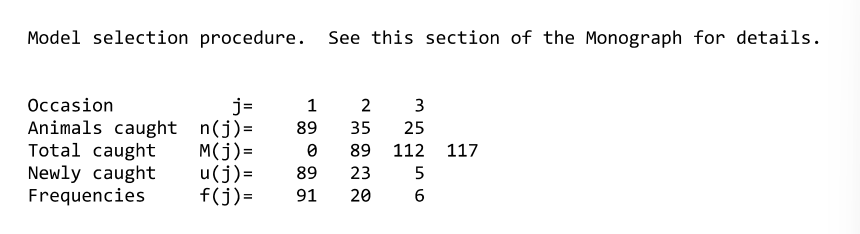
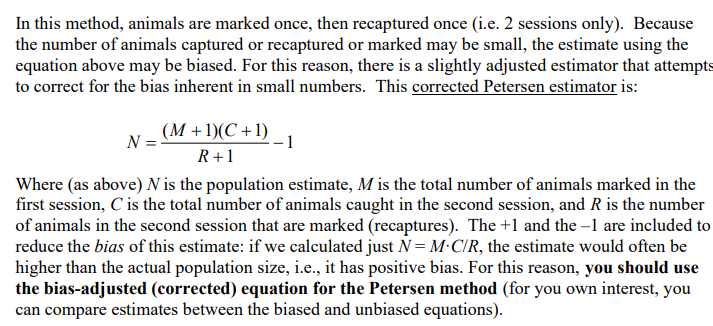
Model selection procedure. See this section of the Monograph for details. Occasion j= 1 2 3 Animals caught n(j ) = 89 35 25 Total caught M(j ) = 89 112 117 Newly caught u(j ) = 89 23 5 Frequencies f (j ) = 91 20 6In this method, animals are marked once, then recaptured once (i.e. 2 sessions only). Because the number of animals captured or recaptured or marked may be small, the estimate using the equation above may be biased. For this reason, there 1s a slightly adjusted estimator that attempts to correct for the bias inherent in small numbers. This corrected Petersen estimator is: o MADCHD R+1 Where (as above) N is the population estimate, M is the total number of animals marked in the first session, ( is the total number of animals caught in the second session, and R is the number of animals in the second session that are marked (recaptures). The +1 and the 1 are included to reduce the bias of this estimate: if we calculated just N = M-C/R, the estimate would often be higher than the actual population size, i.e., it has positive bias. For this reason, you should use the bias-adjusted (corrected) equation for the Petersen methoed (for you own interest, you can compare estimates between the biased and unbiased equations)
Step by Step Solution
There are 3 Steps involved in it

Get step-by-step solutions from verified subject matter experts