Question: Model the following process in BPMN. Make sure you indicate resources and data/information objects and stores where applicable. You must adhere to the naming conventions
In a galaxy far far away, the rebel alliance wants to destroy the death star. Their planned process for this is as follows. Rebel spies will steal the blue prints for the death star. The blue prints may turn out to be fakes so that this activity may need to be repeated by the spies until the real blueprints are obtained. Once the real blueprints are obtained, the rebel leadership identifies the weaknesses of the death star and prepares the attack plan. If the plan involves Jedi action, the Jedi council double-checks the attack plan. After this is completed, the rebel leadership assigns starfighter squadrons to jobs, either as attack fighters or for fleet defence duty, depending on the squadrons capabilities. After this is done, the rebel leadership provides the starfighter squadron commanders with the final battle plan and, at the same time, orders the fleet to full battle readiness. When the fleet is ready for battle, the starfighter squadrons move into position around the death star. At the same time, rebel spies land on the moon of Endor. Once there, the rebel spies have two hours to bring down the shield, after which the starfighter squadrons will destroy the death star. If the shield is not down after two hours, the rebellion leadership calls off the attack and orders the fleet to escape.
It is possible in exceptional situations that during starfighter assignment, it turns out a chosen starfighter squadron is unsuitable for the assignment, for example because starfighters are under repair or maintenance. When this occurs, the rebel leadership changes the battle plan appropriately and may either assign starfighter squadrons again, or notify the fleet that the attack has been called off.
You do not need to model the galactic empire and any message exchanges with it.
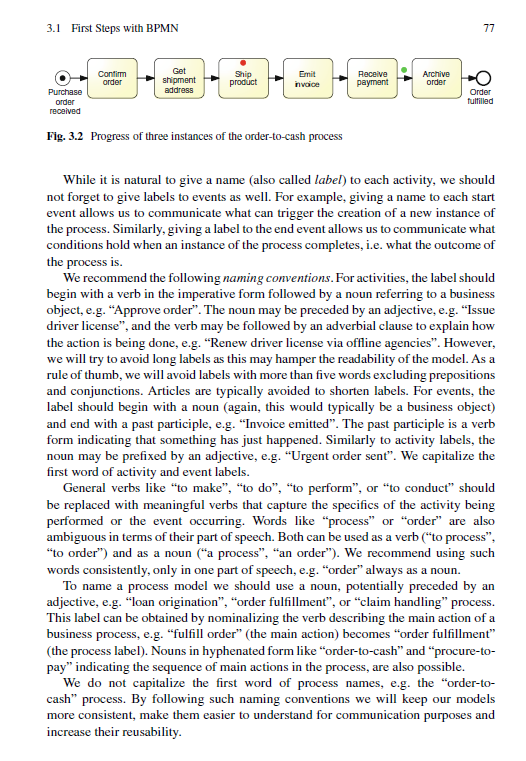
3.1 First Steps with BPMN 77 Confirm order Get shipment address Ship product Emit invoice Receive payment Archive order Purchase order received Order fulfilled Fig. 3.2 Progress of three instances of the order-to-cash process While it is natural to give a name (also called label) to each activity, we should not forget to give labels to events as well. For example, giving a name to each start event allows us to communicate what can trigger the creation of a new instance of the process. Similarly, giving a label to the end event allows us to communicate what conditions hold when an instance of the process completes, i.e. what the outcome of the process is. We recommend the following naming conventions. For activities, the label should begin with a verb in the imperative form followed by a noun referring to a business object, e.g. "Approve order". The noun may be preceded by an adjective, e.g. Issue driver license, and the verb may be followed by an adverbial clause to explain how the action is being done, e.g. Renew driver license via offline agencies. However, we will try to avoid long labels as this may hamper the readability of the model. As a rule of thumb, we will avoid labels with more than five words excluding prepositions and conjunctions. Articles are typically avoided to shorten labels. For events, the label should begin with a noun (again, this would typically be a business object) and end with a past participle, e.g. "Invoice emitted. The past participle is a verb form indicating that something has just happened. Similarly to activity labels, the noun may be prefixed by an adjective, e.g. "Urgent order sent". We capitalize the first word of activity and event labels. General verbs like "to make, to do, to perform", or "to conduct" should be replaced with meaningful verbs that capture the specifics of the activity being performed or the event occurring. Words like "process" or "order" are also ambiguous in terms of their part of speech. Both can be used as a verb ("to process", "to order") and as a noun ("a process, an order"). We recommend using such words consistently, only in one part of speech, e.g. "order" always as a noun. To name a process model we should use a noun, potentially preceded by an adjective, e.g. "loan origination, order fulfillment", or "claim handling" process. This label can be obtained by nominalizing the verb describing the main action of a business process, e.g. "fulfill order" (the main action) becomes "order fulfillment" (the process label). Nouns in hyphenated form like "order-to-cash and procure-to- pay" indicating the sequence of main actions in the process, are also possible. We do not capitalize the first word of process names, e.g. the "order-to- cash" process. By following such naming conventions we will keep our models more consistent, make them easier to understand for communication purposes and increase their reusability









 Study Help