







Question: modelling a pandamic system dynamics In this assignment you will experience the system dynamics modeling process by exploring the propagation of an infectious disease through
modelling a pandamic system dynamics
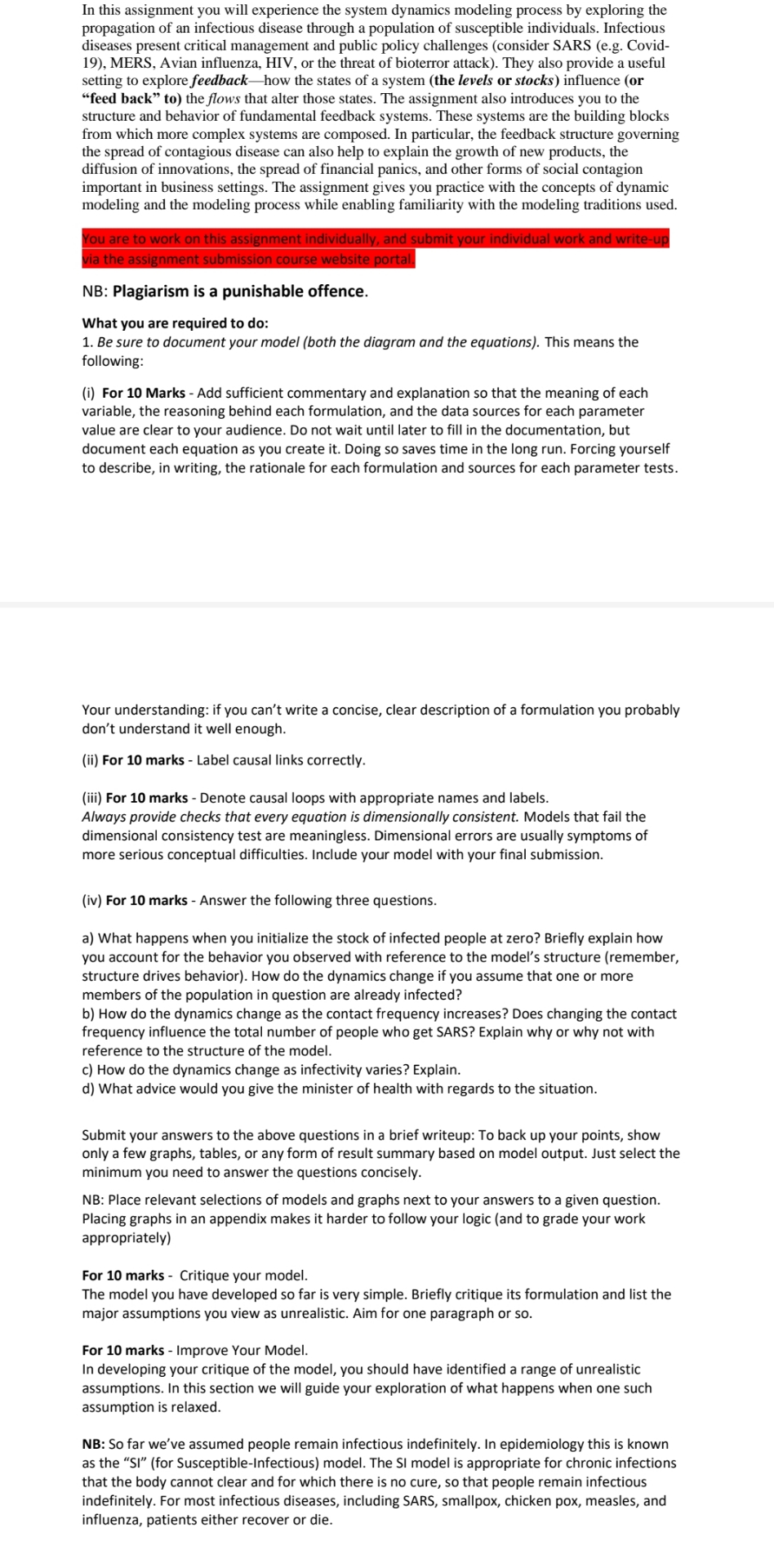
In this assignment you will experience the system dynamics modeling process by exploring the propagation of an infectious disease through a population of susceptible individuals. Infectious diseases present critical management and public policy challenges consider SARS eg Covid MERS, Avian influenza, HIV, or the threat of bioterror attack They also provide a useful setting to explore feedback how the states of a system the levels or stocks influence or "feed back" to the flows that alter those states. The assignment also introduces you to the structure and behavior of fundamental feedback systems. These systems are the building blocks from which more complex systems are composed. In particular, the feedback structure governing the spread of contagious disease can also help to explain the growth of new products, the diffusion of innovations, the spread of financial panics, and other forms of social contagion important in business settings. The assignment gives you practice with the concepts of dynamic modeling and the modeling process while enabling familiarity with the modeling traditions used.NB: Plagiarism is a punishable offence.What you are required to do:
Be sure to document your model both the diagram and the equations This means the following:
i For Marks Add sufficient commentary and explanation so that the meaning of each variable, the reasoning behind each formulation, and the data sources for each parameter value are clear to your audience. Do not wait until later to fill in the documentation, but document each equation as you create it Doing so saves time in the long run. Forcing yourself to describe, in writing, the rationale for each formulation and sources for each parameter tests.
Your understanding: if you can't write a concise, clear description of a formulation you probably don't understand it well enough.
ii For marks Label causal links correctly.
iii For marks Denote causal loops with appropriate names and labels. Always provide checks that every equation is dimensionally consistent. Models that fail the dimensional consistency test are meaningless. Dimensional errors are usually symptoms of more serious conceptual difficulties. Include your model with your final submission.
iv For marks Answer the following three questions.
a What happens when you initialize the stock of infected people at zero? Briefly explain how you account for the behavior you observed with reference to the model's structure remember structure drives behavior How do the dynamics change if you assume that one or more members of the population in question are already infected?
b How do the dynamics change as the contact frequency increases? Does changing the contact frequency influence the total number of people who get SARS? Explain why or why not with reference to the structure of the model.
c How do the dynamics change as infectivity varies? Explain.
d What advice would you give the minister of health with regards to the situation.
Submit your answers to the above questions in a brief writeup: To back up your points, show only a few graphs, tables, or any form of result summary based on model output. Just select the minimum you need to answer the questions concisely.
NB: Place relevant selections of models and graphs next to your answers to a given question. Placing graphs in an appendix makes it harder to follow your logic and to grade your work appropriately
For marks Critique your model.
The model you have developed so far is very simple. Briefly critique its formulation and list the major assumptions you view as unrealistic. Aim for one paragraph or so
For marks Improve Your Model.
In developing your critique of the model, you should have identified a range of unrealistic assumptions. In this section we will guide your exploration of what happens when one such assumption is relaxed.
NB: So far we've assumed people remain infectious indefinitely. In epidemiology this is known as the SIfor SusceptibleInfectious model. The SI model is appropriate for chronic infections that the body cannot clear and for which there is no cure, so that people remain infectious indefinitely. For most infectious diseases, including SARS, smallpox, chicken pox, measles, and influenza, patients either recover or die.
Step by Step Solution
There are 3 Steps involved in it
1 Expert Approved Answer
Step: 1 Unlock

Question Has Been Solved by an Expert!
Get step-by-step solutions from verified subject matter experts
Step: 2 Unlock
Step: 3 Unlock
 Study Help