







Question: Modern data networks are designed to support a diverse range of hosts and communication mediums. Consider a 600 MHz Pentium III-based host transmitting data to
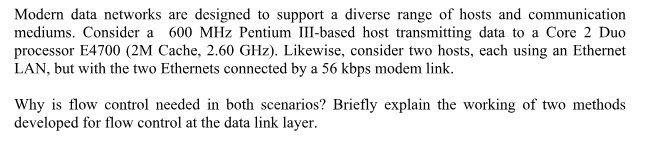
Modern data networks are designed to support a diverse range of hosts and communication mediums. Consider a 600 MHz Pentium III-based host transmitting data to a Core 2 Duo processor E4700 (2M Cache, 2.60 GHz). Likewise, consider two hosts, each using an Ethernet LAN, but with the two Ethernets connected by a 56 kbps modem link.
Why is flow control needed in both scenarios? Briefly explain the working of two methods developed for flow control at the data link layer.
Modern data networks are designed to support a diverse range of hosts and communication mediums. Consider a 600 MHz Pentium III-based host transmitting data to a Core 2 Duo processor E4700 (2M Cache, 2.60 GHz). Likewise, consider two hosts, each using an Ethernet LAN, but with the two Ethernets connected by a 56 kbps modem link. Why is flow control needed in both scenarios? Briefly explain the working of two methods developed for flow control at the data link layer. Modern data networks are designed to support a diverse range of hosts and communication mediums. Consider a 600 MHz Pentium III-based host transmitting data to a Core 2 Duo processor E4700 (2M Cache, 2.60 GHz). Likewise, consider two hosts, each using an Ethernet LAN, but with the two Ethernets connected by a 56 kbps modem link. Why is flow control needed in both scenarios? Briefly explain the working of two methods developed for flow control at the data link layer
Step by Step Solution
There are 3 Steps involved in it

Get step-by-step solutions from verified subject matter experts
 Study Help