



Question: Modern information systems run transactions in parallel. Running hundreds or even thousands of transactions at the same time is commonplace for information systems today. Transactions
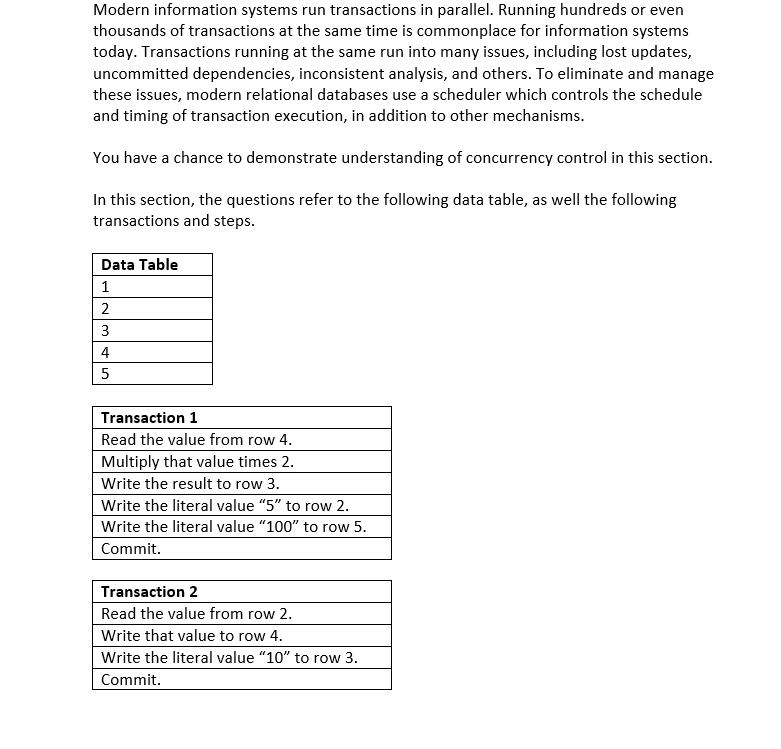
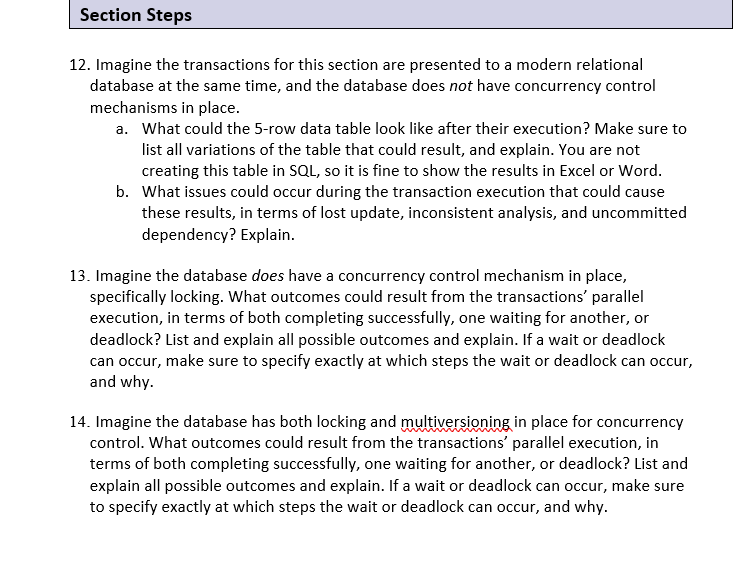
Modern information systems run transactions in parallel. Running hundreds or even thousands of transactions at the same time is commonplace for information systems today. Transactions running at the same run into many issues, including lost updates, uncommitted dependencies, inconsistent analysis, and others. To eliminate and manage these issues, modern relational databases use a scheduler which controls the schedule and timing of transaction execution, in addition to other mechanisms. You have a chance to demonstrate understanding of concurrency control in this section. In this section, the questions refer to the following data table, as well the following transactions and steps. Data Table 1 2 3 4 5 Transaction 1 Read the value from row 4. Multiply that value times 2. Write the result to row 3. Write the literal value "5" to row 2. Write the literal value "100" to row 5. Commit. Transaction 2 Read the value from row 2. Write that value to row 4. Write the literal value "10" to row 3. Commit. Section Steps 12. Imagine the transactions for this section are presented to a modern relational database at the same time, and the database does not have concurrency control mechanisms in place. a. What could the 5-row data table look like after their execution? Make sure to list all variations of the table that could result, and explain. You are not creating this table in SQL, so it is fine to show the results in Excel or Word. b. What issues could occur during the transaction execution that could cause these results, in terms of lost update, inconsistent analysis, and uncommitted dependency? Explain. 13. Imagine the database does have a concurrency control mechanism in place, specifically locking. What outcomes could result from the transactions' parallel execution, in terms of both completing successfully, one waiting for another, or deadlock? List and explain all possible outcomes and explain. If a wait or deadlock can occur, make sure to specify exactly at which steps the wait or deadlock can occur, and why. 14. Imagine the database has both locking and multiversioning in place for concurrency control. What outcomes could result from the transactions' parallel execution, in terms of both completing successfully, one waiting for another, or deadlock? List and explain all possible outcomes and explain. If a wait or deadlock can occur, make sure to specify exactly at which steps the wait or deadlock can occur, and why. Modern information systems run transactions in parallel. Running hundreds or even thousands of transactions at the same time is commonplace for information systems today. Transactions running at the same run into many issues, including lost updates, uncommitted dependencies, inconsistent analysis, and others. To eliminate and manage these issues, modern relational databases use a scheduler which controls the schedule and timing of transaction execution, in addition to other mechanisms. You have a chance to demonstrate understanding of concurrency control in this section. In this section, the questions refer to the following data table, as well the following transactions and steps. Data Table 1 2 3 4 5 Transaction 1 Read the value from row 4. Multiply that value times 2. Write the result to row 3. Write the literal value "5" to row 2. Write the literal value "100" to row 5. Commit. Transaction 2 Read the value from row 2. Write that value to row 4. Write the literal value "10" to row 3. Commit. Section Steps 12. Imagine the transactions for this section are presented to a modern relational database at the same time, and the database does not have concurrency control mechanisms in place. a. What could the 5-row data table look like after their execution? Make sure to list all variations of the table that could result, and explain. You are not creating this table in SQL, so it is fine to show the results in Excel or Word. b. What issues could occur during the transaction execution that could cause these results, in terms of lost update, inconsistent analysis, and uncommitted dependency? Explain. 13. Imagine the database does have a concurrency control mechanism in place, specifically locking. What outcomes could result from the transactions' parallel execution, in terms of both completing successfully, one waiting for another, or deadlock? List and explain all possible outcomes and explain. If a wait or deadlock can occur, make sure to specify exactly at which steps the wait or deadlock can occur, and why. 14. Imagine the database has both locking and multiversioning in place for concurrency control. What outcomes could result from the transactions' parallel execution, in terms of both completing successfully, one waiting for another, or deadlock? List and explain all possible outcomes and explain. If a wait or deadlock can occur, make sure to specify exactly at which steps the wait or deadlock can occur, and why
Step by Step Solution
There are 3 Steps involved in it

Get step-by-step solutions from verified subject matter experts