







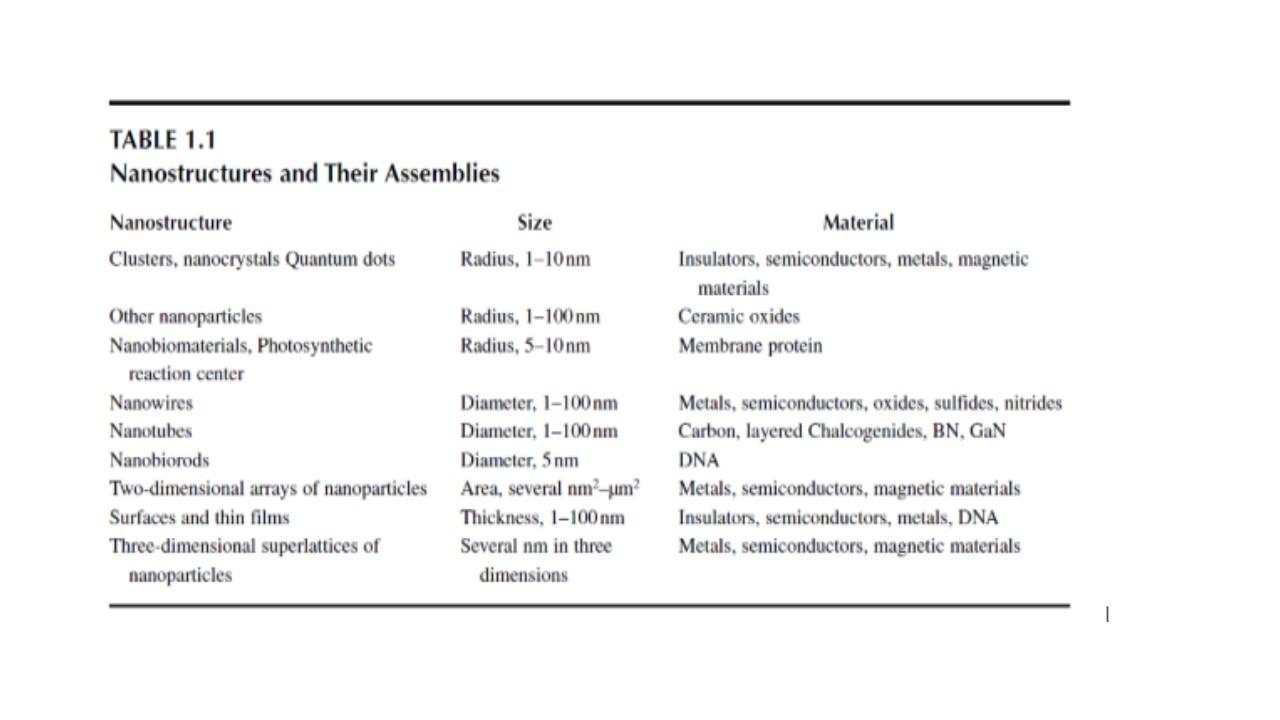
Question: Modify Table 1.1 by including the following: Aspect Ratio, TEM/SEM images and applications. 2. Which of the three methods of nanomaterial solution processing (sol-gel, micro-emulsion
- Modify Table 1.1 by including the following: Aspect Ratio, TEM/SEM images and applications.
 2. Which of the three methods of nanomaterial solution processing (sol-gel, micro-emulsion and precipitation) is cost-effective? Explain your answer.
3. List the analytical tools that could best characterize the mechanical properties of the various nanostructured materials in Table 1.1.
TABLE 1.1 Nanostructures and Their Assemblies Size Nanostructure Clusters, nanocrystals Quantum dots Radius, 1-10nm Material Insulators, semiconductors, metals, magnetic materials Ceramic oxides Membrane protein Radius, 1-100 nm Radius, 5-10 nm Other nanoparticles Nanobiomaterials, Photosynthetic reaction center Nanowires Nanotubes Nanobiorods Two-dimensional arrays of nanoparticles Surfaces and thin films Three-dimensional superlattices of nanoparticles Diameter, 1-100 nm Diameter, 1-100 nm Diameter, 5 nm Area, several nm-um? Thickness, 1-100 nm Several nm in three dimensions Metals, semiconductors, oxides, sulfides, nitrides Carbon, layered Chalcogenides, BN, GAN DNA Metals, semiconductors, magnetic materials Insulators, semiconductors, metals, DNA Metals, semiconductors, magnetic materials
Step by Step Solution
There are 3 Steps involved in it

Get step-by-step solutions from verified subject matter experts
 Study Help