







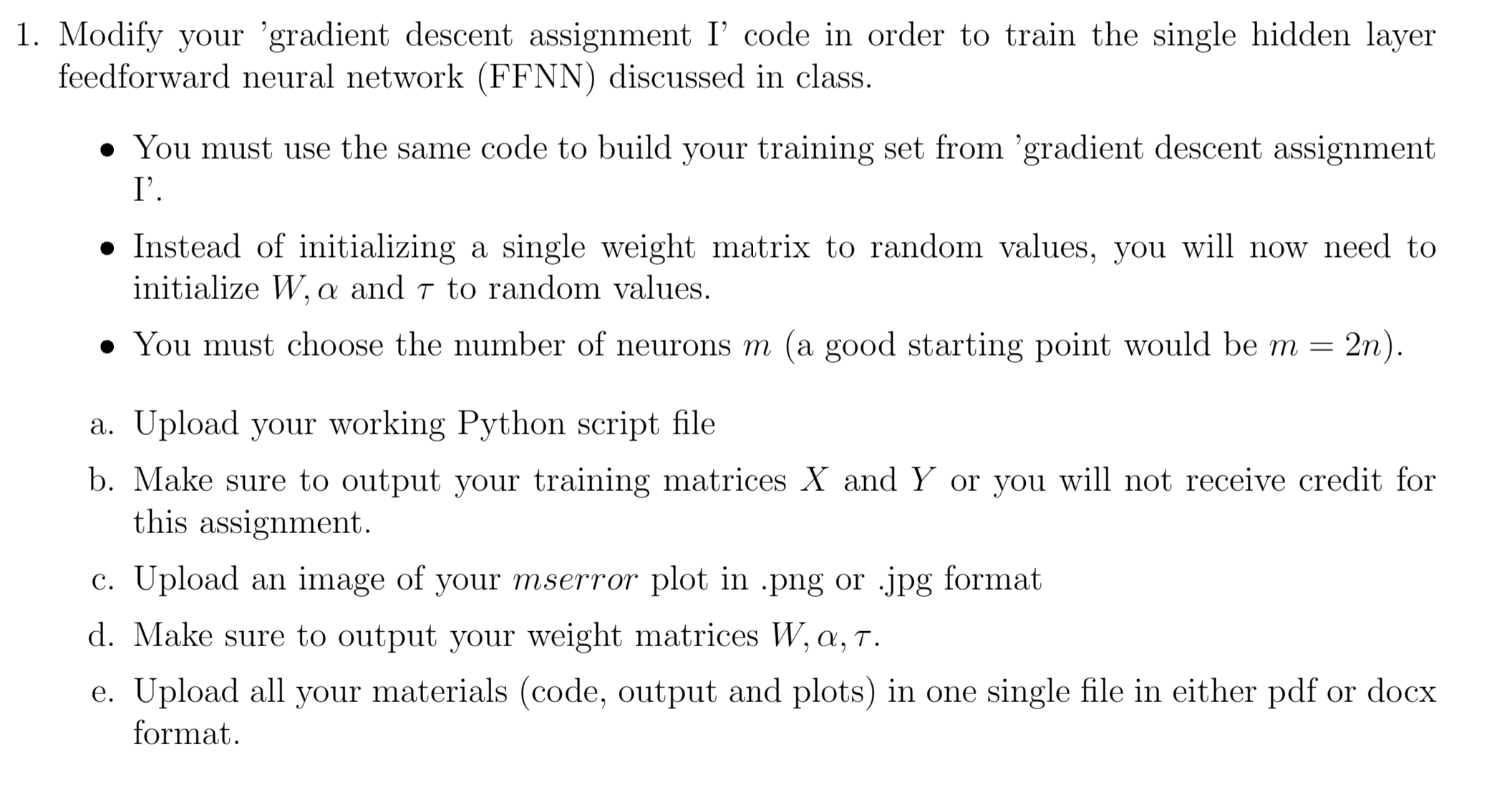
Question: Modify your 'gradient descent assignment I ' code in order to train the single hidden layer feedforward neural network ( FFNN ) discussed in class.
Modify your 'gradient descent assignment I code in order to train the single hidden layer
feedforward neural network FFNN discussed in class.
You must use the same code to build your training set from 'gradient descent assignment
I
Instead of initializing a single weight matrix to random values, you will now need to
initialize and to random values.
You must choose the number of neurons a good starting point would be
a Upload your working Python script file
b Make sure to output your training matrices and or you will not receive credit for
this assignment.
c Upload an image of your mserror plot in png or jpg format
d Make sure to output your weight matrices
e Upload all your materials code output and plots in one single file in either pdf or docx
format.
import numpy as np
import matplotlib.pyplot as plt
def linearnnx y nits, eta:
# initialize dimensions
xshape xshape
yshape yshape
n xshape
N xshape
k yshape
# build the input data matrix
z npones N
a npconcatenatex z axis
# initialize random weights
w nprandom.normalsizek n
# initialize mserror storage
mserror npzeros nits
# train the network using gradient descent
for itcount in rangenits:
Section of code to update network weights
Compute the gradient of the mean squared error and store it in a variable named 'gradientofmse'
gradientofmse npdotnpdotw a y aT
Given the variable 'gradientofmsenorm', update the network weight matrix, w using the gradient descent formula given in class
w w eta gradientofmse
# calculate MSE
etemp
for trcount in rangeN:
# get fXk Yk column vector
avec npconcatenatex: trcount axis
vk npdotw avec y: trcount
# calculate the error
etemp etemp vktranspose vk
mserror itcount N etemp
# test the output
netout npdotw a
return netout, mserror, w
# 'main' starts here
# set up the training set
n
k
N
x nprandom.normalsizen N
y nprandom.normalsizek N
# compute the closed form solution
z npones N
a npconcatenatex z axis
wpinv npdoty nplinalg.pinva
printWeight matrix computed using the pseudoinverse:
printwpinv
print
Section of code to call the gradient descent function to computer the weight matrix
You must input a value for the number of iterations, nits
You must input a value for the learning rate, eta You should run numerical tests with a few different values
nits # Set the number of iterations
eta # Set the learning rate
netout, mserror, w linearnnx y nits, eta
printWeight matrix computed via gradient descent:
printw
print
Compute the sum of the absolute value of the difference between the weight matrices from pinv and gradient descent
wsumabsdiff npsumnpabsolutewpinv w
printSum of absolute value of the difference between weight matrices:
printwsumabsdiff
# plot the mean squared error
pltplotmserror :
plttitleMean Squared Error versus Iteration'
pltxlabelIteration #
pltylabelMSE
pltsavefigplotpng
Step by Step Solution
There are 3 Steps involved in it
1 Expert Approved Answer
Step: 1 Unlock

Question Has Been Solved by an Expert!
Get step-by-step solutions from verified subject matter experts
Step: 2 Unlock
Step: 3 Unlock
 Study Help