Question: Module: Project Managment Question: Identify FIVE (5) risks related to the case study and discuss the relevant response strategies for each risk based on either
Module: Project Managment
 Question: Identify FIVE (5) risks related to the case study and discuss the relevant response strategies for each risk based on either avoidance, acceptance, transference or mitigation Module: Project Managment
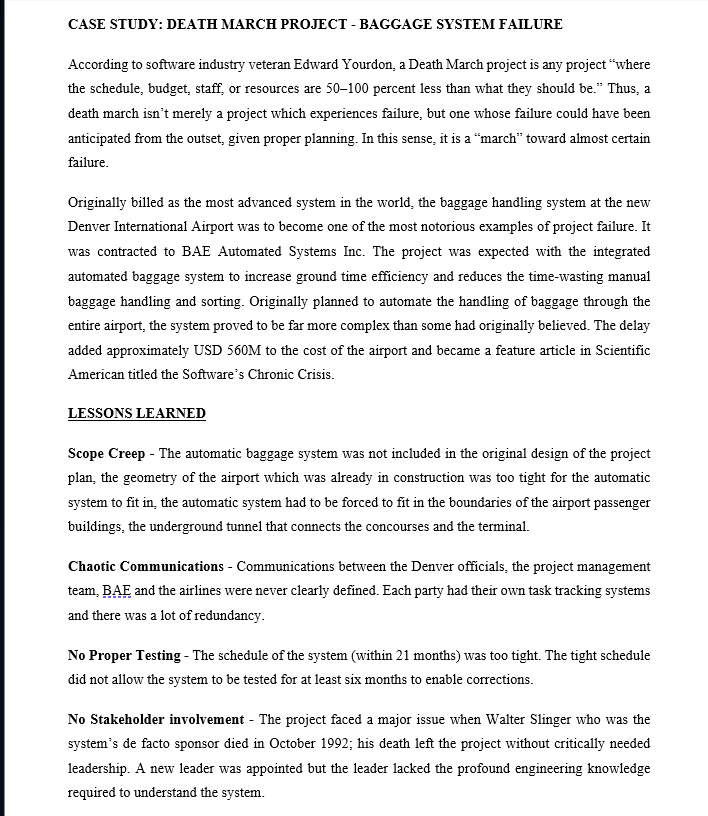
CASE STUDY: DEATH MARCH PROJECT - BAGGAGE SYSTEM FAILURE According to software industry veteran Edward Yourdon, a Death March project is any project "where the schedule, budget, staff, or resources are 50-100 percent less than what they should be." Thus, a death march isn't merely a project which experiences failure, but one whose failure could have been anticipated from the outset, given proper planning. In this sense, it is a "march" toward almost certain failure. Originally billed as the most advanced system in the world, the baggage handling system at the new Denver International Airport was to become one of the most notorious examples of project failure. It was contracted to BAE Automated Systems Inc. The project was expected with the integrated automated baggage system to increase ground time efficiency and reduces the time-wasting manual baggage handling and sorting. Originally planned to automate the handling of baggage through the entire airport, the system proved to be far more complex than some had originally believed. The delay added approximately USD 560M to the cost of the airport and became a feature article in Scientific American titled the Software's Chronic Crisis. LESSONS LEARNED Scope Creep - The automatic baggage system was not included in the original design of the project plan, the geometry of the airport which was already in construction was too tight for the automatic system to fit in, the automatic system had to be forced to fit in the boundaries of the airport passenger buildings, the underground tunnel that connects the concourses and the terminal. Chaotic Communications - Communications between the Denver officials, the project management team, BAE and the airlines were never clearly defined. Each party had their own task tracking systems and there was a lot of redundancy. No Proper Testing - The schedule of the system (within 21 months) was too tight. The tight schedule did not allow the system to be tested for at least six months to enable corrections. No Stakeholder involvement - The project faced a major issue when Walter Slinger who was the system's de facto sponsor died in October 1992; his death left the project without critically needed leadership. A new leader was appointed but the leader lacked the profound engineering knowledge required to understand the system









 Study Help