





Question: Module Six Discussion Question: Solve the problem below. For your initial post in Brightspace. copy the description of your company given in the box below
Module Six Discussion Question: Solve the problem
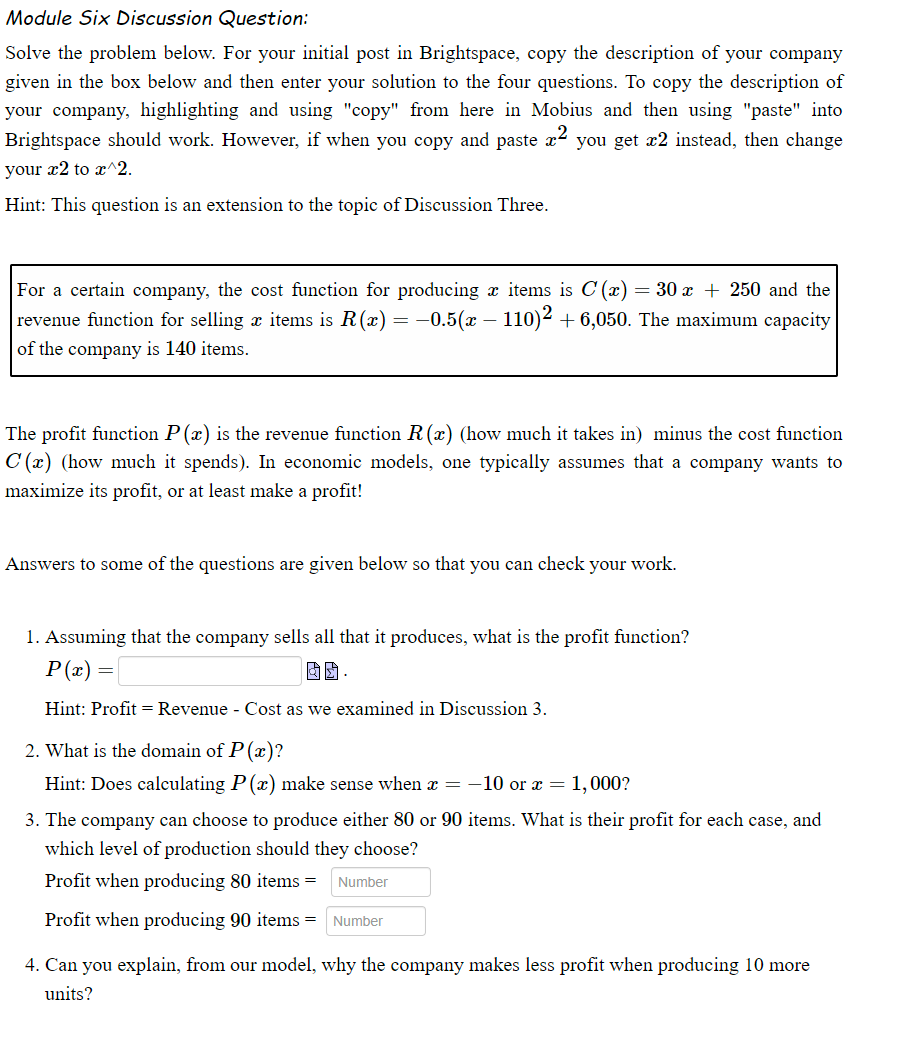
Module Six Discussion Question: Solve the problem below. For your initial post in Brightspace. copy the description of your company given in the box below and then enter your solution to the four questions. To copy the description of your company. highlighting and using "copy" from here in Mobius and then using "paste" into 2 Brightspace should work. However. if when you copy and paste w you get 1172 instead. then change your $2 to arm-2. Hint: This question is an extension to the topic of Discussion Three. For a certain company. the cost lnction for producing a: items is C (m) = 30 a? + 250 and the revenue function for selling 3: items is R{:c) = U.5($ 110)2 + 6,050. The maximum capacity of the company is 140 items. The prot function P (a?) is the revenue function R (at) [how much it takes in] minus the cost function 0(3) {how much it spends}. In economic models. one typically assumes that a company wants to maximize its prot. or at least make a prot! Answers to some of the questions are given below so that you can check your work. 1. Assuming that the company sells all that it produces. what is the profit function? P {as} = @ E - Hint: Profit = Revenue Cost as we examined in Discussion 3. 2. What is the domain of P {m}? Hint: Does calculating P{a:} make sense when :r: = 1U or w = 1. 000? 3. The company can choose to produce either 80 or 90 items. 'What is their profit for each case. and which level of production should they choose\"? Profit when producing 80 items = ":5 Profit when producing 90 items = -- ::e' 4. Can you explain. from our model. why the company makes less profit when producing 10 more units

Step by Step Solution

There are 3 Steps involved in it

1 Expert Approved Answer
Step: 1 Unlock blur-text-image

Question Has Been Solved by an Expert!

Get step-by-step solutions from verified subject matter experts

Step: 2 Unlock
Step: 3 Unlock

Students Have Also Explored These Related Mathematics Questions!