







Question: Module Three Discussion Question: Solve the problem below. Copy the description of your forecast in the box below and include that as part of your
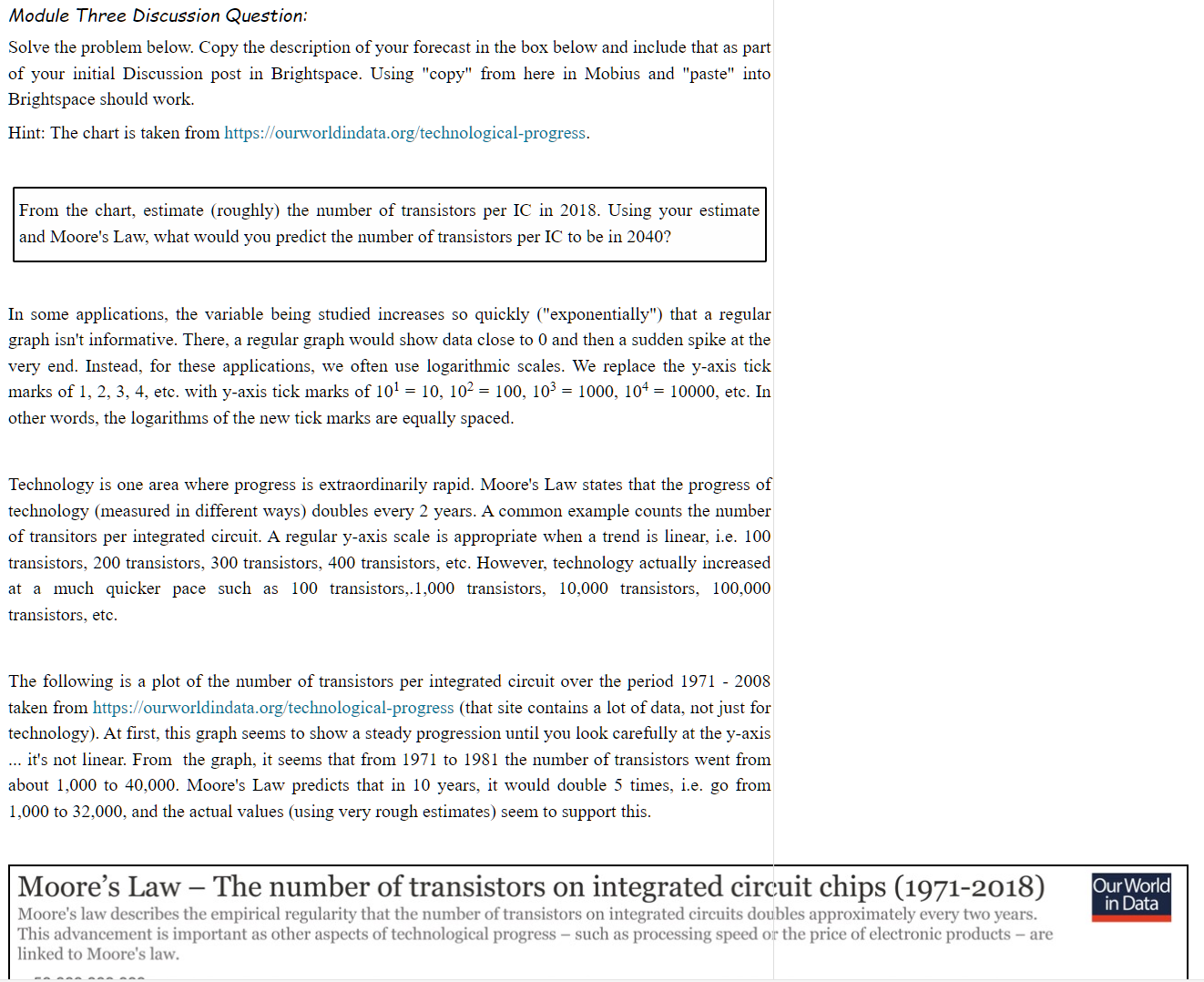
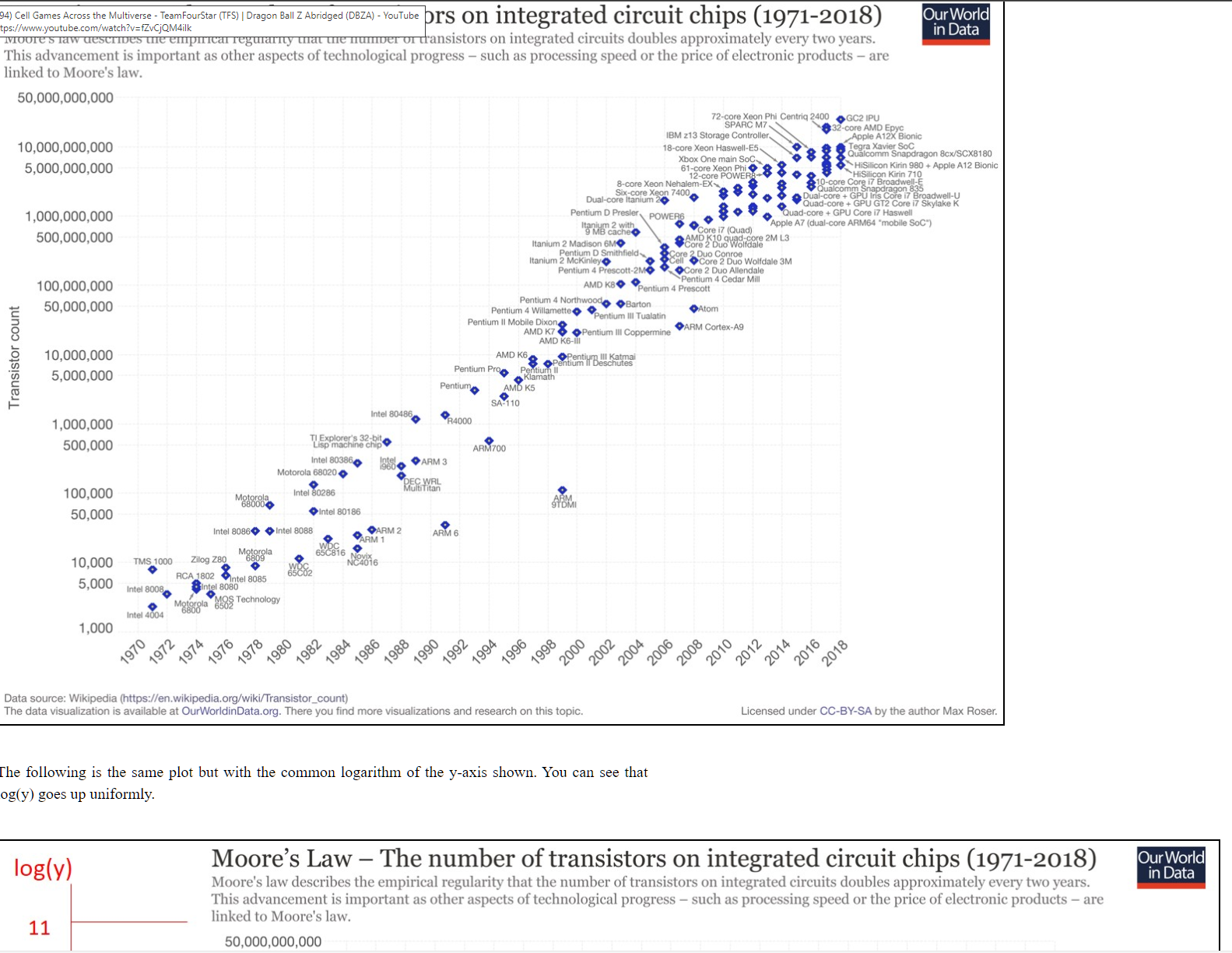
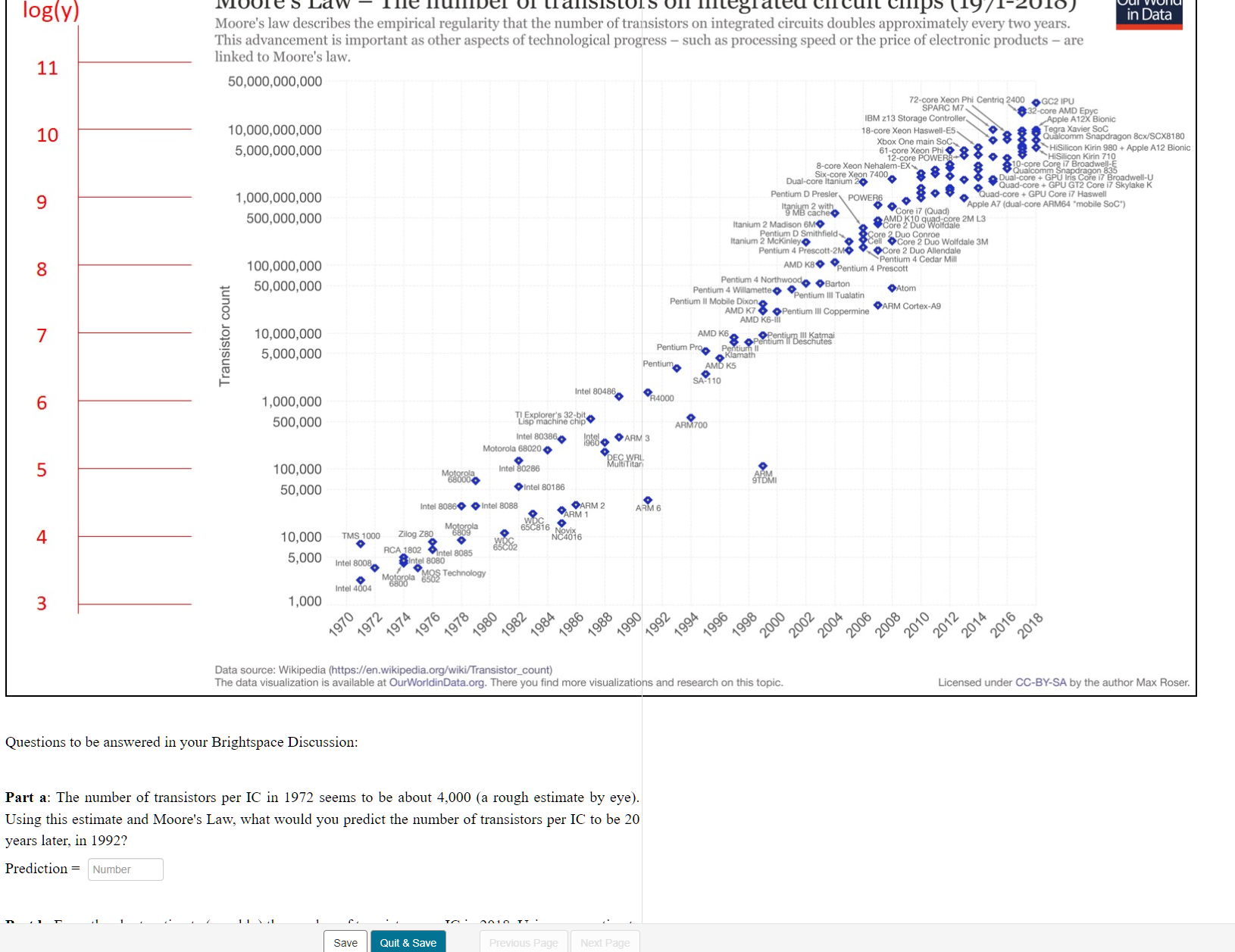
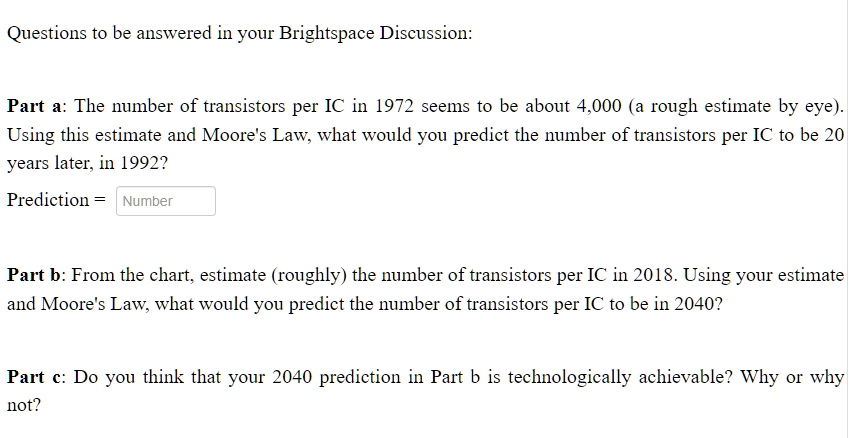
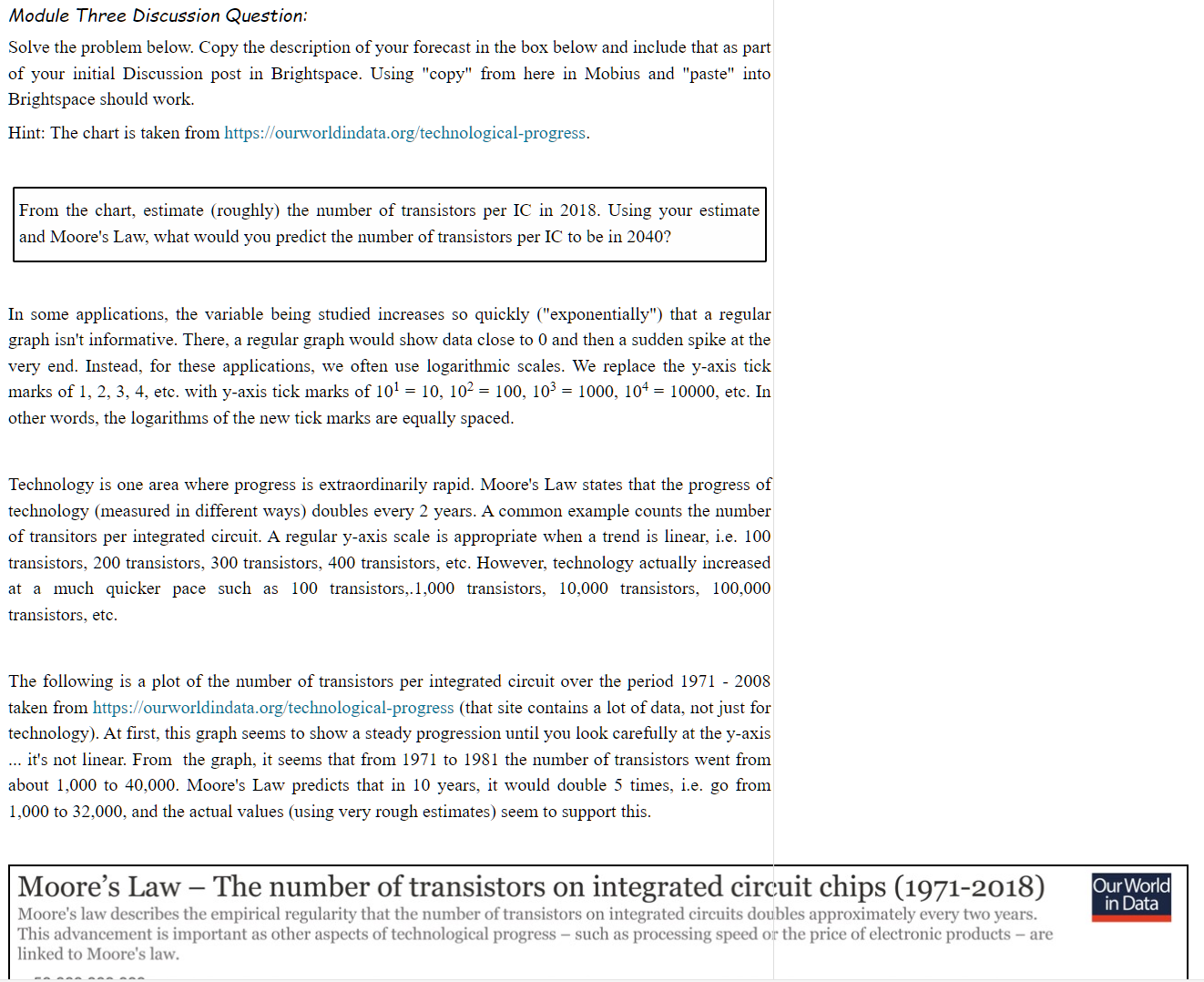
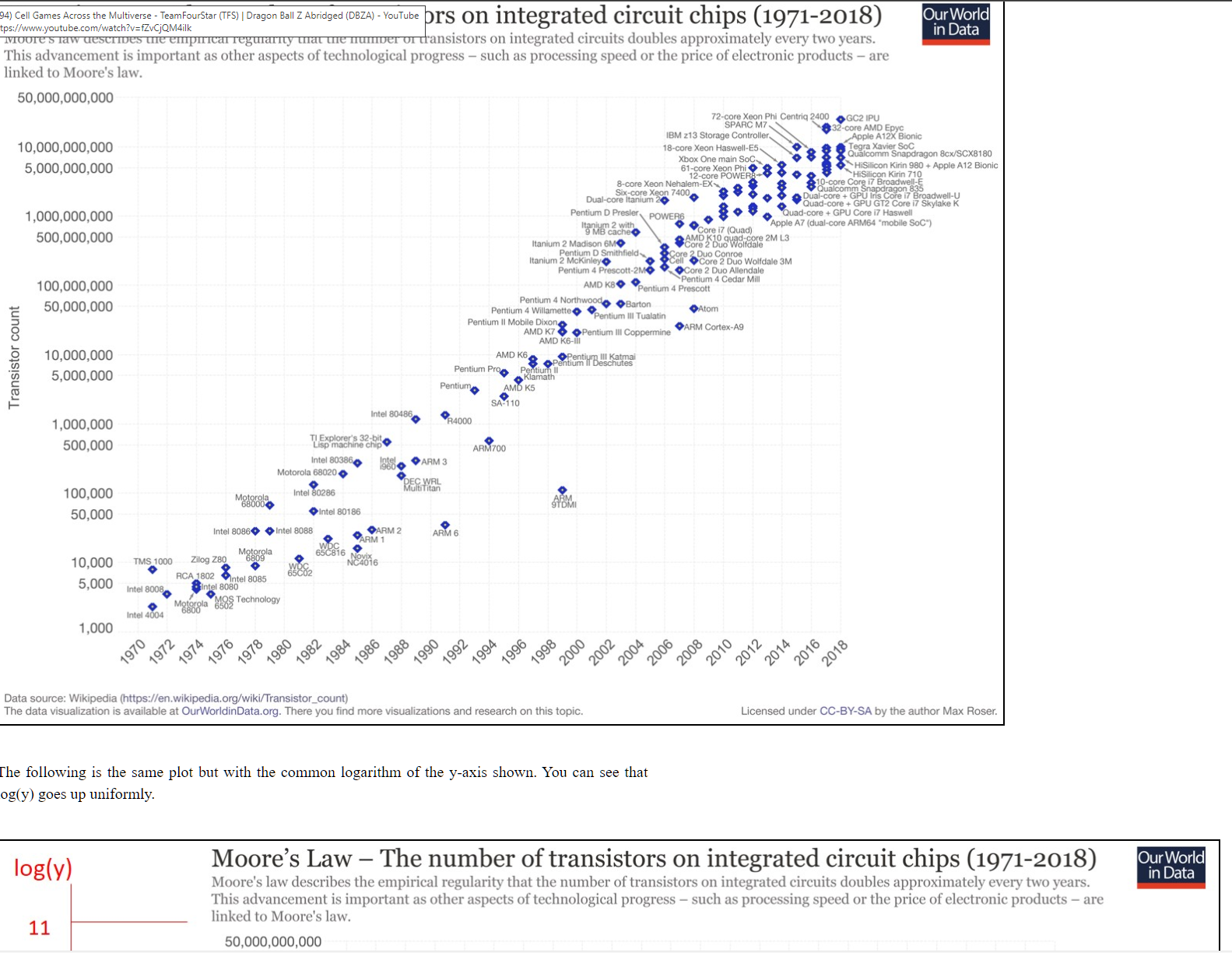
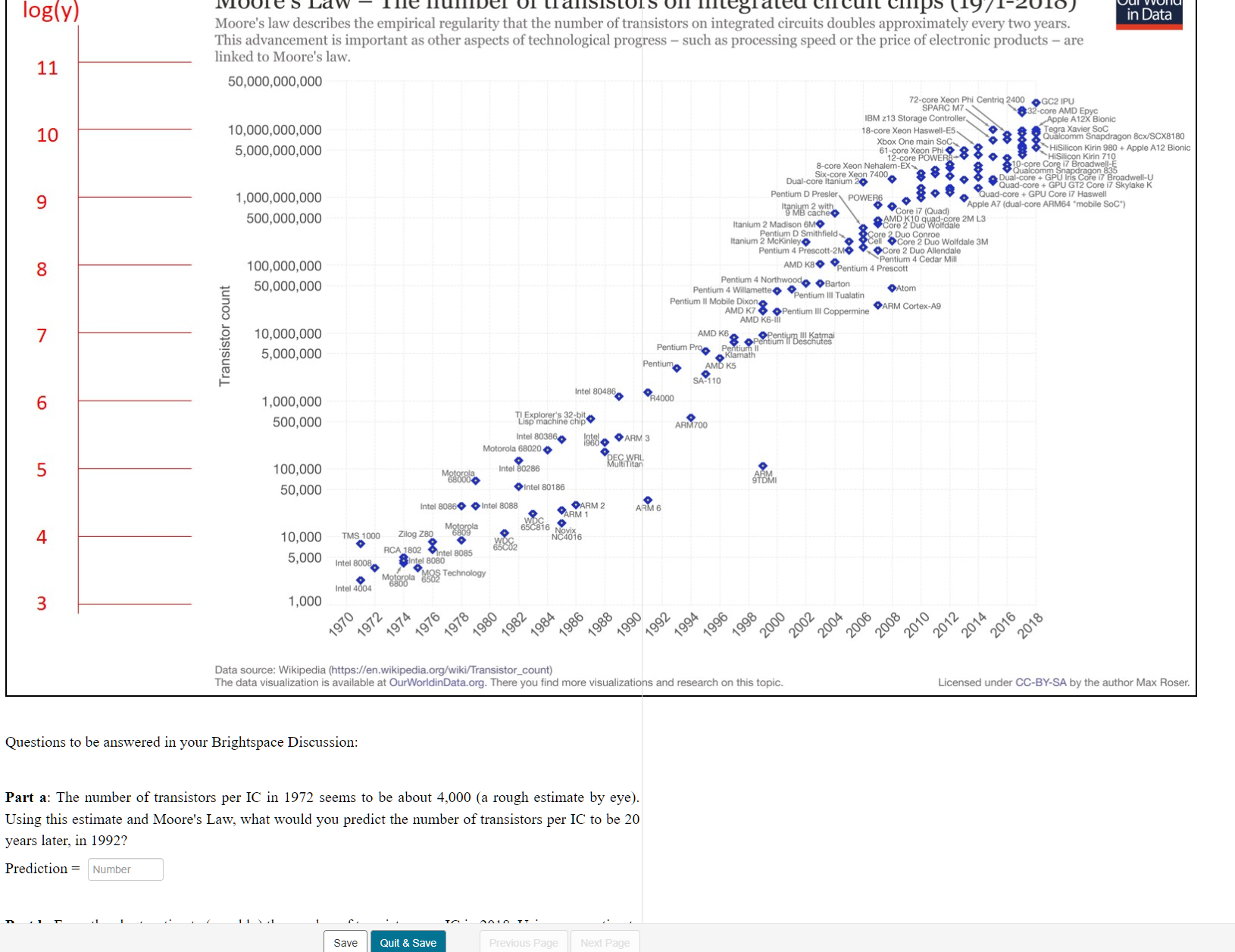
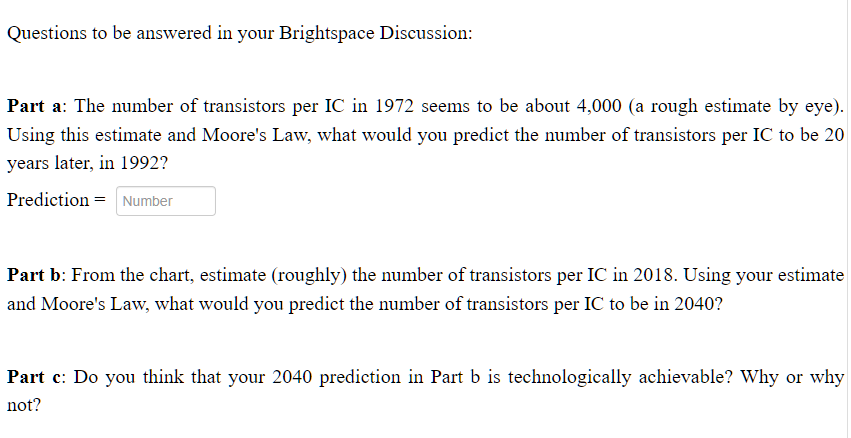
Module Three Discussion Question: Solve the problem below. Copy the description of your forecast in the box below and include that as part of your initial Discussion post in Brightspace. Using "copy" from here in Mobius and "paste" into Brightspace should work. Hint: The chart is taken from https://ourworldindata.org/technological-progress. From the chart, estimate (roughly) the number of transistors per IC in 2018. Using your estimate and Moore's Law, what would you predict the number of transistors per IC to be in 2040? In some applications, the variable being studied increases so quickly ("exponentially") that a regular graph isn't informative. There, a regular graph would show data close to 0 and then a sudden spike at the very end. Instead, for these applications, we often use logarithmic scales. We replace the y-axis tick marks of 1, 2, 3, 4, etc. with y-axis tick marks of 101 = 10, 102 = 100, 103 = 1000, 104 = 10000, etc. In other words, the logarithms of the new tick marks are equally spaced. Technology is one area where progress is extraordinarily rapid. Moore's Law states that the progress of technology (measured in different ways) doubles every 2 years. A common example counts the number of transitors per integrated circuit. A regular y-axis scale is appropriate when a trend is linear, i.e. 100 transistors, 200 transistors, 300 transistors, 400 transistors, etc. However, technology actually increased at a much quicker pace such as 100 transistors,. 1,000 transistors, 10,000 transistors, 100,000 transistors, etc. The following is a plot of the number of transistors per integrated circuit over the period 1971 - 2008 taken from https:/ourworldindata.org/technological-progress (that site contains a lot of data, not just for technology). At first, this graph seems to show a steady progression until you look carefully at the y-axis .. it's not linear. From the graph, it seems that from 1971 to 1981 the number of transistors went from about 1,000 to 40,000. Moore's Law predicts that in 10 years, it would double 5 times, i.e. go from 1,000 to 32,000, and the actual values (using very rough estimates) seem to support this. Moore's Law - The number of transistors on integrated circuit chips (1971-2018) Our World Moore's law describes the empirical regularity that the number of transistors on integrated circuits doubles approximately every two years. in Data This advancement is important as other aspects of technological progress - such as processing speed or the price of electronic products - are linked to Moore's law.4) Cell Games Across the Multiverse - TeamFourStar (TFS) | Dragon Ball Z Abridged (DBZA) - YouTube ors on integrated circuit chips (1971-2018) Our World ps://www.youtube.com/watch?v=fZvCjQM4ilk in Data Moore's Taw describes the empirical regularity that the number or transistors on integrated circuits doubles approximately every two years. This advancement is important as other aspects of technological progress - such as processing speed or the price of electronic products - are linked to Moore's law. 50,000,000,000 ore Xeon Phi Centriq 2400 72- SPARC M7 GC2 IPU IBM z13 Storage Controller, core AMD Epyc Apple A12X Bionic 10,000,000,000 18-core Xeon Haswell-ED Xbox One main SoC. Qualcomm Snapdragon 8cx/SCX8180 5,000,000,000 61-core xeon con Kirin 980 + Apple A12 Bionic 12-core PO HiSilicon Kirin 710 8-core Xeon Nehalem-EX -pore Gorg if Broads 825 Dual-core itanium 20 Quad-core + GPU GT2 Core i7 Skylal 1,000,000,000 Pentium D Presler POWER Quad-core + GPU Core i7 Haswell 9 MB cached Apple A7 (dual-core ARM64 "mobile SoC") 500,000,000 Core 17 (Quad Itanium 2 Madison 6M um D Smi 2 Duo Wolfdale Itanium 2 Mckinley field Core 2 Duo Wolfdale 3M Pentium 4 Prescott-2MQ ore 2 Duo Allendale 100,000,000 `Pentium 4 Cedar Mill AMD K8 Pentium 4 Prescott 50,000,000 Pentium 4 Northwood Barton Pentium 4 Willamette Atom Pentium II Mobile Dixon Pentium III Tualatin AMD K7 Pentium III Coppermine WARM Cortex-Ag AMD K6-III Transistor count 10,000,000 AMD Kog Pentium il Deschutes 5,000,000 Pentium Pro Klamath Pentium AMD KS SA-110 Intel 80486 1,000,000 924000 500,000 Lisp machine chip ARM700 Intel 803860 9609 9 ARM 3 Motorola 68020 100,000 Intel 80286 MultiTitan 86800% 50,000 Intel 80186 Intel 80860
Step by Step Solution
There are 3 Steps involved in it

Get step-by-step solutions from verified subject matter experts
 Study Help