







Question: MODULE V: RISK AND RETURN INTRODUCTION To bemer understand the relationship between return and risk, we must know how and risk are measured first. RATE
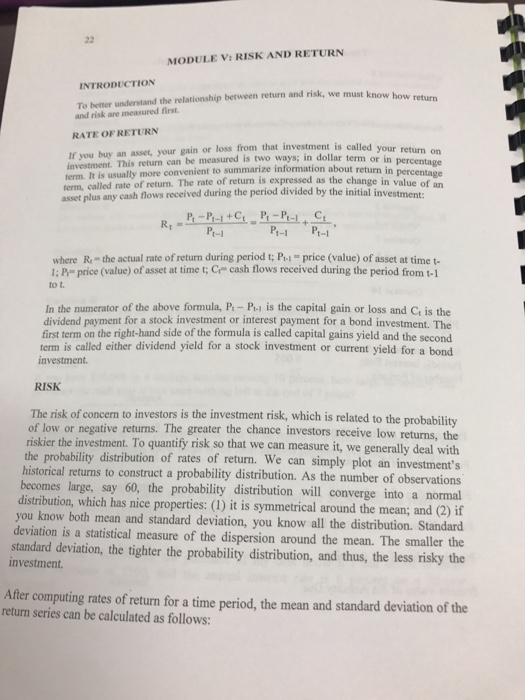
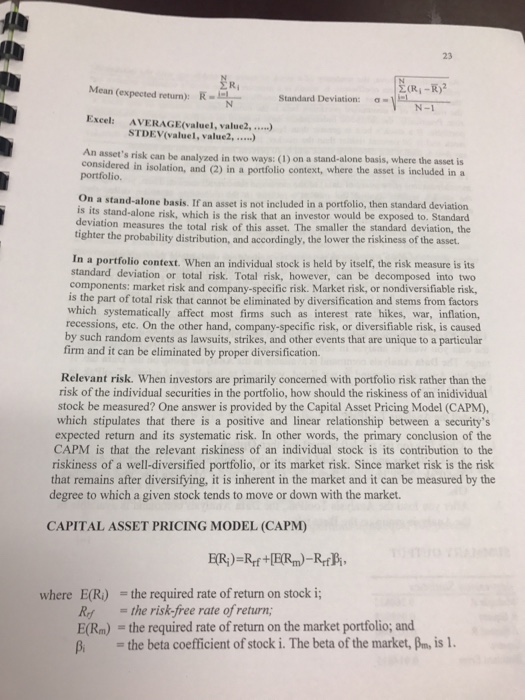
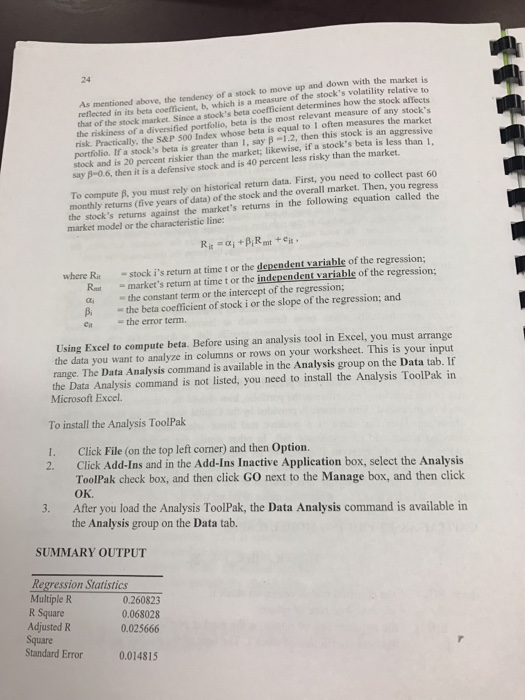
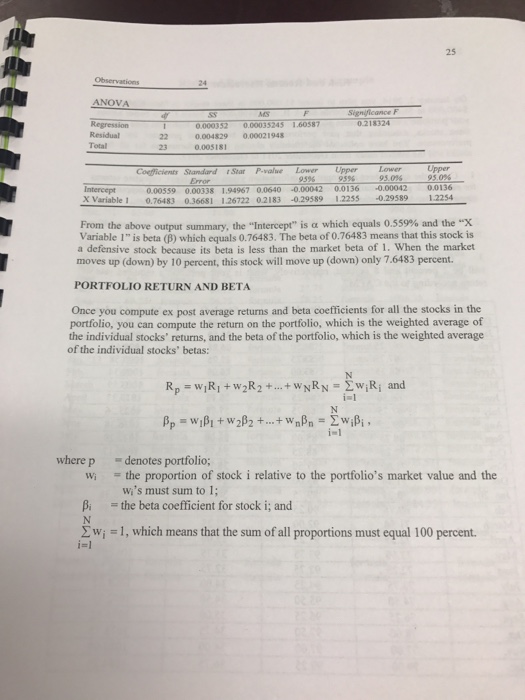
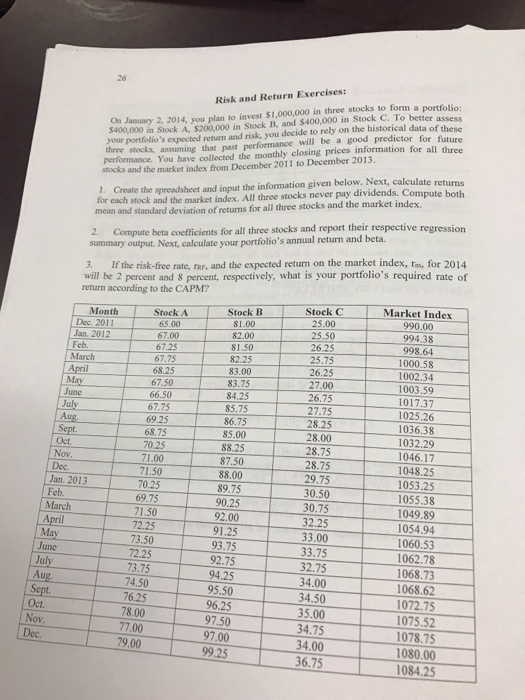
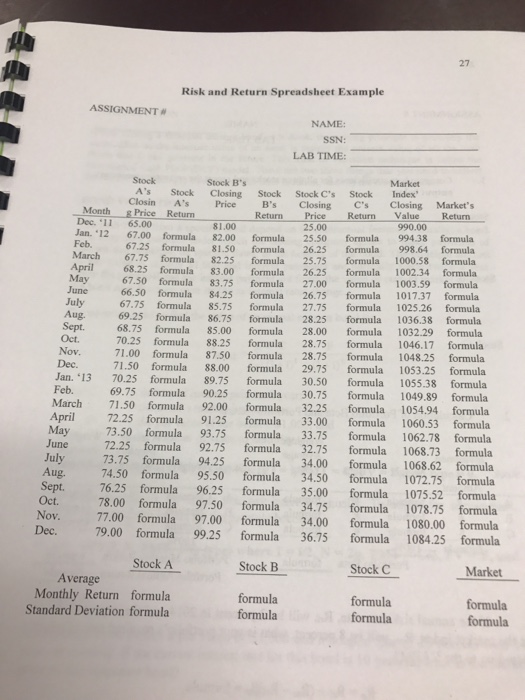
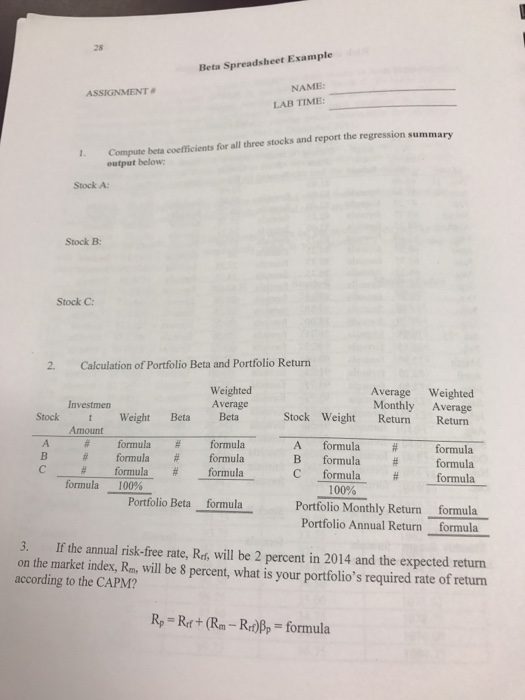
MODULE V: RISK AND RETURN INTRODUCTION To bemer understand the relationship between return and risk, we must know how and risk are measured first. RATE OF RETURN asset, your from that investment is called your return on investment. This return can be measured is two ways; in dollar or term. It is usually more convenient to summarize information about return in value of an term, called rate of return. The rate of return is expressed as change in plus any cash flows received during the period divided by the initial t-1 where R the actual rate of return during period t; Pi price (value) of asset at time t- 1; P-price (value) of asset at time t Ce cash flows received during the period from t-1 In the numerator of the above formula, P Pt-I is the capital gain or loss and ct is the dividend payment for a stock investment or interest payment for a bond investment. on the right-hand side of the formula is called capital gains yield and the second term is called either dividend yield for a stock investment or current yield for a bond The risk of concern to investors is the investment risk, which is related to the probability of low or negative retums. The greater the chance investors receive low returns, the riskier the investment. quantify risk so that we can measure it, we generally deal with the probability distribution of rates of return. We can simply plot an investment's historical returns to construct a probability distribution. As the number of observations becomes large, say 60, the probability distribution will converge normal distribution, which has nice into a properties: (l you know both mean and standard it is symmetrical around the mean; and (2) if deviation deviation, you know all the distribution. Standard standard is a statistical measure of the dispersion around the mean. The smaller the deviation, the tighter the probability distribution, and thus, the less risky the investment. After computing rates of return for a time period, the mean and standard deviation of the return series can be calculated as follows: MODULE V: RISK AND RETURN INTRODUCTION To bemer understand the relationship between return and risk, we must know how and risk are measured first. RATE OF RETURN asset, your from that investment is called your return on investment. This return can be measured is two ways; in dollar or term. It is usually more convenient to summarize information about return in value of an term, called rate of return. The rate of return is expressed as change in plus any cash flows received during the period divided by the initial t-1 where R the actual rate of return during period t; Pi price (value) of asset at time t- 1; P-price (value) of asset at time t Ce cash flows received during the period from t-1 In the numerator of the above formula, P Pt-I is the capital gain or loss and ct is the dividend payment for a stock investment or interest payment for a bond investment. on the right-hand side of the formula is called capital gains yield and the second term is called either dividend yield for a stock investment or current yield for a bond The risk of concern to investors is the investment risk, which is related to the probability of low or negative retums. The greater the chance investors receive low returns, the riskier the investment. quantify risk so that we can measure it, we generally deal with the probability distribution of rates of return. We can simply plot an investment's historical returns to construct a probability distribution. As the number of observations becomes large, say 60, the probability distribution will converge normal distribution, which has nice into a properties: (l you know both mean and standard it is symmetrical around the mean; and (2) if deviation deviation, you know all the distribution. Standard standard is a statistical measure of the dispersion around the mean. The smaller the deviation, the tighter the probability distribution, and thus, the less risky the investment. After computing rates of return for a time period, the mean and standard deviation of the return series can be calculated as follows
Step by Step Solution
There are 3 Steps involved in it

Get step-by-step solutions from verified subject matter experts
 Study Help