







Question: MONTE CARLO SIMULATION The procedures described here will allow you to make decisions throughout the duration of a project. You will define goals considering specific
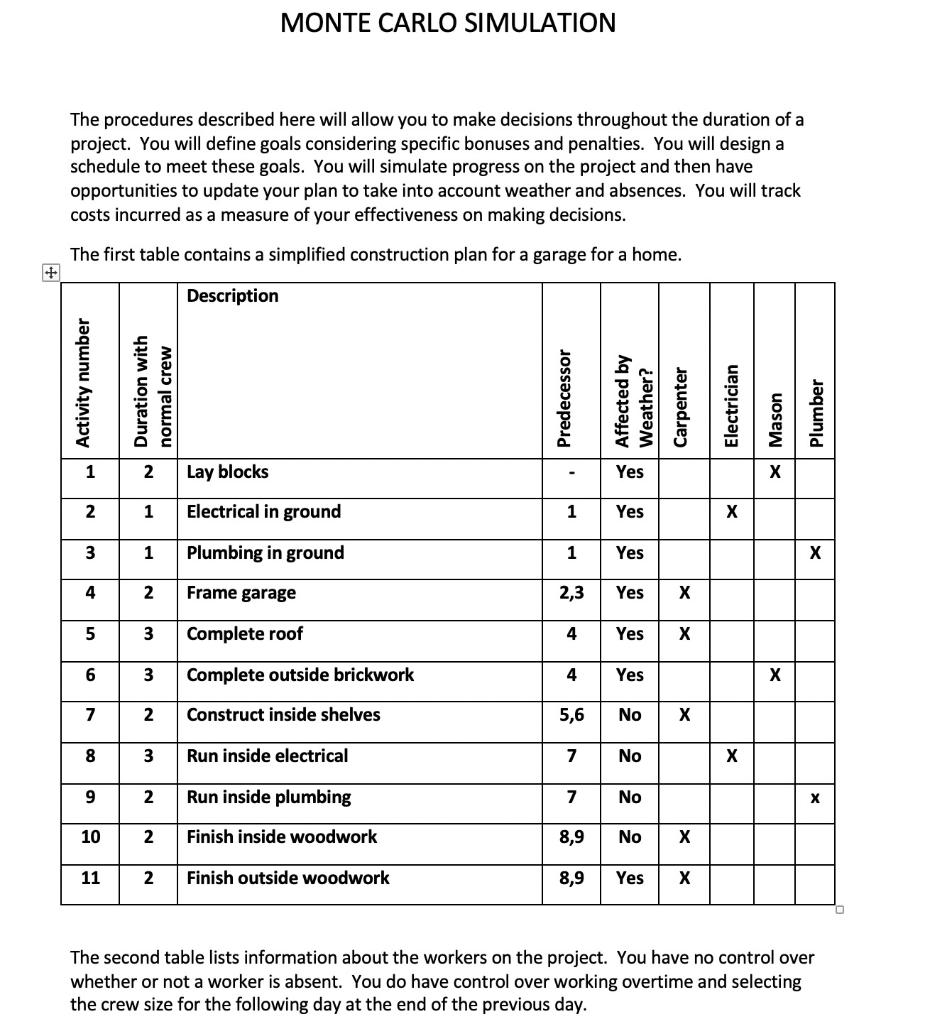
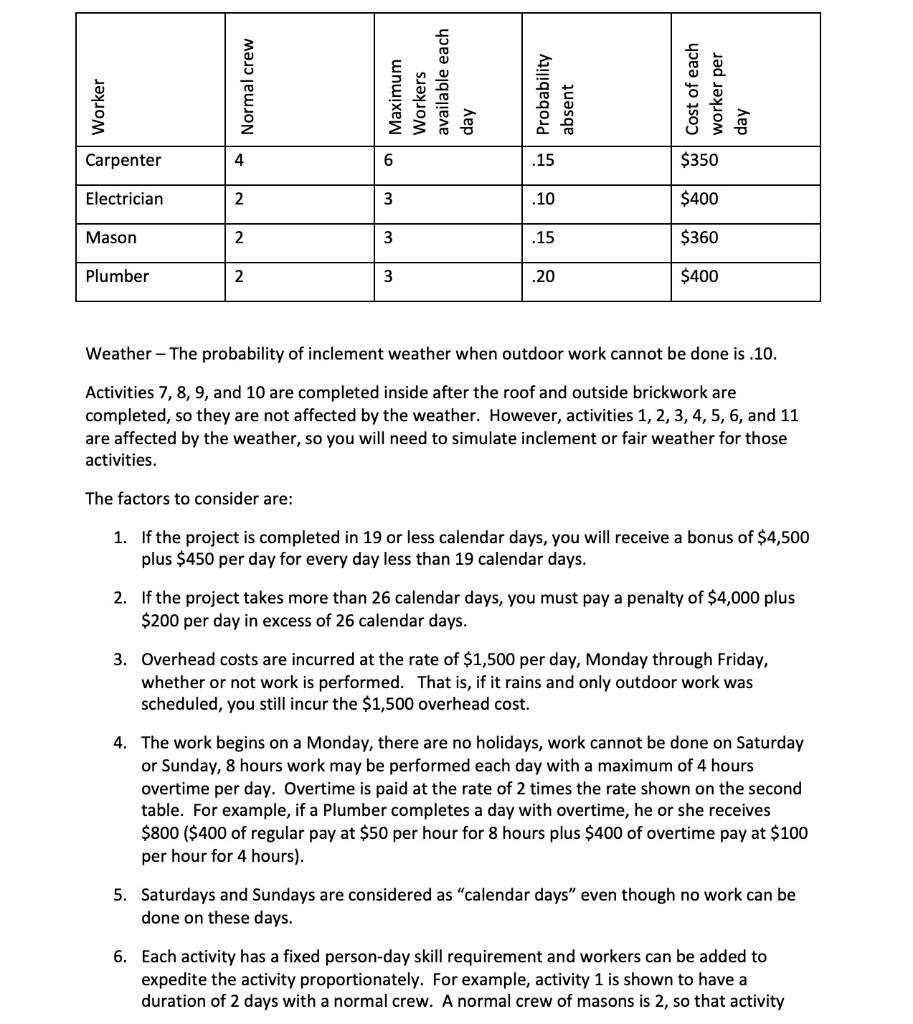
MONTE CARLO SIMULATION The procedures described here will allow you to make decisions throughout the duration of a project. You will define goals considering specific bonuses and penalties. You will design a schedule to meet these goals. You will simulate progress on the project and then have opportunities to update your plan to take into account weather and absences. You will track costs incurred as a measure of your effectiveness on making decisions. The first table contains a simplified construction plan for a garage for a home. Description Activity number Duration with normal crew 1 2 Lay blocks Yes 2 1 Electrical in ground 1 Yes 3 1 Plumbing in ground 1 Yes 1 4 NI Frame garage 2,3 Yes 5 3 Complete roof 4 Yes 6 3 Complete outside brickwork 4 Yes 7 2 Construct inside shelves 5,6 No 8 3 Run inside electrical 7 No 9 9 NI Run inside plumbing 7 No 10 2 Finish inside woodwork 8,9 No 11 2 Finish outside woodwork 8,9 Yes The second table lists information about the workers on the project. You have no control over whether or not a worker is absent. You do have control over working overtime and selecting the crew size for the following day at the end of the previous day. Worker Normal crew Maximum Workers available each Probability absent w Cost of each worker per day Carpenter 4 6 .15 Electrician 2 3 .10 $400 Mason 2 3 .15 $360 Plumber 2 3 20 $400 Weather - The probability of inclement weather when outdoor work cannot be done is .10. Activities 7, 8, 9, and 10 are completed inside after the roof and outside brickwork are completed, so they are not affected by the weather. However, activities 1, 2, 3, 4, 5, 6, and 11 are affected by the weather, so you will need to simulate inclement or fair weather for those activities. The factors to consider are: 1. If the project is completed in 19 or less calendar days, you will receive a bonus of $4,500 plus $450 per day for every day less than 19 calendar days. 2. If the project takes more than 26 calendar days, you must pay a penalty of $4,000 plus $200 per day in excess of 26 calendar days. 3. Overhead costs are incurred at the rate of $1,500 per day, Monday through Friday, whether or not work is performed. That is, if it rains and only outdoor work was scheduled, you still incur the $1,500 overhead cost. 4. The work begins on a Monday, there are no holidays, work cannot be done on Saturday or Sunday, 8 hours work may be performed each day with a maximum of 4 hours overtime per day. Overtime is paid at the rate of 2 times the rate shown on the second table. For example, if a Plumber completes a day with overtime, he or she receives $800 ($400 of regular pay at $50 per hour for 8 hours plus $400 of overtime pay at $100 per hour for 4 hours). 5. Saturdays and Sundays are considered as "calendar days even though no work can be done on these days. 6. Each activity has a fixed person-day skill requirement and workers can be added to expedite the activity proportionately. For example, activity 1 is shown to have a duration of 2 days with a normal crew. A normal crew of masons is 2, so that activity would take 4 mason-days. So, you could also complete the activity using 3 masons in one day and 1 mason for one day. You could also complete it by having 3 masons work one day and having 2 masons work overtime the same day. 7. A new activity can be started only at the beginning of the day, the middle of the day, or at the start of an overtime period (that is, it can only start every 4 hours). If it turns out during the simulation that you can start an activity, but did not schedule workers to come in that day, you cannot work on that activity. 8. Workers are not paid for inclement days. 9. If you call for a worker and the worker does not show up the following day, you do not pay that worker. So, for example, on a Tuesday evening you schedule 5 carpenters and only 3 show up on Wednesday, you only pay $350/day for regular pay for the three carpenters who do show up. 10. You must pay for workers on fair weather days even if they do not work. That is, if you bring in electricians, but the preceding brickwork has not been completed, you must still pay the electricians. If you schedule too many workers for an activity and more show up than you need, you must still pay the idle workers. That is, if you require 2 mason-days of work, but 3 masons show up, you must pay for the 3 masons. Overtime does not have to be scheduled in advance. That is, after you find out how many workers show up on a given day, you may ask them to work overtime that day. 11. To assist in making the problem less complicated, do not allow more than 4 inclement days to occur. SIMULATING PROGRESS The occurrence of a given factor is determined by reference to a random number table. Consider only those factors that affect the activities occurring on the day under consideration. Refer to the second table to determine the effect of the factor. For example, consider activity 1. It is affected by the weather. Using the table of random numbers from Slide 17 of Lecture 9, if you begin at the top of the fifth column of with the number 58, because it is between 15 and 99, work can be done that day. Assume that you have scheduled two masons to work that day. The next number below 58 on the random number table is 43, so the first mason has shown up for work. The next number below that is 10, indicating that the second mason did not show up. So, for that day only 1 mason-day of work will be accomplished. However, you could ask the first mason to work overtime, in which case 1.5 mason-days of work will be accomplished. Note that it would not have been necessary to check on masons if the weather had been inclement. You cannot "look ahead" on the random number table to see if the numbers of the following day would indicate inclement weather or whether or not workers will be absent. Your objective is to complete the project at minimum cost. The required parts of your paper are in boldface type. 1. You must first draw the activity network to represent the plan using the durations shown in the first table. 2. In one paragraph, describe the overall strategy you will use to determine whether or not you will use overtime and the strategy you will use to determine the number of workers to schedule for the following day. 3. To keep track of the costs you incur, you must develop a chart to show for each day: a. How much you pay for the workers in dollars b. How much overtime you incur in hours c. Your overhead costs in dollars d. Any overtime costs in dollars 4. Your chart should also show if work could not be done because of inclement weather. 5. You need to describe at the end of each day the number and type of worker that you want to come in the following day. Say, for example, knowing that you have to begin activity 3, Plumbing in Ground, on day 4, at the end of day 3 you have to say that you are going to call 3 plumbers to see if they could come in at the beginning of day 4. 6. After you have completed your simulation, you should summarize the total cost of completing the project. In keeping with good Total Quality Management procedures, you should describe any lessons learned during the simulation. That is, think about your initial strategy in terms of use of overtime and number of workers scheduled per day and describe what, if anything, you would have done differently. The paper is due on April 28. There will be a reduction of one letter grade for each week the paper is past due. MONTE CARLO SIMULATION The procedures described here will allow you to make decisions throughout the duration of a project. You will define goals considering specific bonuses and penalties. You will design a schedule to meet these goals. You will simulate progress on the project and then have opportunities to update your plan to take into account weather and absences. You will track costs incurred as a measure of your effectiveness on making decisions. The first table contains a simplified construction plan for a garage for a home. Description Activity number Duration with normal crew 1 2 Lay blocks Yes 2 1 Electrical in ground 1 Yes 3 1 Plumbing in ground 1 Yes 1 4 NI Frame garage 2,3 Yes 5 3 Complete roof 4 Yes 6 3 Complete outside brickwork 4 Yes 7 2 Construct inside shelves 5,6 No 8 3 Run inside electrical 7 No 9 9 NI Run inside plumbing 7 No 10 2 Finish inside woodwork 8,9 No 11 2 Finish outside woodwork 8,9 Yes The second table lists information about the workers on the project. You have no control over whether or not a worker is absent. You do have control over working overtime and selecting the crew size for the following day at the end of the previous day. Worker Normal crew Maximum Workers available each Probability absent w Cost of each worker per day Carpenter 4 6 .15 Electrician 2 3 .10 $400 Mason 2 3 .15 $360 Plumber 2 3 20 $400 Weather - The probability of inclement weather when outdoor work cannot be done is .10. Activities 7, 8, 9, and 10 are completed inside after the roof and outside brickwork are completed, so they are not affected by the weather. However, activities 1, 2, 3, 4, 5, 6, and 11 are affected by the weather, so you will need to simulate inclement or fair weather for those activities. The factors to consider are: 1. If the project is completed in 19 or less calendar days, you will receive a bonus of $4,500 plus $450 per day for every day less than 19 calendar days. 2. If the project takes more than 26 calendar days, you must pay a penalty of $4,000 plus $200 per day in excess of 26 calendar days. 3. Overhead costs are incurred at the rate of $1,500 per day, Monday through Friday, whether or not work is performed. That is, if it rains and only outdoor work was scheduled, you still incur the $1,500 overhead cost. 4. The work begins on a Monday, there are no holidays, work cannot be done on Saturday or Sunday, 8 hours work may be performed each day with a maximum of 4 hours overtime per day. Overtime is paid at the rate of 2 times the rate shown on the second table. For example, if a Plumber completes a day with overtime, he or she receives $800 ($400 of regular pay at $50 per hour for 8 hours plus $400 of overtime pay at $100 per hour for 4 hours). 5. Saturdays and Sundays are considered as "calendar days even though no work can be done on these days. 6. Each activity has a fixed person-day skill requirement and workers can be added to expedite the activity proportionately. For example, activity 1 is shown to have a duration of 2 days with a normal crew. A normal crew of masons is 2, so that activity would take 4 mason-days. So, you could also complete the activity using 3 masons in one day and 1 mason for one day. You could also complete it by having 3 masons work one day and having 2 masons work overtime the same day. 7. A new activity can be started only at the beginning of the day, the middle of the day, or at the start of an overtime period (that is, it can only start every 4 hours). If it turns out during the simulation that you can start an activity, but did not schedule workers to come in that day, you cannot work on that activity. 8. Workers are not paid for inclement days. 9. If you call for a worker and the worker does not show up the following day, you do not pay that worker. So, for example, on a Tuesday evening you schedule 5 carpenters and only 3 show up on Wednesday, you only pay $350/day for regular pay for the three carpenters who do show up. 10. You must pay for workers on fair weather days even if they do not work. That is, if you bring in electricians, but the preceding brickwork has not been completed, you must still pay the electricians. If you schedule too many workers for an activity and more show up than you need, you must still pay the idle workers. That is, if you require 2 mason-days of work, but 3 masons show up, you must pay for the 3 masons. Overtime does not have to be scheduled in advance. That is, after you find out how many workers show up on a given day, you may ask them to work overtime that day. 11. To assist in making the problem less complicated, do not allow more than 4 inclement days to occur. SIMULATING PROGRESS The occurrence of a given factor is determined by reference to a random number table. Consider only those factors that affect the activities occurring on the day under consideration. Refer to the second table to determine the effect of the factor. For example, consider activity 1. It is affected by the weather. Using the table of random numbers from Slide 17 of Lecture 9, if you begin at the top of the fifth column of with the number 58, because it is between 15 and 99, work can be done that day. Assume that you have scheduled two masons to work that day. The next number below 58 on the random number table is 43, so the first mason has shown up for work. The next number below that is 10, indicating that the second mason did not show up. So, for that day only 1 mason-day of work will be accomplished. However, you could ask the first mason to work overtime, in which case 1.5 mason-days of work will be accomplished. Note that it would not have been necessary to check on masons if the weather had been inclement. You cannot "look ahead" on the random number table to see if the numbers of the following day would indicate inclement weather or whether or not workers will be absent. Your objective is to complete the project at minimum cost. The required parts of your paper are in boldface type. 1. You must first draw the activity network to represent the plan using the durations shown in the first table. 2. In one paragraph, describe the overall strategy you will use to determine whether or not you will use overtime and the strategy you will use to determine the number of workers to schedule for the following day. 3. To keep track of the costs you incur, you must develop a chart to show for each day: a. How much you pay for the workers in dollars b. How much overtime you incur in hours c. Your overhead costs in dollars d. Any overtime costs in dollars 4. Your chart should also show if work could not be done because of inclement weather. 5. You need to describe at the end of each day the number and type of worker that you want to come in the following day. Say, for example, knowing that you have to begin activity 3, Plumbing in Ground, on day 4, at the end of day 3 you have to say that you are going to call 3 plumbers to see if they could come in at the beginning of day 4. 6. After you have completed your simulation, you should summarize the total cost of completing the project. In keeping with good Total Quality Management procedures, you should describe any lessons learned during the simulation. That is, think about your initial strategy in terms of use of overtime and number of workers scheduled per day and describe what, if anything, you would have done differently. The paper is due on April 28. There will be a reduction of one letter grade for each week the paper is past due
Step by Step Solution
There are 3 Steps involved in it

Get step-by-step solutions from verified subject matter experts
 Study Help