



Question: More Challenging Problems (feel free to use Matlab): 1. When the Russian ruble devalued dramatically in the 1990's, a local businessman who had dealings in
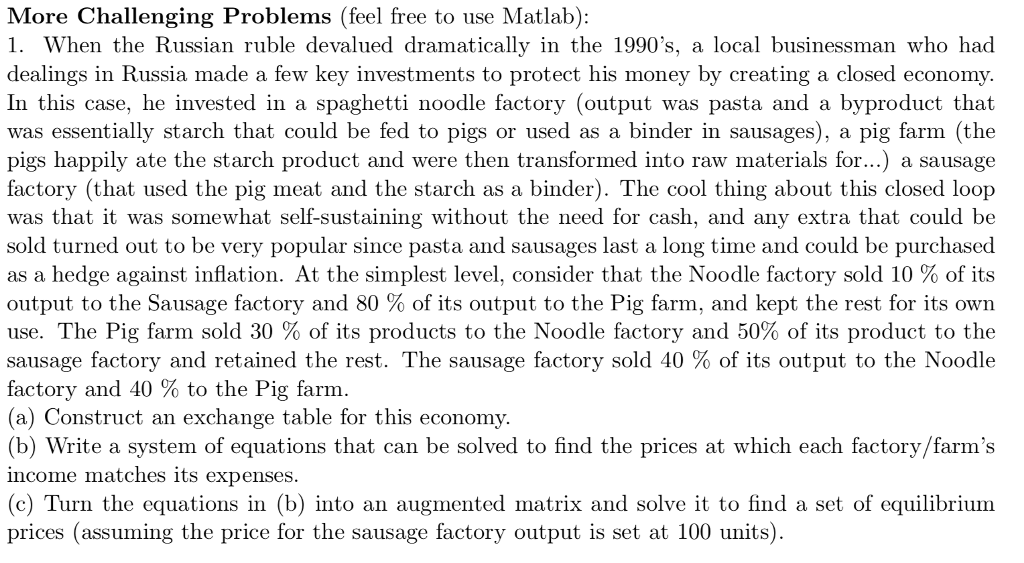
More Challenging Problems (feel free to use Matlab): 1. When the Russian ruble devalued dramatically in the 1990's, a local businessman who had dealings in Russia made a few key investments to protect his money by creating a closed economy. In this case, he invested in a spaghetti noodle factory (output was pasta and a byproduct that was essentially starch that could be fed to pigs or used as a binder in sausages), a pig farm (the pigs happily ate the starch product and were then transformed into raw materials for... a sausage factory (that used the pig meat and the starch as a binder). The cool thing about this closed loop was that it was somewhat self-sustaining without the need for cash, and any extra that could be sold turned out to be very popular since pasta and sausages last a long time and could be purchased as a hedge against inflation. At the sinplest level, consider that the Noodle factory sold 10 % of its output to the Sausage factory and 80 % of its output to the Pig farm and kept the rest for its own use. The Pig farm sold 30 % of its products to the Noodle factory and 50% of its product to the sausage factory and retained the rest. The sausage factory sold 40 % of its output to the Noodle factory and 40 % to the Pig farm (a) Construct an exchange table for this economy (b) Write a system of equations that can be solved to find the prices at which each factory/farm's income matches its expenses. (c) Turn the equations in (b) into an augmented matrix and solve it to find a set of equilibrium prices (assuming the price for the sausage factory output is set at 100 units) More Challenging Problems (feel free to use Matlab): 1. When the Russian ruble devalued dramatically in the 1990's, a local businessman who had dealings in Russia made a few key investments to protect his money by creating a closed economy. In this case, he invested in a spaghetti noodle factory (output was pasta and a byproduct that was essentially starch that could be fed to pigs or used as a binder in sausages), a pig farm (the pigs happily ate the starch product and were then transformed into raw materials for... a sausage factory (that used the pig meat and the starch as a binder). The cool thing about this closed loop was that it was somewhat self-sustaining without the need for cash, and any extra that could be sold turned out to be very popular since pasta and sausages last a long time and could be purchased as a hedge against inflation. At the sinplest level, consider that the Noodle factory sold 10 % of its output to the Sausage factory and 80 % of its output to the Pig farm and kept the rest for its own use. The Pig farm sold 30 % of its products to the Noodle factory and 50% of its product to the sausage factory and retained the rest. The sausage factory sold 40 % of its output to the Noodle factory and 40 % to the Pig farm (a) Construct an exchange table for this economy (b) Write a system of equations that can be solved to find the prices at which each factory/farm's income matches its expenses. (c) Turn the equations in (b) into an augmented matrix and solve it to find a set of equilibrium prices (assuming the price for the sausage factory output is set at 100 units)
Step by Step Solution
There are 3 Steps involved in it

Get step-by-step solutions from verified subject matter experts