



Question: More Discounted Cash Flow Valuation Examples: Amgen DDM Background information: Amgen is an American biotech firm offering products for the treatment of oncology, hematology cardiovascular,
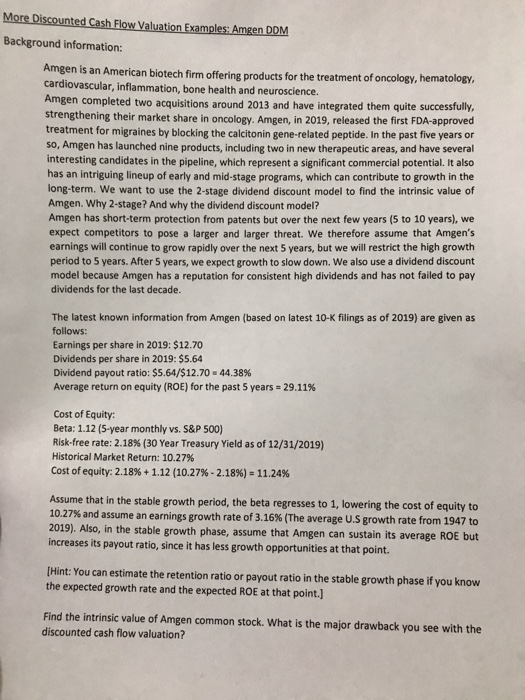
More Discounted Cash Flow Valuation Examples: Amgen DDM Background information: Amgen is an American biotech firm offering products for the treatment of oncology, hematology cardiovascular, inflammation, bone health and neuroscience. Amgen completed two acquisitions around 2013 and have integrated them quite successfully strengthening their market share in oncology. Amgen, in 2019. released the first FDA-approved treatment for migraines by blocking the calcitonin gene-related peptide. In the past five years or SO, Amgen has launched nine products, including two in new therapeutic areas, and have several interesting candidates in the pipeline, which represent a significant commercial potential. It also has an intriguing lineup of early and mid-stage programs, which can contribute to growth in the long-term. We want to use the 2-stage dividend discount model to find the intrinsic value of Amgen. Why 2-stage? And why the dividend discount model? Amgen has short-term protection from patents but over the next few years (5 to 10 years), we expect competitors to pose a larger and larger threat. We therefore assume that Amgen's earnings will continue to grow rapidly over the next 5 years, but we will restrict the high growth period to 5 years. After 5 years, we expect growth to slow down. We also use a dividend discount model because Amgen has a reputation for consistent high dividends and has not failed to pay dividends for the last decade. The latest known information from Amgen (based on latest 10-K filings as of 2019) are given as follows: Earnings per share in 2019: $12.70 Dividends per share in 2019: $5.64 Dividend payout ratio: $5.64/$12.70 44.38% Average return on equity (ROE) for the past 5 years = 29.11% Cost of Equity: Beta: 1.12 (5-year monthly vs. S&P 500) Risk-free rate: 2.18% (30 Year Treasury Yield as of 12/31/2019) Historical Market Return: 10.27% Cost of equity: 2.18% +1.12 (10.27% - 2.18%) = 11.24% Assume that in the stable growth period, the beta regresses to 1, lowering the cost of equity to 10.27% and assume an earnings growth rate of 3.16% (The average U.S growth rate from 1947 to 2019). Also, in the stable growth phase, assume that Amgen can sustain its average ROE but increases its payout ratio, since it has less growth opportunities at that point. [Hint: You can estimate the retention ratio or payout ratio in the stable growth phase if you know the expected growth rate and the expected ROE at that point.) Find the intrinsic value of Amgen common stock. What is the major drawback you see with the discounted cash flow valuation
Step by Step Solution
There are 3 Steps involved in it

Get step-by-step solutions from verified subject matter experts