Question: more from her discussion post Risk Assessment (Management Class) This family control ensures Red Clay evaluates threats and vulnerabilities to its systems. Risk assessments support
more from her discussion post
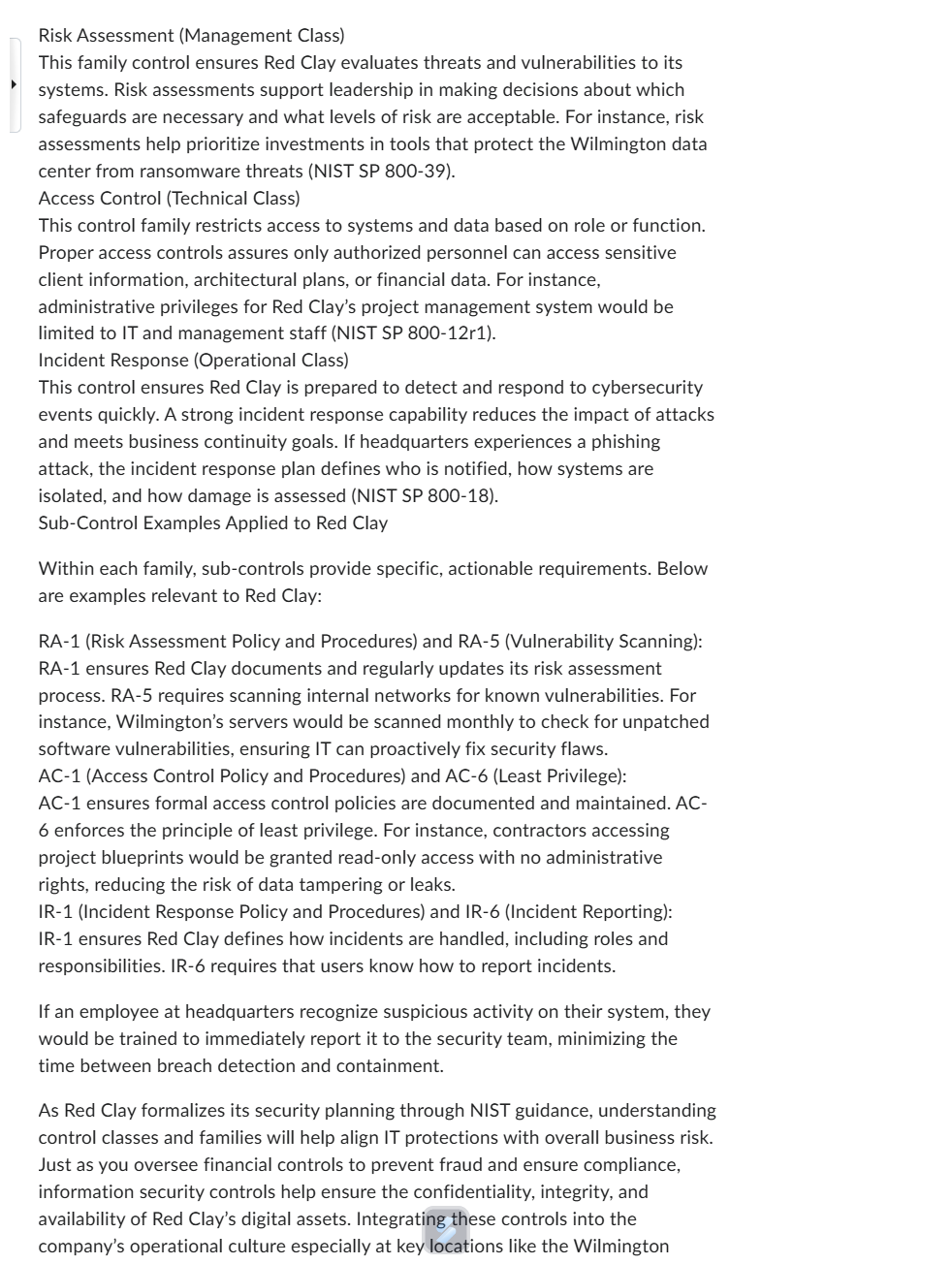
Risk Assessment (Management Class) This family control ensures Red Clay evaluates threats and vulnerabilities to its systems. Risk assessments support leadership in making decisions about which safeguards are necessary and what levels of risk are acceptable. For instance, risk assessments help prioritize investments in tools that protect the Wilmington data center from ransomware threats (NIST SP 800-39). Access Control (Technical Class) This control family restricts access to systems and data based on role or function. Proper access controls assures only authorized personnel can access sensitive client information, architectural plans, or financial data. For instance, administrative privileges for Red Clay's project management system would be limited to IT and management staff (NIST SP 800-12r1). Incident Response (Operational Class) This control ensures Red Clay is prepared to detect and respond to cybersecurity events quickly. A strong incident response capability reduces the impact of attacks and meets business continuity goals. If headquarters experiences a phishing attack, the incident response plan defines who is notified, how systems are isolated, and how damage is assessed (NIST SP 800-18). Sub-Control Examples Applied to Red Clay Within each family, sub-controls provide specific, actionable requirements. Below are examples relevant to Red Clay: RA-1 (Risk Assessment Policy and Procedures) and RA-5 (Vulnerability Scanning): RA-1 ensures Red Clay documents and regularly updates its risk assessment process. RA-5 requires scanning internal networks for known vulnerabilities. For instance, Wilmington's servers would be scanned monthly to check for unpatched software vulnerabilities, ensuring IT can proactively fix security flaws. AC-1 (Access Control Policy and Procedures) and AC-6 (Least Privilege): AC-1 ensures formal access control policies are documented and maintained. AC- 6 enforces the principle of least privilege. For instance, contractors accessing project blueprints would be granted read-only access with no administrative rights, reducing the risk of data tampering or leaks. IR-1 (Incident Response Policy and Procedures) and |IR-6 (Incident Reporting): IR-1 ensures Red Clay defines how incidents are handled, including roles and responsibilities. IR-6 requires that users know how to report incidents. lf an employee at headquarters recognize suspicious activity on their system, they would be trained to immediately report it to the security team, minimizing the time between breach detection and containment. As Red Clay formalizes its security planning through NIST guidance, understanding control classes and families will help align IT protections with overall business risk. Just as you oversee financial controls to prevent fraud and ensure compliance, information security controls help ensure the confidentiality, integrity, and availability of Red Clay's digital assets. Integrating these controls into the company's operational culture especially at key locations like the Wilmington