Question: More specifically, your client has asked you to propose a market research project that addresses the following four research objectives: 1. To learn about customers'
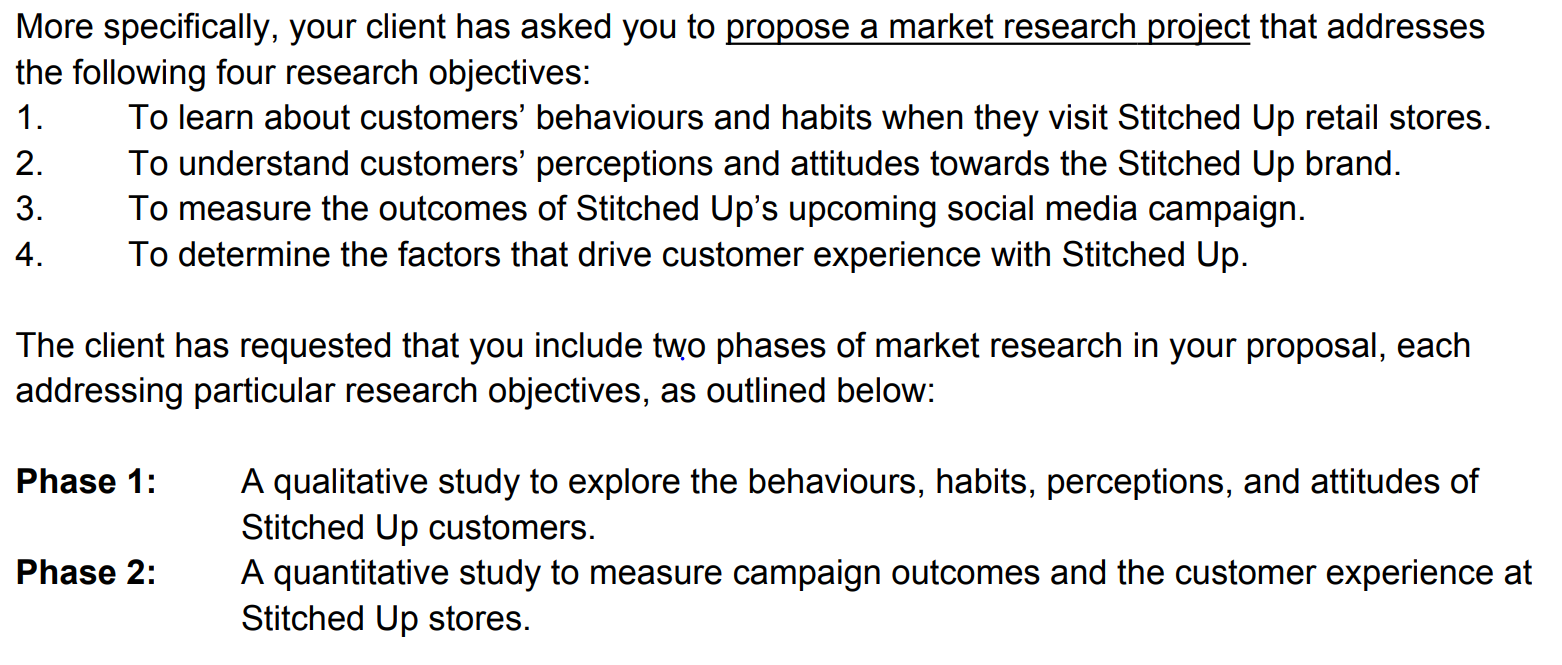
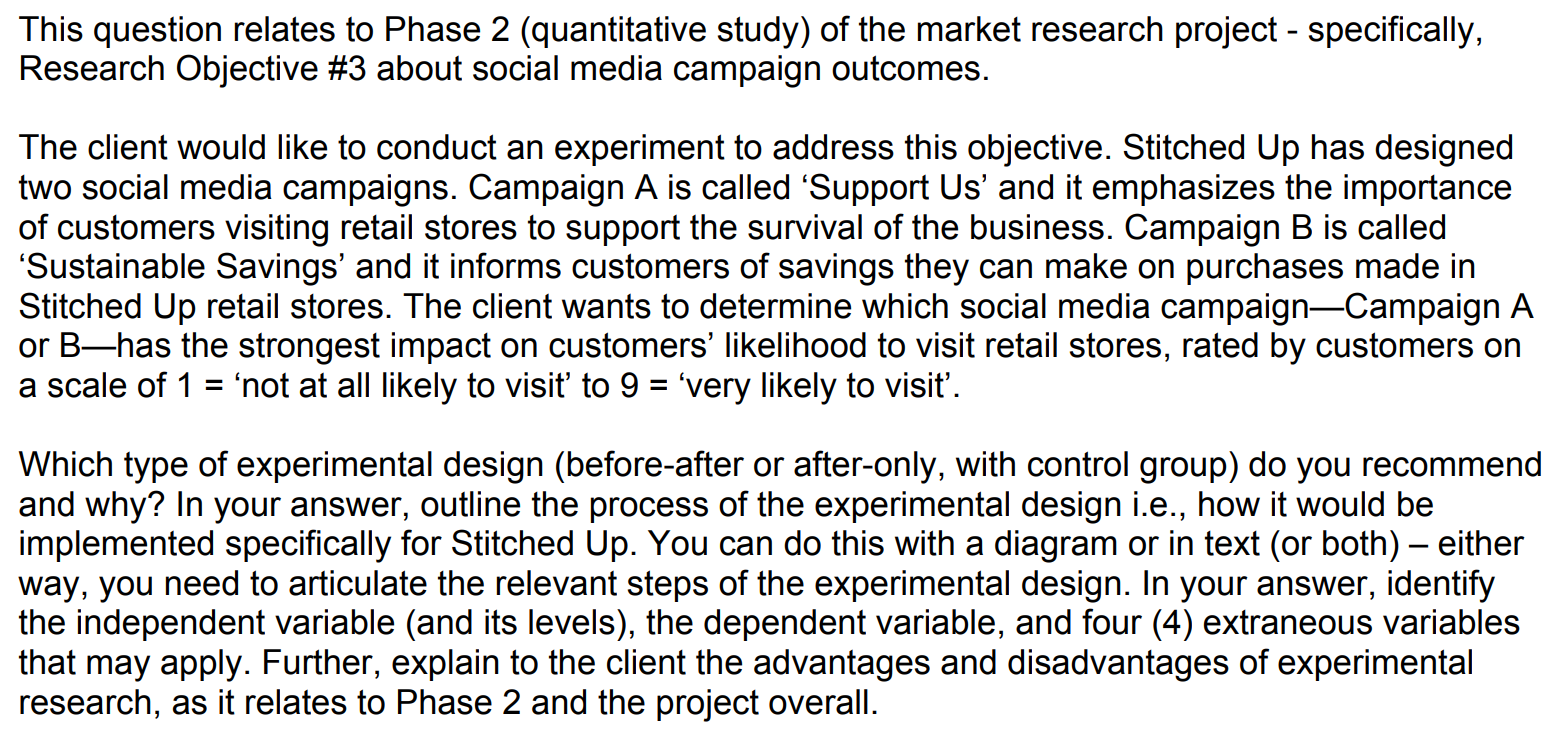
More specifically, your client has asked you to propose a market research project that addresses the following four research objectives: 1. To learn about customers' behaviours and habits when they visit Stitched Up retail stores. 2. To understand customers' perceptions and attitudes towards the Stitched Up brand. 3. To measure the outcomes of Stitched Up's upcoming social media campaign. 4. To determine the factors that drive customer experience with Stitched Up. The client has requested that you include two phases of market research in your proposal, each addressing particular research objectives, as outlined below: Phase 1: A qualitative study to explore the behaviours, habits, perceptions, and attitudes of Stitched Up customers. A quantitative study to measure campaign outcomes and the customer experience at Stitched Up stores. Phase 2: This question relates to Phase 2 (quantitative study) of the market research project - specifically, Research Objective #3 about social media campaign outcomes. The client would like to conduct an experiment to address this objective. Stitched Up has designed two social media campaigns. Campaign A is called 'Support Us' and it emphasizes the importance of customers visiting retail stores to support the survival of the business. Campaign B is called 'Sustainable Savings' and it informs customers of savings they can make on purchases made in Stitched Up retail stores. The client wants to determine which social media campaignCampaign A or Bhas the strongest impact on customers' likelihood to visit retail stores, rated by customers on a scale of 1 = not at all likely to visit to 9 = very likely to visit'. Which type of experimental design (before-after or after-only, with control group) do you recommend and why? In your answer, outline the process of the experimental design i.e., how it would be implemented specifically for Stitched Up. You can do this with a diagram or in text (or both) either way, you need to articulate the relevant steps of the experimental design. In your answer, identify the independent variable (and its levels), the dependent variable, and four (4) extraneous variables that may apply. Further, explain to the client the advantages and disadvantages of experimental research, as it relates to Phase 2 and the project overall. More specifically, your client has asked you to propose a market research project that addresses the following four research objectives: 1. To learn about customers' behaviours and habits when they visit Stitched Up retail stores. 2. To understand customers' perceptions and attitudes towards the Stitched Up brand. 3. To measure the outcomes of Stitched Up's upcoming social media campaign. 4. To determine the factors that drive customer experience with Stitched Up. The client has requested that you include two phases of market research in your proposal, each addressing particular research objectives, as outlined below: Phase 1: A qualitative study to explore the behaviours, habits, perceptions, and attitudes of Stitched Up customers. A quantitative study to measure campaign outcomes and the customer experience at Stitched Up stores. Phase 2: This question relates to Phase 2 (quantitative study) of the market research project - specifically, Research Objective #3 about social media campaign outcomes. The client would like to conduct an experiment to address this objective. Stitched Up has designed two social media campaigns. Campaign A is called 'Support Us' and it emphasizes the importance of customers visiting retail stores to support the survival of the business. Campaign B is called 'Sustainable Savings' and it informs customers of savings they can make on purchases made in Stitched Up retail stores. The client wants to determine which social media campaignCampaign A or Bhas the strongest impact on customers' likelihood to visit retail stores, rated by customers on a scale of 1 = not at all likely to visit to 9 = very likely to visit'. Which type of experimental design (before-after or after-only, with control group) do you recommend and why? In your answer, outline the process of the experimental design i.e., how it would be implemented specifically for Stitched Up. You can do this with a diagram or in text (or both) either way, you need to articulate the relevant steps of the experimental design. In your answer, identify the independent variable (and its levels), the dependent variable, and four (4) extraneous variables that may apply. Further, explain to the client the advantages and disadvantages of experimental research, as it relates to Phase 2 and the project overall









 Study Help