







Question: More than ( 4 0 - 6 0 % ) of tasks in software engineering are related to code reviews. The following
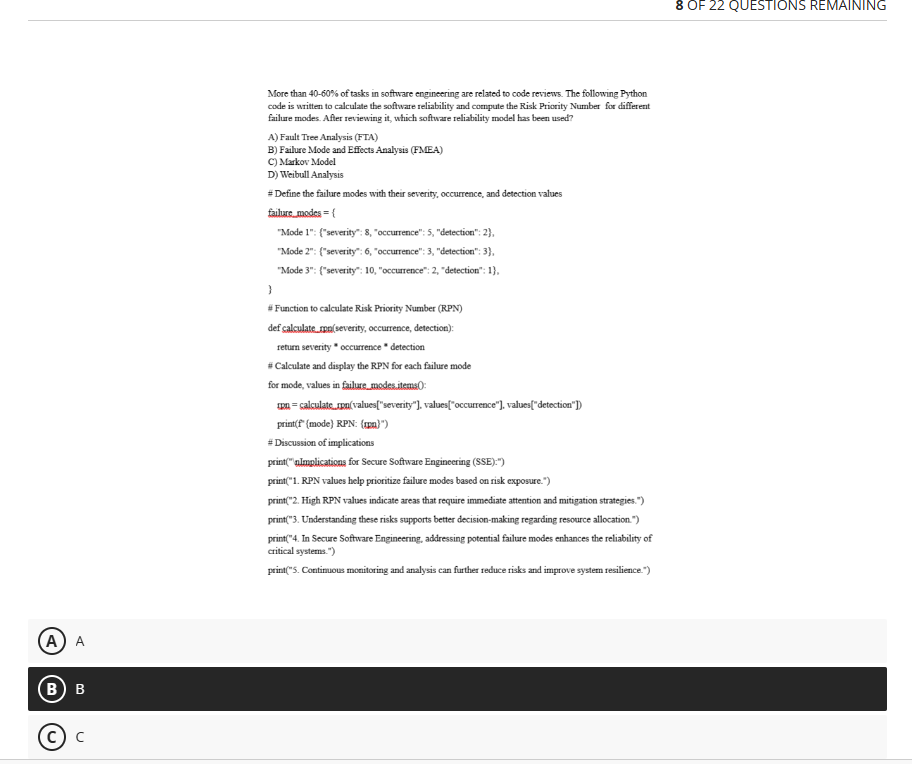
More than of tasks in software engineering are related to code reviews. The following Python code is written to calculate the software reliability and compute the Risk Priority Number for different failure modes. Affer reviewing it which software reliability model has been used?
A Fault Tree Analysis FTA
B Failure Mode and Effects Analysis FMEA
C Markov Model
D Weibull Analysis
# Define the failure modes with their severity, occurrence, and detection values
failure modes
"Mode : severity: "occurrence": "detection":
"Mode : severity: "occurrence": "detection":
"Mode : severity: "occurrence": "detection":
# Function to calculate Risk Priority Number RPN
def calculate mpnseverity occurrence, detection:
return severity occurrence detection
# Calculate and display the RPN for each failure mode
for mode, values in failuremodes items :
men calculate.rmnvaluesseverity valuesoccurrence valuesdetection
printmathrmfprimemode RPN: mal
# Discussion of implications
printnImplications for Secure Software Engineering SSE:
print RPN values help prioritize failure modes based on risk exposure."
print High RPN values indicate areas that require immediate attention and mitigation strategies."
print Understanding these risks supports better decisionmaking regarding resource allocation."
print In Secure Software Engineering, addressing potential failure modes enhances the reliability of critical systems."
print Continuous monitoring and analysis can further reduce risks and improve system resilience."
Step by Step Solution
There are 3 Steps involved in it
1 Expert Approved Answer
Step: 1 Unlock

Question Has Been Solved by an Expert!
Get step-by-step solutions from verified subject matter experts
Step: 2 Unlock
Step: 3 Unlock
 Study Help