







Question: mplement Brent's method for one-dimensional unconstrained optimization (Figure 13.7) in c++ using the following started code: #include #include #include double func(double x) { return 2*x
mplement Brent's method for one-dimensional unconstrained optimization (Figure 13.7) in c++ using the following started code:
#include
#include
#include
double func(double x) {
return 2*x + 3.0/x;
}
double brentsopt(double xl, double xu, double f (double)) {
...
return u;
}
int main() {
double u = brentsopt(0.0,20.0,func);
std::cout
}
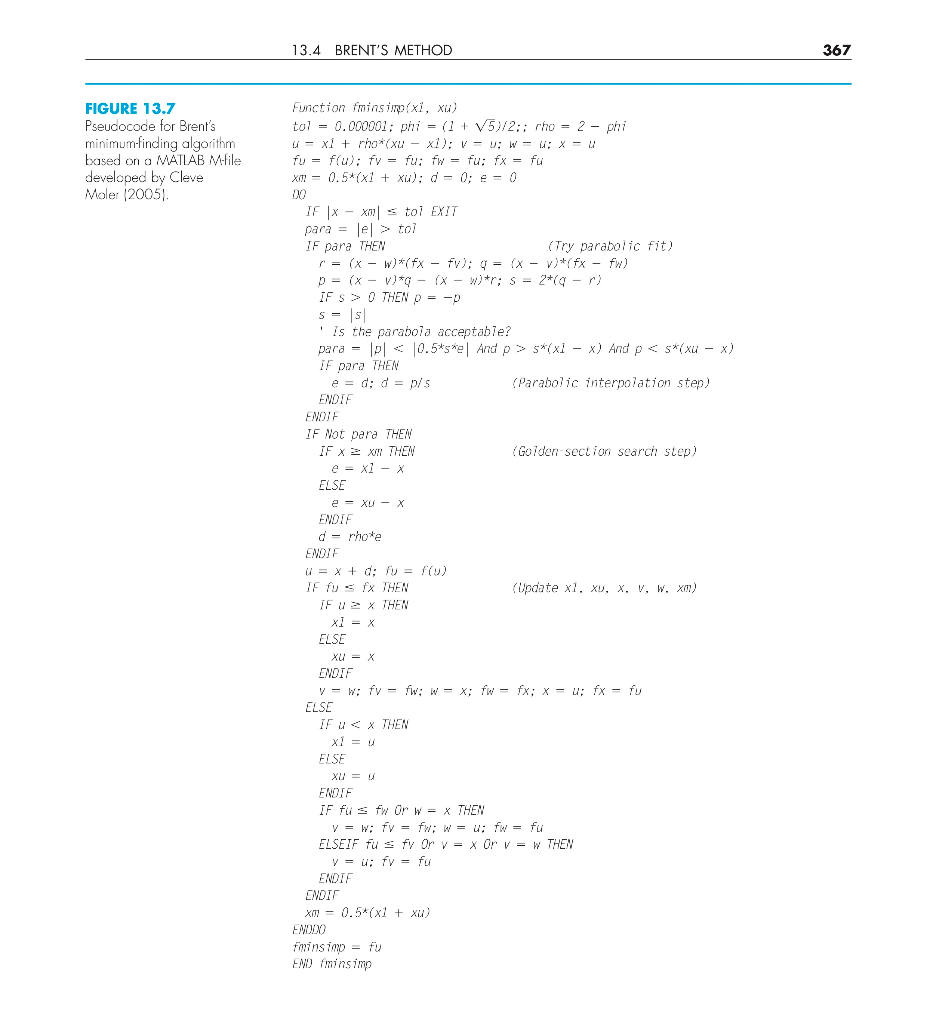
13.4 BRENT'S METHOD 367 FIGURE 13.7 Pseudocode for Brent's minimum-finding algorithm based on a MATLAB Mfile developed by Cleve Moler (2005) Function fmins imp(xi, xu) | 0 = 3.9001; D = 1 + 5)/2;; G = ? - Chi u = xi + rho*(Xu xl): V = y; b = u: x = u Fu = f(u); fv = fu; fw = fu: fx = fu XIT = 0.5*(x1 + xu); d = 0; e = 0 10 IF X XO s toi EXIT para = |el > toi IF para THEN (Try parabolic fit) r = (x W)*(fx fv); q = (x V)*(fx fw) D = (x - )*G - (x w)*r; S = 2*19 - ri IF S > 0 THEN D = -2 5 = 5 is the parabola acceptable? para = p 5*(x1 - x) And p toi IF para THEN (Try parabolic fit) r = (x W)*(fx fv); q = (x V)*(fx fw) D = (x - )*G - (x w)*r; S = 2*19 - ri IF S > 0 THEN D = -2 5 = 5 is the parabola acceptable? para = p 5*(x1 - x) And p
Step by Step Solution
There are 3 Steps involved in it

Get step-by-step solutions from verified subject matter experts
 Study Help