







Question: mplementing Activity - Based Costing ( ABC ) The case of a juice company The juice company is a medium - sized company producing four
mplementing ActivityBased Costing ABC
The case of a juice company
The juice company is a mediumsized company producing four different flavors of juice,
including two new flavors recently added on the ground they were in high demand by customers
who were willing to pay a premium for them.
Recently, under the pressure of shareholders about the poor financial performance, Grace Orland,
manager of the juice company, has been concerned over the erosion of the recent financial results
especially for the standard flavors A and B which used to earn a per cent of profit margin.
Richard Dunn, the manufacturing manager, was also excited to introduce the new flavors since
they were expected to generate higher margins while using the same technology as standard
flavors. However, he noticed that the introduction of new flavors added some technical
complexities to the production process. For instance, unlike Flavors A & B which were
produced in huge volume and in long production runs, difficulties started to arise with the new
flavors which were produced in smaller batches but required more changeovers and more
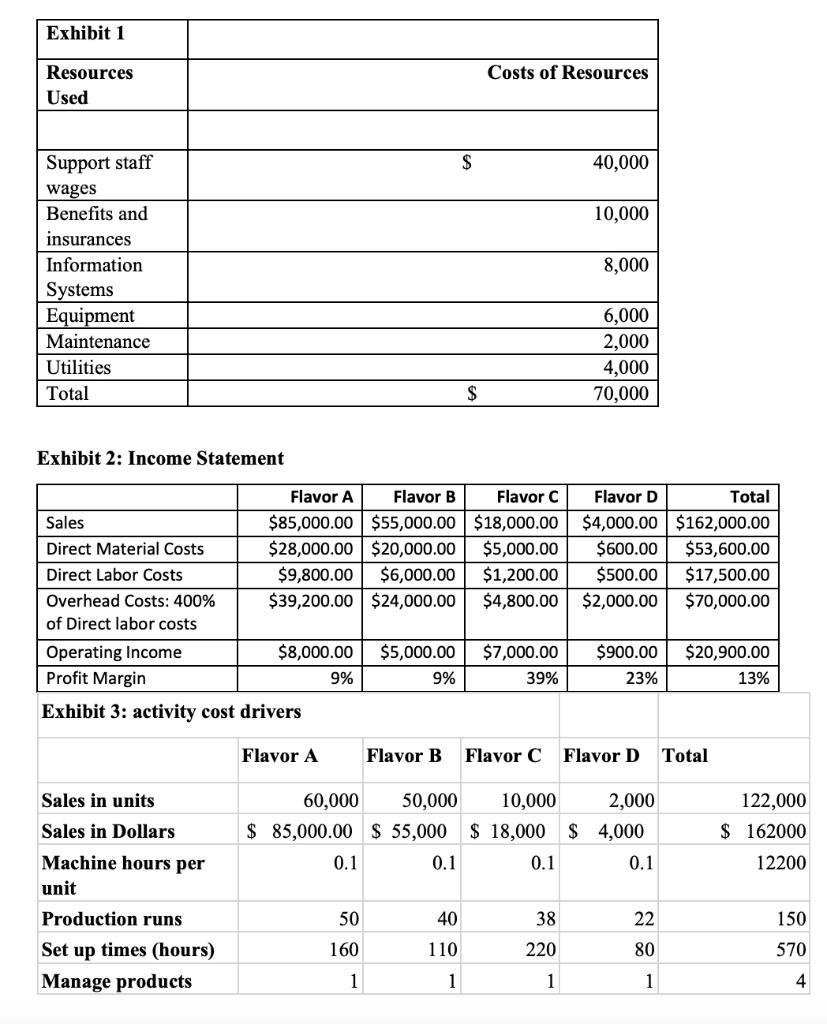
production runs see Exhibit
The juice company produced the different flavors in the same factory. Each flavor had a bill of
materials that tracks the direct materials consumed by each flavor. Additionally, a cost sheet was
used to track the direct labor expenses incurred at each operating step for each of the four
flavors. All overhead costs were grouped at the plant level and arbitrarily allocated to each flavor
based on direct labor cost. The rate was set at of direct labor costs see Exhibit
Grace was intrigued by the behavior of their main competitors who were more interested in
competing in what appears according to the companys current costing system, to be low profit
margin flavors A and B than in high profit margins Flavors C &D Such behavior has led the
manager to question the accuracy of that costing system and to conclude that the current method
of allocation of indirect costs may be distorting their product costs thereby causing inappropriate
pricing.
The manager hires you as a cost accounting trainee to investigate the root causes of the cost
distortion and come up with actions and initiatives to address these issues. Grace promised to
provide you with all the information you may need in your undertakings.
Based on the topics you covered in your cost accounting class, you thought that ActivityBased
Costing ABC may represent a strong tool to tackle the problem.
To remedy the distortions caused by the traditional method of costing based on one single cost
pool of indirect costs, you decided to implement Activitybased costing ABC method which
focuses on the activities, how they are performed, and the resources they consumed and to assign
activities costs to products based on how much demand each of these products puts on these
activities. After careful analysis of the companys operations, you identified four main activities:
process production run, set up equipment, manage products, and run machines. The demand on
these activities by different flavors is illustrated in Exhibit
You began by identifying the resources that were being consumed by activities. These resources
were grouped in six categories as shown in Exhibit
After interviewing the department heads in charge of support staff wages and benefits and
insurance, you found out that their services are used by three activities: process production run
set up and the remaining consumed to manage products.
Next, you tackled the information system item and determines, after interview with the head of
the information system department, that process production runs accounts for of their
services while are used to manage products.
The results of your investigations about the usage of the equipment revealed that it was entirely
used to run machines. Maintenance services were shared equally between the production run
activity and run machine activity. Finally, utility was shared equally by the four activities.
Questions
Describe the problem the company is facing.
Calculate the costs for the four flavors using ABC and produce the new income statement
based on ABC calculations.
Explain why, in this case, the ABC results are different from those calculated under the
traditional method based one single cost pool of indirect costs and provide specific examples
from the case that support your analysis. Be as much specific as you can.
What are the opportunities for cost reduction you may suggest to Grace?
Step by Step Solution
There are 3 Steps involved in it
1 Expert Approved Answer
Step: 1 Unlock

Question Has Been Solved by an Expert!
Get step-by-step solutions from verified subject matter experts
Step: 2 Unlock
Step: 3 Unlock
 Study Help